
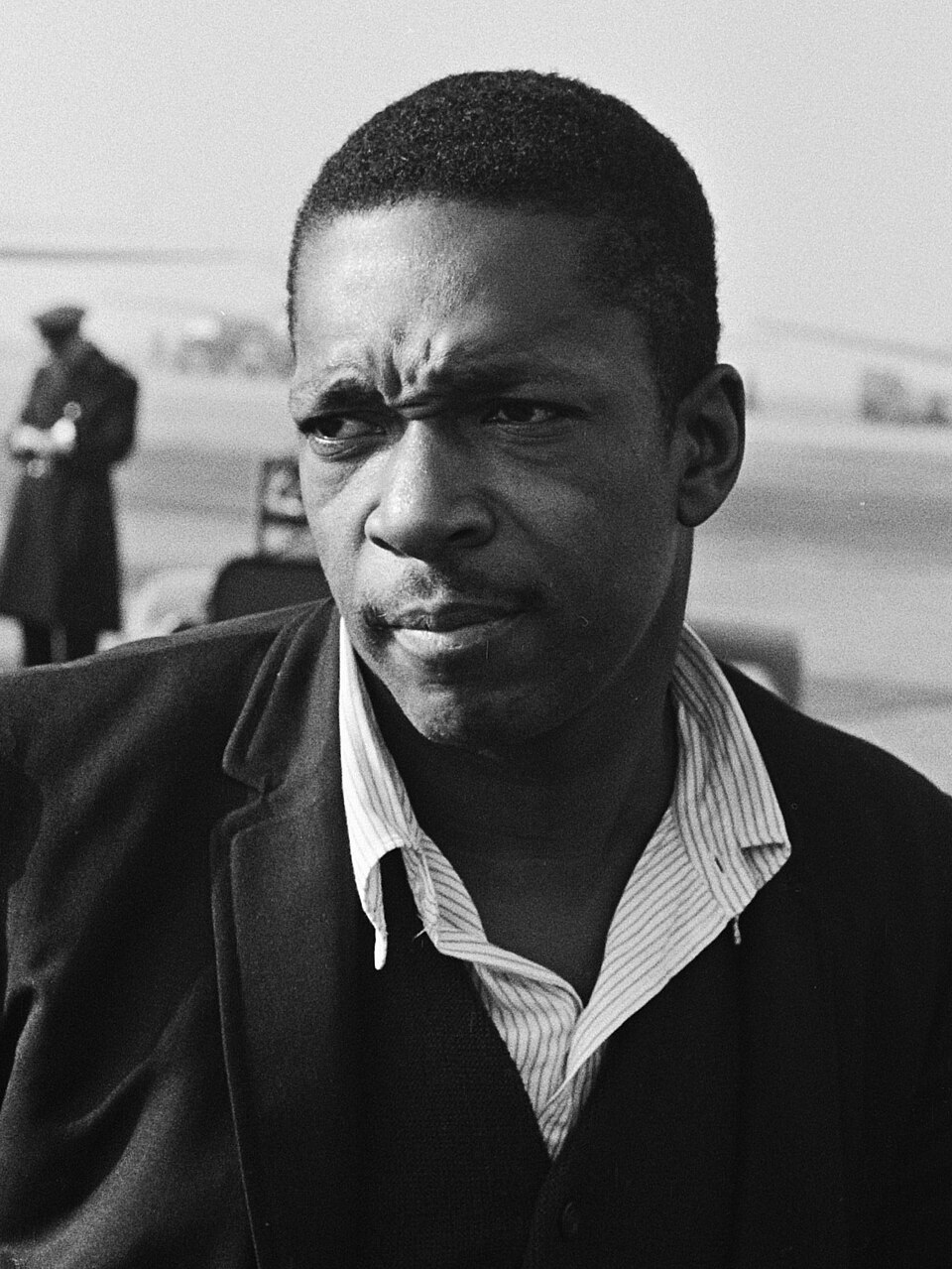
Happy beloved 100th birthday, John Coltrane.
We are publishing a short statement by Philadelphia composer and saxophonist Bobby Zankel to mark Coltrane’s centenary. Bobby Zankel is dedicated to the lifelong study and interpretation of Coltrane’s legacy for the 21st century. He is currently working on a composition connecting the revolutionary lives of Martin Luther King Jr. and John Coltrane.
John Coltrane’s life and music are inseparable from the Black Freedom Movement and the Asian and African independence movements. He scientifically advanced the revolutionary method of nonviolence, bridged Afro American civilization to darker humanity as a whole, and sought to achieve a world colored modernity.
As we approach the 100th birthday of Saxophonist, Philosopher, Composer, Teacher, Mystic, Cosmologist known as John Coltrane or just Trane, the enormous impact and influence of his music and words on his peers, and particularly the generations that have come after his death have grown exponentially.
His recording career as a bandleader began in 1957 and ended in 1967, a remarkably short period especially compared to Miles Davis, Duke Ellington Max Roach, and Dizzy Gillespie who all had around 50 years of recording. John Coltrane’s approach to music was very much like a scientist continuously evolving in terms of rhythmic, melodic, and tonal complexity, as well as emotional and spiritual profundity and intensity.
John Coltrane’s music and worldview never stopped advancing, expanding, and challenging musicians and listeners to see the universe with new eyes, ears, and an open heart. To connect to John Coltrane’s spirit and understand his life work and true achievement we must study his final period. I am not trying to tell musicians or listeners what music that they should like and play. Taste is totally personal and subjective. To have a thorough understanding of John Coltrane, his final period with its non-metric drumming, chromatic tonality, floating phrases that do not revolve diatonically, should be considered as his most advanced concepts and most creative and personal music. To ignore the musical conclusions of a Master is a disservice to all.
Leave a Reply