
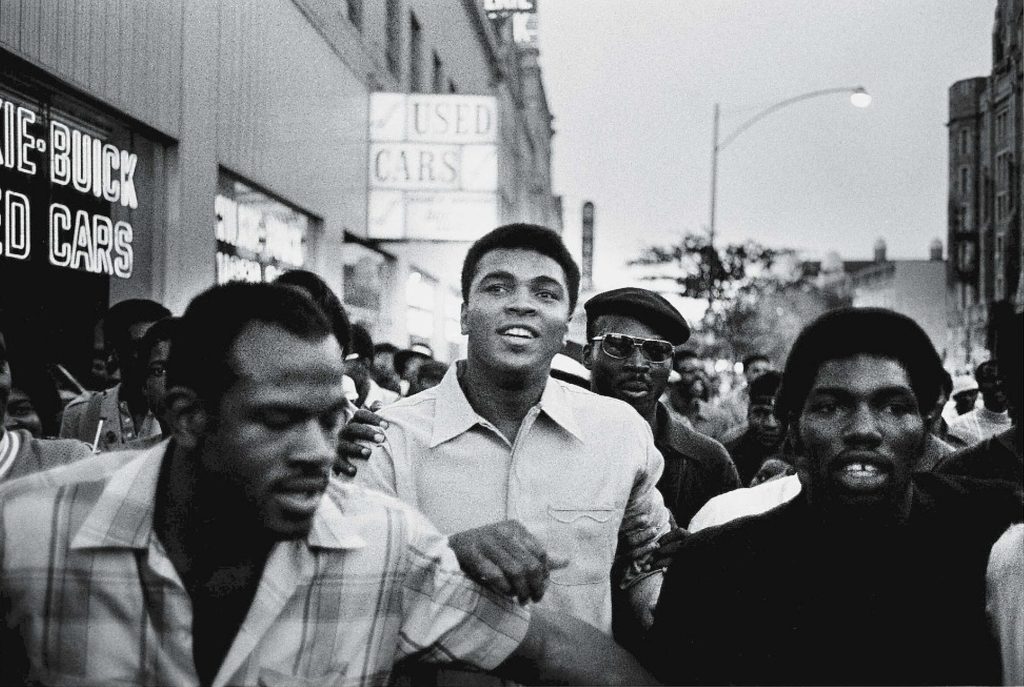
In a time in which standing for the truth is devalued and not considered worth minor inconvenience, we need the example of Muhammad Ali. When Black men are told to shut up and dribble, we need Ali. When the very idea of truth is under attack, we need that simple proletarian love, that most profound recognition of the truth, that made millions of the world’s oppressed anoint him the People’s Champion. In the face of Jim Crow, the genocidal war in Vietnam, and the might of the U.S. government, the oppressed said, “It is humanity that chooses our champions, not white supremacist governments.” And they chose Ali.
Those who strive to be revolutionaries, know that our struggles will not be fair contests. We face the normal challenges of American life but we also fight against mountains of tyranny, just as Ali fought not just murderous punchers in the ring but the whole white supremacist social system. Like Muhammad Ali, we may work our hardest but still lose our prime career years, our livelihoods, be mocked and scorned, yet the man from Louisville’s life shows us that with moral courage, we can win the greatest prize — the eternal love of the people.
Ali turned a barbaric sport into an elegant ballet. He came onto the scene at a time when Black fighters dominated boxing, with the stipulation they never speak their minds. Ali’s refusal to accept the constraints of the fight game showed he was more than a fighter in himself — he was a fighter for a Black people in revolutionary becoming: the wretched of North America, tearing down the walls of Jim Crow, poverty, and a civilization of war.
A Child of the Freedom Struggle
As Harry Belafonte said, Ali grew up into the era of the freedom struggle, what we call the Third American Revolution. As a child he was profoundly affected by the murder of Emmett Till. He bore the wounds of his parents’ unfulfilled dreams — his father an artist forced to work as a sign painter, and his mother working as a domestic. As a rising amateur, a rich, white “manager” forced him to work as a domestic; an experience Ali said felt like being a slave at a plantation. His boxing prowess took him to the 1960 Olympics in Rome, where he defeated a Polish and Soviet boxer to win gold. He came to regret defending the treatment of Black people in America to a Soviet reporter. Returning to Louisville a hero, he was enraged by the fact that he was refused service in a downtown restaurant because of the color line. He threw his hard-won medal into the Ohio River in protest.
His early professional career began amid the heavy years of the Southern civil rights struggles and the first steps of Africa’s newly independent nations. He established himself as a charismatic and entertaining young fighter who soon earned a shot at the title. However, few experts believed that the brash young Cassius Clay could defeat the fearsome champion Sonny Liston. What they did not know is that he fought not just for himself alone but for a greater cause, taught to him by the Honorable Elijah Muhammad and the Nation of Islam. He shocked the world by defeating Liston for the heavyweight crown, but even more so by publicly announcing his joining the NOI the following day. No longer the brash, entertaining Cassius Clay, he arose as a world champion: embracing a liberation theology that refused to bend to the standards of white America. After winning the title, Elijah Muhammad’s student Ali did not tour European capitals; he toured West Asia and the African continent where he sought the company of the global anti-colonial struggle, leaders such as Gamal Abdel Nasser and Kwame Nkrumah. He said that while the State Department funded trips for Black people defending the U.S. government, he was rare in receiving invitations by heads of state because of his membership in the NOI. These leaders saw in the NOI and the broad Black movement, a sister force in the Bandung Spirit. In Ghana, he denounced the bombing of Black churches in the U.S. South and praised Kwame Nkrumah’s commitment to freedom. Gamal Abdel Nasser gifted Ali a miniature golden mosque, which Ali presented to the Honorable Elijah Muhammad upon his return to the U.S.
The War in Vietnam, was his tryst with destiny. He saw photographs of dead Vietnamese children and read about the genocidal war in Muhammad Speaks, the newspaper of the NOI, which served as a key platform for the global anti-colonial struggle. After his stance against the draft, the government took away his passport like they did with Paul Robeson and W.E.B. Du Bois before him. Ali said this was because the government knew that the masses of the world gave him strength. His travails made him beloved by the darker peoples of the world — the villagers of Bangladesh and Zaire and the Philippines.
Opposing the Draft
The U.S. state sought to target Ali for his religious beliefs by singling the heavyweight champion out for the draft. In 1967 he said the famous words, “I ain’t got no quarrel with the Vietcong.” He refused induction into the army, unlike his predecessors in boxing like Joe Louis and Sugar Ray Robinson. In reality this meant refusing a cushy, public relations role avoiding any exposure to combat. He followed this with a longer statement after accompanying Martin Luther King at a housing rally in Louisville. He was sentenced to five years in prison, stripped of his passport. He was subsequently stripped of his title and the ability to obtain a boxing license, making him unable to earn a living. State governments throughout the country passed resolutions against allowing him to work. He made the choice to resist following the example of the Nation of Islam, whose Messenger along with many male members were jailed for draft resistance during World War II as well the Korean and Vietnam Wars. He was fully backed by the Nation of Islam, who gave him financial and spiritual support. The stripped heavyweight champ — who admitted he had only graduated high school because of his sporting prowess — earned his living through speaking at colleges, explaining his opposition to Black participation in the war and his religious beliefs. He stood firm in the national media, saying that only sacrifice could bring freedom to Black people and that the title was meaningless if he could not stand with them. A three and a half year court battle ensued.
Ali’s example inspired young Black men to resist the draft and spurred on the peace movement. The solidarity of the Black proletariat, including the Nation of Islam and activists from the Civil Rights Movement, pressured the Supreme Court to allow him to return to the ring.1 He sacrificed his prime years for his principles. He came back a physically diminished fighter, and it would be a bumpy four year journey to challenge the most feared fighter alive, George Foreman, in the 1974 Rumble in the Jungle in Zaire. With a restored passport, Ali regained strength through the hero’s welcome he received among world humanity. With the championship fight set in the heart of Africa, the reception Ali received from people of Zaire gave him the ability to accomplish the greatest comeback in boxing history by knocking out Foreman.
Ali: The Black Worker Meets World Humanity
The Black Freedom Movement produced a champion. At a time when boxing was the most popular sport in the world, Ali as heavyweight champion became the most famous man on the planet; a level of fame we cannot fathom. Nearly half the world watched his fights. Revolutionaries from South Africa to Vietnam to the U.S. cheered for him as a symbol of the fight against imperialism and white supremacy. The biggest celebrity in the world was a symbol of peace. Coretta Scott King called him a champion of peace and human rights; Ralph Abernathy called him “the March on Washington with a left hook.” Huey P. Newton wrote an open letter telling Ali he was a Black man who fought against the whole system of imperialism.
If there is one thing that made Ali beloved, it was his willingness to sacrifice for the oppressed. Solidarity, a subset of love, is something scarce today. We cling to material things and see our lives and worth as tied to them. In a time in which superpowers genocide children, at most we utter cautious words of sympathy. Yet, Ali shows us that to live one’s principles means to be willing to sacrifice everything — wealth, titles, even exposing one’s life to racist attacks. A higher belief, what King identified as the third dimension of life, what Ali called Allah, a concept of God that motivates moral courage and sacrifice, is inherent in the Black Freedom Struggle, and something that Ali exemplified. As we look at more than 600 days of the genocide of the children of Palestine, we see the courage of Ali in the Axis of Resistance — the peoples of Yemen, Lebanon, and Iran — who tie their fate to the Palestinians; and after them we see it in the courageous student encampments who sacrificed elite credentials in solidarity with the oppressed. Humanity will prevail when we see ourselves as tied to each other, and are willing to sacrifice accordingly.
Ali’s international visits showcased his internationalism. In 1975, Prime Minister Michael Manley of Jamaica welcomed Ali as part of a NOI delegation including Minister Farrakhan. At a public rally Manley said of Ali, “Your fists may have put you into everybody’s favor but it was your conscience that has written you into immortality in the history of human affairs.” In later days, he deliberately prolonged his career so that the heavyweight championship could be a platform for unity and world peace, to the detriment of his physical health. His work for peace would take him on a friendship tour of the USSR and Prime Minister Indira Gandhi would invite him as an official guest of the Indian government for Republic Day. In a 1977 visit to villages in Bangladesh, Ali said, “Look at these beautiful people, I am working for peace and unity, it would be a crime to do something else with my fame.” The love between him and the darker people of the world was mutual and profound. He fought bravely for the victims of racism and imperialism.
Ali represents the Black Worker striving for a new modernity. He is a representative of a civilization of peace. When the U.S. state silenced Paul Robeson, another artist who became an icon of the struggle against white supremacy, Ali appeared on the world stage. It is fitting that he would play the role of a Reconstruction senator, originally meant for Robeson, in the long delayed film adaptation of the novel Freedom Road by once blacklisted writer Howard Fast. Ali is one of Black America’s greatest gifts to humanity. The footage that remains of him, viewed billions of times over the decades, shows world humanity’s love for Black America. What would he have been without the moral choice? Cassius Clay, another prizefighter. Yet the impact of the people, their zeitgeist, and a liberation theology turned him into Muhammad Ali, a champion for world peace, truth, and humanity; a man for the future; a sign of the world to come.
Today
Western civilization has brought our modern world to the brink of annihilation in its attempt to control the fate of dark humanity. The future of civilization, the hope for our children, rests upon the shoulders of the earth’s disinherited — upon the shoulders of Black men like Muhammad Ali.
Then as now, American elites smeared the Nation of Islam as a hate group. In the years since Ali’s great period, they have tried to separate the man from the movement and the people who produced him. Yet this is very far from the truth. The elites fear the ideological clarity and unity of the oppressed. They seek to control history and ideas, we must separate from this way of thinking just as the Honorable Elijah Muhammad taught Ali to separate from it. The Nation of Islam has left a permanent imprint on America. There is no way of imagining a future of freedom, justice, and equality without reckoning with the teachings and work of the NOI, who to this day stretch out the hand of unity to all of the oppressed. The Honorable Elijah Muhhamad taught that our unity is greater than an atom bomb, and this power will be necessary to fulfill King’s vision of a freedom explosion across this suffering world.
Ali is an embodiment of the new movement of world thought begun by W.E.B. Du Bois in the aftermath of the defeat of Reconstruction. He was the son of the Black Proletariat who joined a great religious movement for freedom in the NOI; who stood with darker humanity against the warmongering of the U.S. elite; he pursued one of the few avenues available to Black men — boxing — as a demonstration of excellence as well as a platform for the message of freedom, justice, and equality. He brought the message of the Black proletariat to the world stage in the age of television, refusing to be limited by the racist attitudes of corporate media. Though the counter-revolution waged by the U.S. ruling class has tried to whitewash and diminish his significance, we who strive for the truth remember Muhammad Ali as an extraordinary talent who dedicated himself to even more extraordinary things — the struggle for world peace, truth, and justice for the oppressed.
The American people and world humanity have been changed through their love for Muhammad Ali. He is an icon of truth and world peace who lives in them. They see him as an example of what they can become with moral courage and strength. He was a man of the Third American Revolution, who embodied the freedom movement’s challenge to rethink notions of art, beauty, science, and democracy. He was a fierce, but gentle, Black embodiment of the truth, in his clinical pugilism, his poetry, his approach to the poor, children, and the oppressed. The spirit of Ali, which is an embodiment of the Black Freedom Struggle, lives in the hearts of the people. It can be ignited when they revolt against warmongers and oppressors. When they strive to be people who cannot fit into a system of warmongering and oppression. When they see that the uphill battles of their day to day lives are for an eternal cause greater than themselves. When they see that art and beauty are not defined by the elites but something for everyone. When they begin to think about the world in their own terms and not those of elite intellectuals; it is this that still holds the potential to free humanity.
Avant-Garde, Issue 4
June 2025
- He prepared for the Fight of the Century with the knowledge that his conviction may be upheld by the Supreme Court and he would be serving prison time. Coincidentally, the fight was used by a group of activists to break into an FBI office in Media, PA, leading to the exposure of COINTELPRO for the first time. ↩︎

 Avant-Garde: A Journal of Peace, Democracy, and Science
Leave a reply to harmonythoughtful104701c996 Cancel reply