
We are publishing a transcript of Dr. Anthony Monteiro’s remarks at Paul Robeson, Warrior for Peace and Justice, an event organized by the Saturday Free School for Philosophy and Black Liberation at the DuSable Museum of African American History in Chicago, on May 25, 2023. The event featured the premiere of the documentary, “Paul Robeson: A Man for the Future.” The Free School will host another event celebrating the 125th birth anniversaries of Paul Robeson and the Most Honorable Elijah Muhammad in Philadelphia on June 16-17.
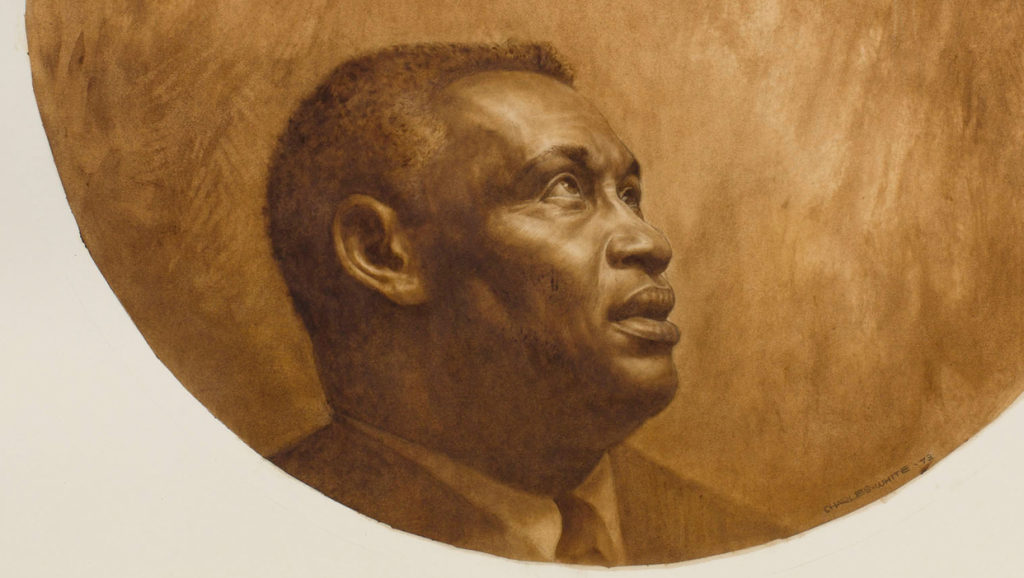
We’re gathered here today in the interest of the truth, an inconvenient truth for the ruling elite of this country. At one time this room would have been filled with people coming to celebrate the life of Paul Robeson. Today, fewer and fewer people know Paul Robeson, and fewer people realize his importance, not just in the past but for the future.
Perhaps few, if any people, have so thoroughly studied human beings scientifically, their cultures and civilizations, through their languages and music as had Paul Robeson. He discovered scientifically — I wish to underline this — scientifically, the vast diversity which is humanity. To use the words of one of the producers of the film, Neha, he discovered a universal human: that within every culture and every civilization, was every other culture and civilization. A singularity, as it were. One striving for completeness, and this is a centuries-old aspiration, and that is what Paul Robeson discovered in folk music of these diverse cultures and civilizations — a common striving for completeness, and for singularity, for oneness.
That it is natural, as he discovered, for people to want to learn the languages of other people. To learn their food, their history, and to be friends with people who are not exactly like them, because in the other they see themselves. Hence Paul Robeson concluded that it was natural for human beings to seek completeness in other human beings, in people whose languages they did not speak. And if one goes back millenia, centuries ago, most people lived in isolated communities and tribes, and did not know many other people. They knew more about the past than they did about their future.
But, in the modern world, and this is quite unintentional by those who brought us together for our common exploitation, but brought us together, that we began to know each other. And in the struggle for freedom from the oppressor, we saw that we had more in common with people who were not our same skin color, did not speak our language, did not have our religion, but we felt we had something in common with them.
And this is the great awakening. Greater than even the European Enlightenment, because it involves tens of millions, and billions of people. We are, in fact, living at a time of a new human consciousness. A new human consciousness — I agree with Brother Ishmael Muhammad that every revolution is a revolution of the mind. Every system that is anti-revolution has to resort to arms to destroy people, and to destroy their minds, and to destroy their communities. I completely agree that the chaos and violence that we see so often in African American communities — and I don’t know if Philadelphia’s worse than Chicago, we might just be small. But the tragedies of the situation are the same — it represents something more and more of the mind. An absence in the intellectual, spiritual, moral life of our people.
And if we are to be honest about the whole situation, somebody that is not concerned with us intervened upon us, having seen what we could produce, as in the case of Paul Robeson, the great W.E.B. Du Bois, not to mention our achievements in music. To undermine all of that as a first step to disorganizing and turning the people against themselves, turn us on ourselves rather than to ourselves.
Thus Paul Robeson saw war, racism, Nazism and the exploitation of man by man as not just anti-human, but unnatural. The world produced by capitalism, known as the modern world, which is celebrated by universities, in media, in books – that world is celebrating an unnatural order. This is not natural. World War II, where upwards of 70 million people in Europe and Asia and parts of Africa, were martyred, that is not natural. But in a world where greed and exploitation is the law, it is natural.
So, Paul Robeson sought to bring the world back to what it should be. That is why he studied folk music. That is the oldest form of art and music, it is the people’s narrative of themselves. And that is why in studying them, he saw commonalities. For example, Paul Robeson saw a direct linguistic, hence cultural connection between the peoples of Central Africa, in particular the Congo and the people of Central Europe. He loved the Russian language, because he saw in it the Bantu languages of Central Africa.
This connection must still be explored because it would seem, if the measure of what is common is the way we look — in other words, the people of Central Asia are very white, the people of Central Africa are very black — that is appearance, but what is the essence? Paul Robeson was seeking, scientifically, the essence of humanity. And what he discovered, these people who look so different — and in many ways their food was different, their physical environments were different — but he found a common linguistic link between the Slavic peoples of Central Europe and the Bantu people and languages of Central Africa.
That discovery in itself warrants entire departments and research institutions in the best universities to pursue this line of research. And the big question is, why hasn’t it been pursued? And could not part of the reason for the erasure of Paul Robeson be not just for his political stance, but for his scientific discoveries? Indeed, it was not for nothing that Albert Einstein found common cause with Paul Robeson. There’s a reason, and again I hope to emphasize this — one of the great scientists of the modern epoch — Robeson was a complete human being. As complete a human being as can be produced under conditions of capitalism and imperialism. He was a complete human being, more than a Renaissance man because the Renaissance came out of Europe. And it was great, no argument with that. The art, the science, so on.
But Robeson was working out of a framework, a paradigm where he believed the future would be an Afro Asiatic reconstitution of humanity. And this is why, by the way, Minister Ishmael, in Philadelphia, in June we’re going to celebrate Paul Robeson’s birthday. And we’re calling that — because we’re not just going to do Paul Robeson — we’re calling our event “Unconquered Love: The Magnificent Lives of Paul Robeson and the Most Honorable Elijah Muhammad.” [Audience clapping]
You know, I’m convinced that had they had the opportunity, and had they been able to sit down the way the Honorable Elijah Muhammad and James Baldwin did, the way the Honorable Elijah Muhammad and Martin Luther King did, they (Robeson and the Honorable Elijah Muhammad) could have talked for days. And there would have been a common way of looking at the world: the Asiatic Black man, the Afro Asian reconfiguration of humanity.
This is what we’re talking about, this is all about our future. And unless we can convince our youth, our people, not just our youth, it’s not like the adults are so enlightened [audience laughs] of the future. Of the truth that is discovered through understanding the future.
Most people believe that truth is found in discovering the past, but what if truth is discovered in discovering the future? What happens to the way we think if we’re thinking of our future? And I’m not talking about artificial intelligence, I’m talking about a human future. The Afro Asiatic reconstitution of humanity, where human beings will increasingly identify themselves through this singularity, this oneness, and this totality, this completeness as Afro Asiatic, or as Asiatic Black men?
Superseding the European concept of separateness and hegemony in the cause of domination, a reconfiguration of humanity which must be our future is in essence what democracy means. It is demos, the people’s rule, not just some people, but all people. This is Paul Robeson. So when we pay homage, as we are, and respect to Paul Robeson, and if you needed any greater evidence of who he was, this documentary made it absolutely clear. [Audience claps]
You got the sense that those who have erased him, and I would say those among our own people who participated in this, who continue to participate in this, I’m talking about the political class that is more interested in serving the wealthy and the war-makers than bringing knowledge and clarity to our people. That’s what they’re doing, let’s be real about it. But in paying homage to Paul Robeson, we are welcoming the future. It takes courage to stand for the future. It is the coward that will not face the future. Well, they say, “You got the right to vote, don’t you?” And the ordinary black person says, “But I’m still not free.” “Well, you could go to any restaurant in the Loop,” and the ordinary person says, “But I’m broke.”
Well, you can go to any school you want to go to. And the young person says, “But they ain’t teaching me.” What they are saying in substance is, you want me to be satisfied on this plantation, and you say to me there is no future. Any parent or grandparent must be outraged at this narrative, got to be outraged. And recognize that we, especially the African American people, [have endured] what under international law must be called a crime against humanity.
The only way this is not considered a crime is if we black folk are not considered human. But if we are considered human, what we are experiencing is a crime against humanity. In 1951, Paul Robeson and William L. Patterson took before the United Nations a legal document charging the American government with the high crime of genocide against the African American people. Not just for past injuries, but for present ones. The greater crime against humanity is to deny us a future, and to deny us a future by denying us the capacity to imagine, to rob us of an imagination.
Paul Robeson was right — to take a people’s great art and stomp it into the ground, to trivialize it, to bring forward coons and Toms in their old form and current form. By doing that to a people’s art, you are denying them an imagination. Go into any school in this country, and what you see are children who cannot imagine.
Well, you can go into most black communities, most churches, I would dare say most mosques, and most synagogues. People have been denied the right to imagine. During World War II, Paul Robeson and his heroic wife Eslanda Goode Robeson dedicated all of their moral, political and organizational capacities to the fight against Hitler’s fascism and Japanese imperialism. After the successful conclusion of that war in May 1945 [in Europe] and August 1945 in Asia, where 27 million Soviet citizens were martyred, tens of millions of Chinese, Korean, Vietnamese, Filipinos had been killed. Robeson declared, and this was a moral stance — when Paul Robeson says the artist must take a stance, I would like to add, at least for the sake of interrogating the concept of a stand — for me, a stand means the ground upon which you stand. This is not new, and it’s not modern philosophy, this is in the ancient scriptures. It’s in black spirituals, “Upon this rock I stand,” that’s what Paul Robeson sang, his father was a preacher.
Upon this ground, which is a moral ground, I take a stance. That never again must there be a war like World War II. So after the war he insisted that in order to prevent war, you had to end imperialism and colonialism. He said that defeating Hitler did not end the struggle. It just meant that it went to another level. And to the American government he said, “If you thought I was in this as long as I was allied to the Soviet Union and the fighting forces in China, let me reintroduce myself,” as they say. And what Robeson said, that we were fighting not only to defeat Hitler, but for the right of nations and people to build a new social system which guaranteed to their citizens welfare, where the government was committed to the people and not to the wealthy. That’s what he was fighting for, and for him it was just unbelievable that the simple truth seemed so difficult for the people in power to understand.
Robeson believed in human love. He loved the people. You know, that is not merely a natural instinct. If it is nearly merely natural, it can be extinguished by forces that suppress the individual. But real love, Martin Luther King sometimes referred to it as agape, that kind of love that you don’t expect back, selfless love. Robeson’s love for the people was unconditional. There are not many people who could achieve that level of consciousness, and it is a level of consciousness. Selflessly to love humanity. And I’m so grateful to the people who made the documentary. It came across, his selfless love, unconditional love — “I don’t expect,” as he would have it, “to get anything in return. I do this because it’s right.” Martin Luther King said that love is “the sword that heals.” And so it was for Paul Robeson, he used that sword to heal humanity.
I was going to say just a few things about Robeson and Du Bois. And I would suggest, this is a book, Paul Robeson Speaks, and in it there is an essay published in 1965 in the journal Freedomways. And he talks about his relationship to Du Bois, how he always looked up to Du Bois, and how he admired the scientific rigor combined with moral commitment. Just parenthetically you know, a lot of people get it wrong. Most scientists get it wrong. They believe that to be scientifically rigorous means to be disengaged from people. Not to stand for anything, not to be committed to anything, not to be passionate.
If you’ve ever taken a course in mathematics, let us say calculus. One of the problems in the pedagogy of science and mathematics is that they try to infuse into the learning, into pedagogy, a lack of commitment and passion. So it is as though you are learning equations and formulas that have no human source. There is no humanity in it. So the scientist and the mathematician are socialized and conditioned to be dispassionate. Which means their science is a narrow science, very narrow.
Like Du Bois, Paul Robeson believed that science is a human enterprise, and that science is about freedom. And Du Bois said in that great essay called “Galileo Galilei”, a 1908 speech he gave at Fisk University on the 20th anniversary of his graduation. And they invited him back, and after he gave this speech, everyone that invited him was fired. But in it, he talked about Galileo. Everybody knows who Galileo was, he discovered that it was not the sun going around the earth but the opposite, the earth going around the sun. But that went against the religious authorities of the Catholic church. So when the pope called him in and asked him to recant, he did just that. And Du Bois condemned Galileo, and he says, “Science is a great mistress, but there’s something greater than science, and that is humanity.”
By which he was saying unless science and ideas and thought and intellectuals and academics serve the people, they have betrayed their mission. [Applause] Lastly we are here to bring forward inconvenient truths. The Bible is right; “Know the Truth and the Truth will make you free.” We are here not to go along to get along. We don’t have a political agenda, we have a human agenda. Our agenda is freedom and peace, and the unity of the people. So thank you very much.

 Avant-Garde: A Journal of Peace, Democracy, and Science
Leave a reply to Jamilia Cancel reply