
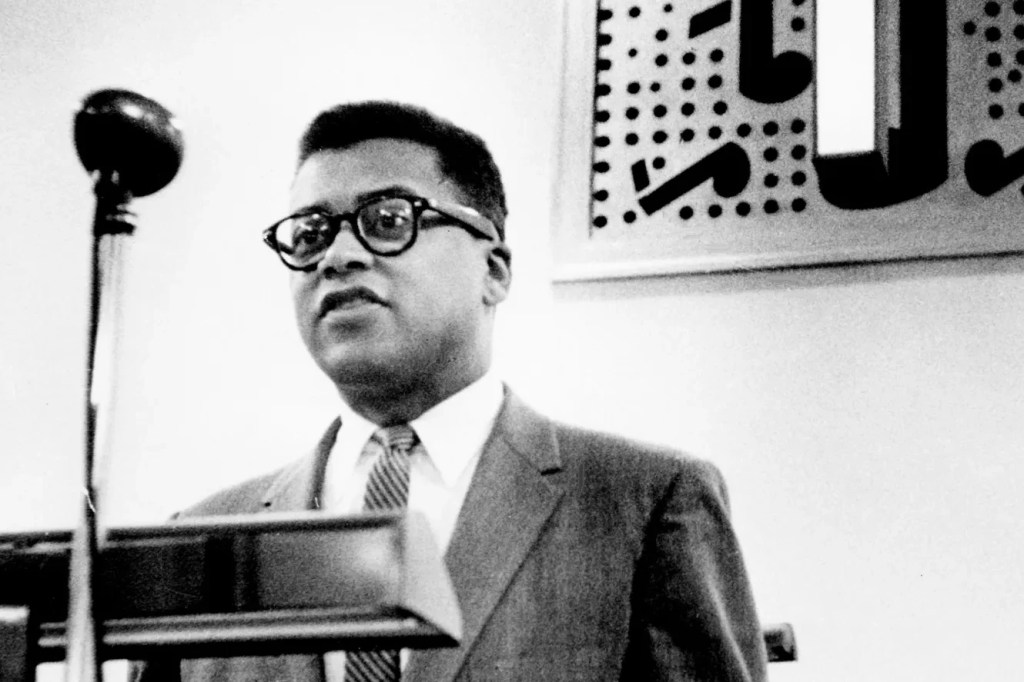
We are publishing a keynote speech given by Rev. James Lawson, the architect of nonviolence in America, at the 50th anniversary of the Student Nonviolent Coordinating Committee (SNCC) in Raleigh, North Carolina in 2010. In it, Rev. Lawson identifies the Civil Rights Movement as the greatest movement in the history of the United States—yet one that must be surpassed in the 21st century. He ends by revisiting Mahatma Gandhi’s meeting with Howard and Sue Bailey Thurman, which compels him to conclude that Black folk in America must be a bridge between a dying white civilization and “a new earth and a new heaven.” In essence, America’s revolutionary calling is to remake itself into a new civilization. Such words find renewed importance as our nation faces its 250th anniversary in 2026.
I am extremely pleased to be here, as you can guess. Whoever would’ve thought that 50 years later, we would be gathering again at Shaw University in Raleigh. And all of us who were in the first meeting in 1960, of course, had little or no sense of what we were trying to do—except that we did have a passion for reversing the wrong that we saw in our country. And we were willing to break the barriers and go ahead and try to do it.
Now I’m doing something this afternoon that I don’t normally do. That is I’ve carried a book up here with me, and I’ve done so deliberately because I decided I wanted to read you a section from it.
We have much to celebrate. But we also have much, perhaps as much more, not to celebrate, but to analyze and assess where we are and how we’re going to get this country of ours, to where we want it to be. Because it has not yet arrived. And we must understand that.
I hope that this time together will allow each of us and each of you to not only assess where your life is. But at the same moment, I hope that it will strengthen you in the resolve that no matter what the circumstances are today, one day, Raleigh and Nashville and Los Angeles, and every other place in our country will represent the best of the human family and the best of justice and equality and liberty for all.
I hope that those of you who were operative in the 60s, in the 50s, that if you have scars and most of us have some, if you have things of the past that need to be corrected or healed, that this 50th year will enable you to do that hard homework on yourself, that will enable you to then move into the next level of your life. After all, in the final analysis, no nation will rise or fall greater than the people of that nation. In the final word, who you are and the way in which you accept and use the precious gift of life that has been given to you, is one of the ways by which we can measure whether or not the earth has a chance to become a better place for all of us. So I hope the event will help your healing.
It is, of course, a wonder that we’re here. Let me applaud the fact that the Movement of the 50s and 60s and 70s was one of the most magnificent times that this nation has ever experienced. Even though many people in the nation are not willing to acknowledge that. I put the Movement of intensive years of activity between 1953 and 1973—it was the finest moment in the process of the American revolution for equality, liberty, and justice for all. Many people do not understand that.
The Tea Party people and the parties that they represent, and the economics that they represent, and the political leaders that they represent, do not understand the marvel of our country. Nor do they understand the extraordinary vision that this country can offer to us and to all. The church has never really understood this period because those 20 years, those two decades that I lift up, represent also the finest moment of religion in the United States. Though many people in Christianity abhor the very thought of that Movement representing religion, it was religion’s finest hour.
Let me say next that indeed the Movement of which we were a part was the most comprehensive movement that the people of the United States had ever engendered. Let me see if I can say this in a way that’s important. Because it’s important for SNCC to understand as one segment of that Movement, that we were empowered to create SNCC because a Movement had already begun. And because there was a larger vision and a larger hope and a larger expectation among millions of people, not only in the United States, but in Latin America and Africa and Asia alike, that what we were beginning here and doing here would indeed spread across the very earth itself.
So I’m saying to you in the simple ways I can, that we were a part of an intergenerational movement. And I’ve read most of the books thus far about that period. I know the effort on the part of some intellectuals, some academics, and some people who think that they’re on “the left” to pretend that SNCC somehow was something outside this comprehensive struggle that none of us really fully understood then, or now.
I’m saying this deliberately, because we must have a 21st century movement that will cause the Movement between 1953 and 1973 to fade in comparison to its power in the 21st century. And such a movement must be intergenerational. Such a movement must combine the wisdom of the past of the human family, with the energies and the vitalities of the present moment—if that movement is to reshape our land, as our land needs reshaping.
It was a comprehensive Movement. I’ve found no book that seems to understand. Illustration one: 1960, the Sit-In Movement that began. It went to every single state of the union. It went to literally hundreds and hundreds of universities and colleges, where we had support for that struggle from everywhere. Well, think for just a moment: that Movement has really never yet been researched. Just that one year in 1961.
1963, there were over a thousand demonstrations in the midst of the Birmingham Campaign, the Washington March, the efforts to do voter registration in Mississippi and elsewhere. There were over a thousand major demonstrations across the nation. Again, that has not been researched.
The point I’m making is, it was the most comprehensive struggle of people for freedom that maybe the earth has ever known, or that certainly the United States has ever known. And it must be done with many times of the power and energy again, in the 21st century. The critical issue for the United States today is whether the government and the economy will be of, and for, and by the people; or whether it will continue to be for Wall Street and for the Pentagon and so forth and so on. So our country has not yet arrived. We have not yet arrived.
Let’s make certain we understand that. This is not to say that there has not been progress. Yes. I love the fact that I look at the White House and I see a Black family, and I see a Black president in the Oval Office. But that does not mean that justice has arrived. And we better be sure that we understand that. On the contrary, the president’s office is so shackled with the powers that be—to use a phrase from the 13th chapter of Romans, “the powers that be”—so shackled by the powers that be, that you and I, for the most part, the 300 million people of our country are not really represented in the White House or in Congress, or in most of the places of the governors of this country of ours. We are not there. Our well-being is not there. The issues that besiege us are not there. And only if there is a new movement in the 21st century, can we put our agenda there.
Let me just describe this. We have not arrived in three different ways.
First of all, we still live in a country that is the most racist country that human history yet has recorded. And we are in a country that is going through the throes and the mysteries of 16th generational racism. No previous generation faced the problem boldly, nor did any previous generation map the goals and the strategies and the processes by which racism could be moved to be dismantled. No previous generation; and our generation has not done yet that terrible, perplexing, but yet energizing work.
Racism is alive and well. That’s one of the mottoes that we in Nashville have adopted, when on this coming Monday, we will reiterate the 50th anniversary of the Silent March, which at that time in 1960, was the largest such march that had ever taken place in the South. Where nearly 5,000 of us marched in silence—and it was a rather eerie, wonderful feeling. Marched in silence from Tennessee State University, down to City Hall to confront the mayor over the issues of racism and segregation. We’re going to repeat that. That’s why I’m not here this week. And it’s why I’m leaving again this evening.
We’ve said three things. That the dynamite that blew up the home of Z. Alexander Looby, our chief lawyer, [in 1960]; that dynamite is dynamite that is blowing up millions of people across our country and still devastating this country in ways that many of us still do not understand. The second thing we’re saying is that racism is alive and well. Nashville is still separate and still unequal. And the third thing we’re saying in that demonstration is that we must wake up and begin the concrete grassroots organizing in our communities, in our cities to resist the racism in our nation and to resist in every way possible.
And here may I simply say that I see this as an inclusive task. When I use the word racism, you may want to add other words, but I want to add the words that I think are essential, without which we will not face the issue of racism. The United States is still largely shaped today by racism, sexism, violence, and plantation capitalism. These four elements that are interconnected and interrelated. And we cannot remove any one of these four, or change any one of these four, or dismantle the structures of oppression in any one of these four elements, unless we are connected to all of them and see that they’re all related. The environmental movement, which is largely a white middle-class movement in so many different ways, has to come to understand that the environmental movement has no chance for success, unless it deals with the economic exploitation of sexism, of racism. And unless it deals with the issue of the violence of America against the poor, against the people of color, and against women in our land, it will get nowhere.
I want to just suggest an anecdote at this point. ‘Cause Harrison Ford is an actor whose name is well known, who’s been very much engaged in the environmental movement across the earth. And he said recently in a printed piece, that “what I see in the environmental movement is the failure of 20 years.” And he said, “what the environmental movement needs is a movement similar to,” what he called, “the Civil Rights Movement of a few years ago.” And I understand him to mean this. That only direct action in which millions of people put their bodies and their hearts and their minds around the common purpose of cleansing our society, of plucking it down and raising it up again, will do the work. This is in part what our heritage of the past represents.
And then the third thing I want to say—we have not arrived—is this. My country is still the number one enemy of peace and justice in the world. I discovered that in the 1960s. And most of us Americans don’t want to understand that. Don’t know what that means. We are the number one enemy of justice and peace in the world.
Illustration: the militarization of our nation has moved on systematically. It is a tyranny. We have 800 military bases in 130 countries, including troops on the ground in five nations. Most of us are unaware of that. As we have systematically built military bases, we are building five more in Colombia, under the title of the “drug war.” That’s really for the purpose of trying to prevent any other Hugo Chavez or Evo Moraleses from being elected in Latin America. That’s what that’s mainly about. We announced in 2008, in November, the formation of the [U.S.] African Command, whose purpose will be to build military bases down the east coast of Africa. That is to see to it that Africa with its people and its minerals will be maintained and controlled and dominated by plantation capitalism and by the military of the United States. Its one purpose.
Eight-hundred military bases, a budget of nearly a trillion dollars, but no president in the last 40 years has had the money to finance entirely Head Start for all the children of America. No Republican, no Democrat, no Congress. We have a trillion bucks being spent now in Afghanistan. Iraq’s almost a trillion. But we have no money to stop infant mortality rates in the first year of life in the United States, none. That represents the moral, spiritual, political bankruptcy of the powers that be in the United States, which makes us the number one enemy of peace and justice in this country of ours.
The second thing I want to say about this is that from my perspective, every war that we have fought in the last 50 years has essentially been a war of racism. Essentially, a war of racism, therefore of sexism, therefore of plantation capitalism, having nothing to do whatsoever, either of the safety of the American people, of the need of the American people for the kind of life we want.
I should just add now the United States has as its main ally, western Europe. And a part of this issue is that white civilization in the world insists, and I’m gonna say it this way: “We are the most important civilization that has ever existed in the human family. And we intend to preserve the prerogatives of white civilization of the last 500 years.” I say this very deliberately and very concretely. There are many symbols of this.
My final point goes like this. That we need a nonviolent direct action movement in the United States in the 21st century, that begins on issues that relate to the American people. That enables us to move again on the issues of equality, liberty, and justice for all 300 million of this people that we call the United States. It must be an inclusive revolution. Martin King in his speech, April 4th, 1967—he essentially said that, in his speech at Riverside Church. It must be a revolution of politics, a revolution of morals, a revolution of our values, and the like.
So I want then finally to insist that one of the things I learned from the Movement of the past is that there is no other way to change this nation except through nonviolent conflict and struggle. And those of you who think that somehow there are practical effects of the gun or the bomb or the nightstick, I want to push you hard to indicate that you must change your minds. When I say nonviolence, I’m not talking pacifism, and I’m not talking passive resistance, and I’m not talking protests primarily or agitation. Nor am I running away from conflict and from difficult issues that we human beings face. Most of us, raised in America in a society of violence, do not understand that the term nonviolence did not begin until Gandhi. Around 1909, 1907, 1908 in South Africa. It is a 20th century word and phrase and understanding.
There are those academicians and pacifists and others who teach, “Well, nonviolence began back with Buddha or Jesus or Ashoka.” And all of that has a point to it. But the point I’m making is that Mohandas K. Gandhi of India introduced nonviolence as a science of social change. One that produces what it says it’s going to produce. Not change that we can make, but change that is made towards freedom and justice and community and hope. He experimented with that process. It is an old concept, but never termed the concept nonviolence.
Gandhi introduced also a methodology that requires discipline and strategy and planning. It also requires people who are prepared to submit themselves to a discipline that makes a difference in their own lives, but also makes a difference in the way in which the movement moves and challenges our current times. So let me read for you—and that’s why I brought the book up here—a wonderful discussion that has been a part of my thinking for many years. I bought this book in 1953 or ‘54 in India itself, in Nagpur, India.
It is a conversation that was recorded in a book that was published in ‘43, whose author is Mohandas K. Gandhi. It records how on March 14th, 1936 in India, a man by the name of Howard Thurman and his wife Sue, and a couple by the name of Edward [and Phenola] Caroll spent some time in India. One of the main major things they did was to find time to have a conference with Gandhi. And they went to him. This is an extraordinary discussion. It almost has become for me a kind of a piece of scripture, because I learned something new from it all the time as I read.
So imagine this scene, maybe in Wardha, in the Sevagram Ashram of Gandhi. Gandhi sitting on the floor in his office in his bedroom, and the Thurmans and the Carrolls sitting near him around it. And he had usually a secretary who did recording and this secretary recorded this conversation.
Dr. Howard Thurman asks, “Is nonviolence from your point of view, a form of direct action?”
And Gandhi replies, “It is not one form—it is the only form. I do not, of course, confine the words ‘direct action’ to their technical meaning. But without a direct active expression of it, nonviolence to my mind is meaningless. It is the greatest and the activest force in the world. One cannot be passively nonviolent. Nonviolence is a term I had to coin in order to bring out the root meaning of ahimsa. In spite of the negative particle ‘non,’ it is no negative force. It is a force which is more positive than electricity and more powerful than any ether.
“At the center of nonviolence is a force which is self-acting. Ahimsa means love in the Pauline sense. Ahimsa includes the whole creation, and not only human. Ahimsa is not a negative force, but a force superior to all the forces put together. One person who can express ahimsa in life exercises a force superior to all the forces of brutality.”
And then they said, “Come to the United States, come to America. We want you for the purpose of the problems that we face.” And Dr. Thurman explained that Negroes were ready to receive the message. But Gandhi responded, [“How I wish I could come. But I must make good the message here before I bring it to you.”]
“Much of the peculiar background of our own life, of our life in America, is our own interpretation [of the Christian religion],” Thurman insists. “When one goes through the pages of the hundreds of Negro spirituals, striking things are brought to my mind which remind me of all that you have told us today.”
“Well,” said Gandhi, bidding goodbye. “If it comes true, it may be through the Negroes that the unadulterated message of nonviolence will be delivered to the world.”
Now, I want to say something about that. Because I like to insist that we, Black people—and I see many white friends as well. But we, Black people in America are called to be the bridge people between the supporters of a white civilization that has caused so much mayhem and violence in the world, and the rest of the peoples of the world: towards creating a new earth and a new heaven.
What I have learned from the past is this. That the United States government, its plantation capitalists are not on the right side of truth, or the right side of the universe, or the right side of history. And therefore can only continue to make a mess of the world, can only continue to create the escalation of violence and of division and of hatred and untruth. Even to the extent that it could very well become the vehicle for the explosions that would either by a whimper or a bang, assault the earth and the human race such as no one has ever imagined. The alternative to that, in my judgment, is for us to learn new ways of living in the fullness of the creative power and energy of the universe. To insist that life is a gift and that gift has in it, its own powers. Those powers are not the powers of destruction and hate, but the powers of truth and healing and helping and repairing and restoring and establishing justice for all, liberty for all, community for all. So I say, if this meeting is to be a meeting of power, let it be one that indeed continues to sow the seeds for that nonviolent revolution that the nation needs—without which this nation may be lost.
 Avant-Garde: A Journal of Peace, Democracy, and Science
Leave a comment