
We are publishing a transcript of Dr. Anthony Monteiro’s opening remarks from the Saturday Free School’s July 12, 2025 session. The Free School meets every Saturday at 10:30 AM, and is streamed live on Facebook and YouTube.
I guess mainly this will be a discussion of deindustrialization and poverty, specifically as it is manifested in North Philadelphia, and I’ll provide a brief history of North Philadelphia, especially in the 20th century — how it was populated and how it became the industrial center of all of Philadelphia. In the throes of a crisis like this, sometimes I become impatient with the pace at which Black people are moving and, of course, the violence. And it’s not just Philadelphia. This is every major city.
It’s easy to lose a sense of the people who we feel are the central force for change in this society. To put it another way, at every period of American history, Black people have played a role, or the central role. I would argue, since the Civil War, the central revolutionary force in this society have been the Black proletariat.
I find it strange and difficult to understand why this so obvious a truth is not the center of everyone’s analysis. I don’t know that I’m making myself clear enough. But why was it so easy to adapt, among some mainly younger people, Black Lives Matter, identity politics, queer theory or Afrocentric theory? I mean, of course, in a complex society like this, and Black people are very complex, there are going to be all kinds of ideas. But why one that is so obvious does not find greater acceptance and embrace, and that is the Black proletariat. Why can no one get that the situation that Black folk are in, in a lot of ways, is due to the revenge of the ruling class. Of course, deindustrialization was the ruling class’s final solution to the question of the American working class, who were more educated, more organized, and demanding more by the 1970s than they ever had. And so they had to bring them down, which they did, and we’ll talk about that.
But when it comes to Black people, without all the evidence, who’s going to tell the truth about this? A revenge-assault was carried out against Black people for at least 40 years now. We can never forget that when we talk about the state of Black America. So sometimes it’s easier to default to the indicators of the crisis such as violence, such as poverty, such as no education or poor education, you know. And so, you know, like most sociologists do a counting of the horrors and the catastrophe without anything deeper. We want to do something different.
That’s where this concept of Black gods comes in. And I want to define what gods are and how you know even in writing it out. Black gods. Do you do capital “B” and capital “G” or do you do capital “B” for Black folk or people, and a small “g”? Are these gods secular or are they only sacred? How do they function in the minds of Black people? And this is the key and it’s very unique. But in understanding Black people, the Free School has done so many things and, of course, all of us are in certain way a little exhausted, but I found a need for more than just the intellectual, the political and the ideological in all that we do. I found the need to go a little bit external, not unusual for us in the Free School, something else, something more, something that spoke to what we’re trying to understand, but from another angle.
So I found myself grasping on to Donnie Hathaway and his unusual genius. Unusual. In fact, once, he was heard by singers like Luther Vandross. You can, if you listen to Luther the right way, you hear so much Donnie Hathaway. I believe that Stevie Wonder took Luther’s style of singing and just adapted it. And what we think is Stevie Wonder, I think is Luther Vandross. There are other figures in jazz such as Will Downing, Andy Bay, who are not as well-known. But you hear Luther Vandross all over it. The Whispers performed a song dedicated to Donnie Hathaway and I think it is so accurate when they talked about his humility, his generosity, how he refused to sell out for money and he stood firm into his art. Donny’s impact was such that the Alvin Ailey Company performed one of his pieces. It was choreographed by Ailey himself and performed by Dudley Williams, one of his principal male dancers. And apropos of Kathie’s work on Barbara Bullock and Arthur Hall, the dancing that you will see is the way Arthur danced. Arthur did African dance, but he also did modern dance using the Black anthropologist choreographer Katherine Dunham and Graham — these two schools of movement. But I want you to look at this dancer and how he performs it, how he is overcome by Donnie Hathaway. I just want to explain some things. Singing is not just singing. When you talk about a great singer, if you talk about an Ella Fitzgerald or you talk about Aretha Franklin or you talk about Donnie Hathaway, you’re talking about high levels of interpretation — not just of lyrics, but of chords, of movement, the use of the voice. Donnie Hathaway was at the top of the game. He wasn’t just a singer; he was an interpreter of ideas.
You know the reason so many of these singers come out of the church is because the church is the place where this great music was incubated, was created and people learn to sing, learn to perform in the church; not in Juilliard School of Music or the high school — maybe the high school choir. I’m not certain. But it’s mainly the church. But it is this point, this moment where the sacred and the profane or secular, the sacred and the secular meet. And when you hear Donny, you know that he’s also extolling Black gods. There’s a way to get at the same thing through different ways. Donny comes out of the church. He sings like the person that’s coming out of the church. And what he would be singing about in the church, he is singing about in the secular world. It is the search for those gods of beauty, of justice, of freedom. And I don’t think we should make any mistake about it. It’s hard to go to a Black church and not realize this is what you’re in the middle of. Even though the people in the church might not be able to express it like we are. But they are always seeking those special gods that will deliver people from 400 years of oppression.
And so with Donny, you could hear it in this one I’m going to play, “Take A Love Song.” Now, what is a love song? Is it a romantic love song or is it a song of love for humanity, love for people? Because the next line he says, “And wear a smile.” The lyrics themselves express the coming together of the sacred and the secular, the sacred as a form of the struggle for freedom. And I would say this over and over and over again. I know sometimes it’s easy to lose sight of what all of this is and that it is the struggle for freedom all the time. There is hardly a moment in the day when Black people consciously or unconsciously are not thinking about freedom. Sometimes it, you know, doesn’t have the expression that we would like. Sometimes it’s completely nihilistic.
But you cannot even imagine an encounter with a Black person where they’re not, somewhere in the region of their soul, thinking, “I’m unfree. My parents were unfree. And my grandparents. We have never been free.” It becomes burdensome at times most times. It is a burden to always have to be on guard, always have to think about this — all the promises broken, all the lies told.
I would say if you get a chance, listen to The Whispers’ tribute to Donny and I think it’s an accurate description of the revolutionary artist and I would like to just say Donny is a revolutionary and like Du Bois said — man must know man. This is the challenge of 20th century science. But he said to know man you must ultimately know Black man. And this is Alice’s thesis. Man must know man. I know that we think about all that we do also in the context of the world’s people. What must India know? What must China know? What must Asia know? What must Africa know? And I think one of the great achievements in the modern epoch is the African American people. Therefore we are compelled always to go back to what they have created in order to know them. To know Black people, in a lot of ways, you must know their art, their religion, their intellectuals, their composers, their dancers. In a lot of ways, there is no America without Afro-America. There is no modernity without Afro-America, to be very for real about it.
Now this song by Hathaway — first of all, the way he handles the lyrics, his phrasing, and his articulation. You know he’s a Black man because of the way Black people talk. We articulate certain words and other things which are very special and unique to us. But the other thing is the use of chords. Donny Hathaway is great as a singer because he was able to navigate complex chord structures in a single song. And the other thing is his extraordinary range. He’s singing mainly at the tenor level but he’s able to go low — like that — without losing any of the clarity of the lyrics or the music. The other thing is, you know, one way that you’re able to tell how good a singer is, not if they can sing fast, but what they do with a slow one. That’s the key. And this is just my last point — how he understands and interprets love. It’s so Baldwinian. It’s so Baldwinian. It’s like Baldwin birthed him and spit him out, man. It’s just they’re just so similar, you know, in their spirit and such. We’re going to start with this one. Take a love song. And it’s so optimistic. And he’s saying how you must live. You must take a love song. You must take a smile. You must take a strong heart. You know, and these human values, that’s what I wanted to say — these human values. All these are things that you must take in order to live. But let’s listen to it now.
[“Take a Love Song” by Donny Hathaway plays]
A people who can produce this can lead humanity. And the only explanation for our losing our way partially is a vicious attack upon us, especially the cognitive and especially the moral and cultural manipulation coming specifically at young people and young Black men, which we’ll talk about when we talk about deindustrialization. But this [song] is more definitive of the African American people than all of the horrible things that we often see in cities, especially violence. This is the default. If you want to know the African American people, you must know this. Love and freedom are not separate in the Black consciousness. They really are not. Love and freedom and beauty — they’re not separate. And so to know the Black proletariat, as we’re going to try to get closer to knowing in these next months, you must know their spiritual life world. And that’s more than their economic condition. But Emily, could we play the next one? I just want people to see this dancing.
[“A Song For You” by Donny Hathaway plays, performed by Dudley Williams]
What these dancers achieved was this great synthesis of ordinary Black people’s movement. So, a lot of things you see him doing are things you could see in the church when people get happy. You know what I’m saying? That is extraordinary movement to an extraordinary song. I heard him give an interview and he said at the end of it he was weeping. So I’m just saying all of this as kind of a prelude to who are the people that we’re talking about, who have given so much to humanity, and received so little from their own government.
I think the category of Black gods, and I’m thinking with small “g” right now, it is apparent when you listen to Donny Hathaway, Washington D.C., grew up a poor kid like everybody… This dancer Dudley Williams — no one gave him a scholarship to dance. He comes from the people. It is the soul of Black people that produced him. In particular, the Black church. Everybody has to go. That’s the beginning, institutionally, of a realization of art and Blackness. But, in secular terms, it is the search for Black gods — the secular Black gods of freedom, justice, art, beauty, singing, peace. If we were to study any church, any Black church or any mosque, I think if you ask what is God, who is God, they would associate God with love and peace and freedom and beauty. There is no two ways about it. And that’s why this music can go between the sacred and the secular and pretty much nothing be lost. I say that because — these crisis conditions and the catastrophe that has befallen Black folk and increasingly the nation — the answer must also be found in the spiritual capacity of the people to fight and to not give up.
Deindustrialization, as it is called, pretty much took off in the 1970s in this country. At least that’s when most communists associate it with. However, the deindustrialization of North Philly began in the 1950s, maybe close to two decades earlier. But deindustrialization is part of the drive to consolidate and expand the American empire. To hold on to the empire, the ruling class, the ruling elite, the military, the corporate elites, the universities, without blinking an eye, were prepared to sacrifice the American people. We have gone on the industrialization tours and I’ve tried to explain what was lost, not just in physical terms, and we can see it all around — abandoned factories, abandoned shipyards and abandoned people — but really the undermining and destruction of a working class that was admired all over the world, contrary to far leftist thinking. They were admired for their education. I saw it in my own family. I saw it with the women who worked with my mother. They all had high school educations and they were all far better educated than most college graduates today. They were educated women. They were articulate women. They were women that upheld institutions like churches, educated children, and held on to families. Often they were the only breadwinner, which, in a lot of ways, I don’t know that we even saw that as a deficit. It was just normal, you know. And that is often because men were held back. But interestingly enough, I don’t recall a gender gap back then as we see it today. So maybe we’ll talk about that.
So if you talk about what we call North Philly and let me just attempt to describe it. First of all, it is not just a geographic location. It is a social location. When you say North Philly, you’re talking about Black neighborhoods. You’re talking about Black working-class and poor neighborhoods. That went for Black people who moved to West Philly or to Germantown or to West Oak Lane. They were attempting to escape the worst crisis, the worst problems of Black Philadelphia. And all of that was associated with North Philly. You said North Philly, you meant Black. You meant, in a lot of ways, the best dressers, the most hip guys, the best looking women, the best dancers, everything. And you know, Teddy Pendergrass, all of that, not to mention Coltrane, all of that is North Philly. It’s very significant as a cultural, political location.
The history of the Civil Rights Movement in Philadelphia is about North Philadelphia. There were things in West Philly. I don’t remember anything in Germantown, but it was North Philadelphia. The great art of Philadelphia is North Philadelphia, but it all issues from this working class, this proletariat. It looked different than it does today. There was more pride in its working class character. I grew up in mainly a female environment — my mother, aunts, the women that worked with them. And I always heard, “He got a good job! A good job! He work on the waterfront!”
I recall the house where I live now, sitting on the steps and watching different brothers, sisters coming home from work. It was like, you know, it’s like the army of the working class all coming home at the same time. And it was just such a proud thing. I remember the women coming home from the garment factories and how they were dressed. They wore dresses to work and stockings. And they worked on power machines. Their mothers had worked in the houses of white women, but they were working in a factory with a union. And they took care of themselves. There wasn’t no “I’m waiting for my husband.” I’m my own man. I got this. I can handle this. I knew women who fought men, physically. And if they couldn’t beat them with hands, they could stab them. But these women were independent women working in factories on power machines. You know what I’m saying? These were sewing machines, not like you would have in your homes, but for industrial things — making raincoats, making other garments that were sold all over the world.
Men, many of whom didn’t have a good education but were disciplined, could go down to the waterfront and that was a whole different kind of industry. It wasn’t a factory. You went every day and you signed up with a gang. Not a fighting gang — a gang that would work on the ships to unload them. And all great cities going back to ancient times were built on rivers. And so, Philadelphia was fortunate to have the Delaware River, you know, which empties into the Atlantic going north. And so the hopes of Black people rested upon the hopes of the working class. Everybody, even if we didn’t say it, we knew it. If we are to go forward, it will be the working class, the shoulders of the working class.
My neighborhood was a Black neighborhood. It was North Philly. I knew there were white people that lived on certain streets down towards Spring Garden. We didn’t interact with them and they didn’t interact with us. Everything was Black. That’s how segregated things were. I mean can you imagine segregating cemeteries? Like I was telling y’all, the assumption was that if a Black person bought a house on your street, immediately the property values would decrease no matter how good that Black person was, how stellar their reputation, whatever. But the concept that Black people devalue everything. And so we all carry that spiritual burden. None of us have overcome it.
We just don’t know how deeply embedded some of this is where you’re always told no matter what, you’re never good enough. “You don’t have this American dream because you don’t deserve it.” This is where the immigrant question becomes very, very, difficult for Black people because they [white people] then in the 80s and 90s began to refer to Asians, especially South Koreans, as the model minority which was a slap in the face to us and we knew it. We understood. We decode the white man in ways that most people don’t. Oh, they’re the “model” and we are the ones that fought for civil rights? We are the ones that fought, but anybody else is a model minority? So, I say that to say the life world of Black people was just that, a separate life world, a segregated life world, a life world based upon struggle all the time. And finally, the search for gods of the metropolis, gods of the Black working class, gods of the future. North Philly became the manufacturing center of Philadelphia in the 20th century, probably the late 19th century. You can go to any other part of Philadelphia, you don’t see the concentration of factories the way you see them in North Philadelphia. I don’t even think I recall even a factory in West Philadelphia. I don’t think there were many in South Philly, but you go to North Philly, there is a high concentration of factories. This is also after the Civil War and Reconstruction with the great migrations from the South. The area of settlement where Black people were allowed to live was North Philly, close to factories. So when we go around Philadelphia, I will try to show you all the traditional neighborhoods of North Philadelphia.
As the Black population throughout the 20s and 30s and 40s and 50s increased with people coming from the south, white people left the area. And then with the Civil Rights Movement and pretty much with the development of the economy, it was then made available to white people to live in suburbs or white exclusive neighborhoods because they believed that to be around Black people was to devalue themselves, their children, their schools, their property. As they moved out of West Oak Lane or parts of Germantown, Black people seeking to escape the situation of high rents, of tenancy, of poverty, of crime, moved into West Oak Lane, West Philly and places like that. So when you see Black people, for example, if you go around Chestnut or Walnut Street going west from the University of Pennsylvania, most Black people that live in those houses — and they are beautiful houses by the way — arrived there only after the 1950s or 60s, and only after white folk had decided they wanted to live in the suburbs.
And all this was sold — a whole economy rooted in white supremacy, which ultimately and finally came back to strike white people in the ass with deindustrialization. I think you can see the cycle. But nonetheless, Black people moved out. But yet, North Philadelphia remained the highest concentration of Black people. And however we define North Philly these days, it remains so. Back in the days, North Philly was pretty much from, let’s say, Girard or maybe Fairmount going north. At some points it would bleed over to the west side of Broad Street. For example, if you go up 16th and Master Street and you walk west. Well, there was always a push back of Black people moving too far because then you would be getting close to Strawberry Mansion, which was a heavily Jewish neighborhood. They’d have Jewish bakeries and stuff up there. And so we were slowed down from moving west towards Strawberry Mansion but encouraged to stay where we are or move east. So the population of Black people in what is known as North Philly, that is, let us say, Girard, Poplar, going north would be on the east side of Broad Street. But it would stop. Now at one point it stopped at Lehigh Avenue. But always there is this conscious management of where Black people can live, and how quickly they would replace white people who are moving to the suburbs. And often we would pay much more than anyone else to get a better house, a better neighborhood, a cleaner neighborhood. You know what I’m saying? But it is this aspiration.
So when we go in North Philly, you will see factories and churches often both abandoned. But the spiritual life world, in a lot of ways, is defined by the principal institution of Black life, which is the Black church. Then the family, the neighborhood and then different civic organizations like Masonic lodges, Elks lodges, different ladies auxiliaries and these types of things. But a high predisposition for organization where the factory and the church — the shop steward or union leader in the factory could be the president of the deacon board in the church.
Therefore the deindustrialization of North Philadelphia anticipates and precedes the deindustrialization of Philadelphia where in spite of the fact that we always knew that we had a limit on what we could do, how much we could make, where we could do — we operated in that, and created a spiritual life world within what apparently were structural limitations, but we created a spiritual infinitude. An infinity of the spirit, of the arts, of creativity.
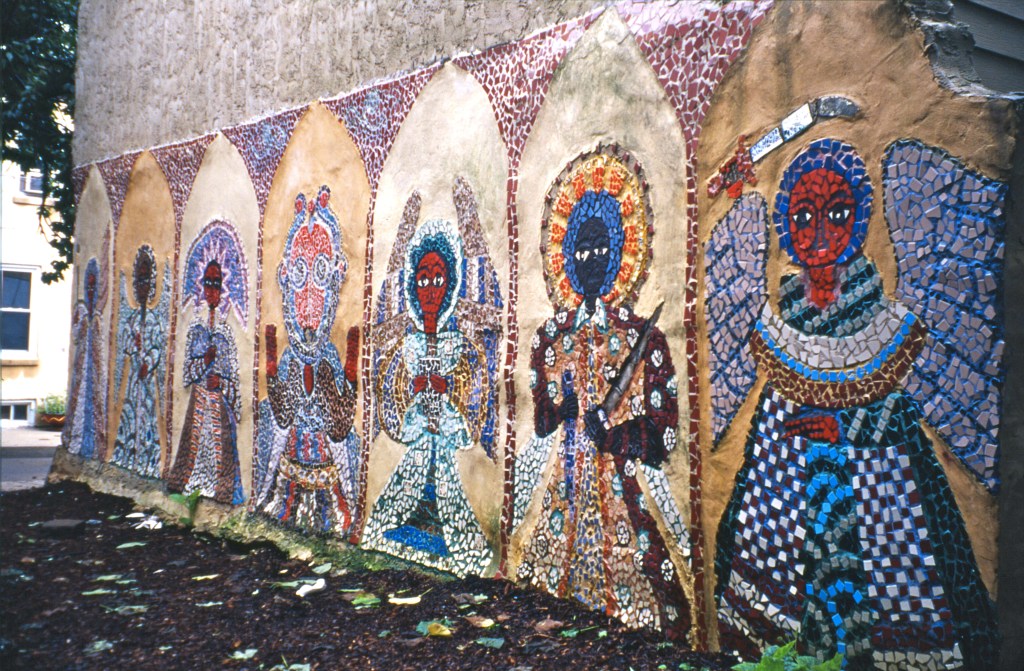
Therefore when you talk about, for instance, Ile Ife and the Village of Arts and Humanities with all of those statues that are kind of a throwback to the Sahel of West Africa — that is the area where Burkina Faso is, where Mali is. You see all of that statuary that they built on abandoned lots. We will not give up. Ile Ife. And then of course out of that you get Barbara Bullock and Sun Ra — all of these things creating a spiritual life world saying we’re not going to be defeated. We will serve humanity in spite of everything.
North Philly was the center of the industrial manufacturing base of Philadelphia. Philadelphia is not like Detroit or Cleveland, maybe even Missouri or Chicago where you have a concentration of heavy industry. We have a medium level industry — more diverse industrially. So we have garment, there would be some steel production. I think the last steel factory in Philly has been torn down. There was auto production and other things but it was all manufacturing. Now, when industry expanded in the city, it moved to the Northeast. That’s why when you talk about Kensington or Frankford you’re talking about a previous manufacturing area that was settled primarily by white workers. But it was different than what we would call North Philly. It tended to be more stable, which meant they got higher wages. They could buy homes. It was what Du Bois called the wage for whiteness. You’ll see newer factories built in the 50s and 60s if you go northeast up Roosevelt Boulevard. Nonetheless, the industrial center was traditionally North Philly, which is the traditional settlement of Black folk in Philadelphia. You get the visual of it? And so when we go to certain places, you see houses right across the street from a factory — very nice houses by the way — or you see, especially in North Philly, the church adjacent to the factory. It is this kind of organism that I’m trying to explain. Therefore, the deindustrialization of North Philly undoes a lot of other things because everything is connected — the factory, the church and the community. So, a leader in the factory, it wouldn’t be a big thing for that person to be a leader in the community or the church. I know in Zion Baptist Church, which was a highly sophisticated social organization, leaders in factories, like my mother, they were also leaders in the church. And as I recall things, we didn’t elevate celebrity and, you know, all the smart people and all of that. It was the worker, as I remember it. Okay, you know, person was a lawyer. “Oh, he’s a lawyer,” you know. Oh, good. But the day-to-day leadership in the church and in the community was workers.
Again, deindustrialization began in North Philly in the 1950s, perhaps the late 50s at the very time the Civil Rights Movement was taking off. Garment factories, where my mother and aunts and the ladies that I grew up around worked, moved to the south, seeking cheaper labor on their way to move out the country. The industrialization that did occur was mainly of new factories being built in primarily all white suburbs. So you get it in Ohio, with for example Lordstown, Ohio, where they have a famous auto plant — I don’t think it’s there anymore — Lordstown, where the working class was primarily white. But not far from Lordstown is Detroit, right? And in Detroit, the workforce was increasingly becoming Black and taking on characteristics of the Black proletariat.
In Philadelphia, there was no place for Black workers to go. We were locked in because of the segregation of housing. We couldn’t live everywhere. We couldn’t live in the suburbs. You know, this thing where you see Black people living in Cheltenham — it was just an unimaginable dream. We never thought of ever living in any suburb until the suburbs start going down and white people start seeking out newer suburbs and so we could move in there. But we were confined to North Philly. The life world of the church, the factory, the family, the school, the neighborhood was held together on the basis of working people. I want to emphasize that if this city is worth anything, the value of this city has more to do with the Black working class than any other group. The Black working class has remained through good times and bad times. Other people fled — I’m going to the suburbs, I’m going to live here or there. We stayed. We tried to make the best that we could of this city. We tried to reform the political system — it was Black folk. The independent political movement, which was a morphing out of the Civil Rights Movement — the Black political movement. We just don’t want to have the right to vote, we want to have the right to be elected, to hold office. See what I’m saying?
Now, of course, so much of this has been seized upon by opportunists, but that was Black folk coming in the 60s and 70s. The Voting Rights Act, you know, lifted the spirits of everybody. Churches threw themselves into this battle to break machines, the greatest of political machines. The greatest achievement in this is Harold Washington who managed to break the most powerful political machine in the country, the Chicago machine. And they broke it and it’s never been put back together quite like it was. A lot of times, you know, you hear the narrative after it’s about 40 or 50 years old, and it comes through people like Mamdani. C’mon dawg, this was laid 30,40 years before you even came or even thought about anything. And it was the Black movement to reform the governance of big cities — everything from the collection of trash to who could work for the city to the public schools. And so the political independence movement, that’s what we called it, independent of both parties, although mainly running in the Democratic Party. But at the core was, again, North Philadelphia. The political movement of independence was based in North Philly. It was based there because the level of consciousness, the level of resistance is stronger there.
By the 1970s, North Philadelphia was almost completely deindustrialized. Many of the people who grew up there and lived there were still around, although death became more prominent — people are dying younger, and you know a lot of the deaths have to do with over drinking, alcohol, drugs and so on. You might see them. They might be holding on. They’re certainly dying faster than would be expected had deindustrialization not taken over. But deindustrialization in the era of the earlier period in the effort of the US empire to consolidate itself. We were still in the throes of the Cold War. You got the overlay of anti-communism and war. War is always a permanent feature of sociopolitical life in this country. There’s no generation that has not faced a war or multiple wars at the same time, and the extraction of resources from the people.
All of this adds a different quality to poverty. It is not the poverty that we began to accept as normal. There would be poor people. There would be government programs and ultimately through jobs and other things they would get out of poverty. Poverty was solvable, so to speak. Just like Franklin Roosevelt and then Lyndon Johnson — we will fight poverty. For those who do not have enough food, government trucks would bring cheese and flour and other things to poor people. And then there was the expansion of the welfare system and the idea of different programs for children and youth of the poor. Education was still, into the 1970s, seen as something valuable and to be helpful in getting a person out of poverty. So people were not only just interested in getting a high school education but then they wanted to get technical training wherever they could find it. But the spirit of an upward trajectory — rising tides raises all boats. So we thought that the nation will never fall, that America in spite of its wars and in spite of its racism was an upward trajectory, an upward movement of the people. And as the nation moved up, as the nation became wealthier, so would Black people. But we would have to protest and call for a redistribution of the wealth and income and jobs of the country. At the center of it was education for most of us. The historically Black colleges were, if not the only option, the only real option for us. And so we made Black colleges and universities into better colleges and universities than the Ivy League. And I think that was a fact because there was a purpose for education.
I just want to talk about this new qualitative poverty. Black folk experience a type of poverty that is unknown to any other group in this society and probably no other group in the world. Black people have never been anything but poor. As a people, as a community, and this goes back to slavery. We’re talking about 20 generations of intergenerational poverty and deprivation. Yes, some of us escape, but we’re not that far removed. Most of us never escaped. Most of the dreams of economic stabilization have been abandoned. This new quality of poverty means that the poorest group among Black people is children and youth. But the next poorest group, and maybe it’s a tight competition, are Black men. This is new. But it is not just that they are poor now. They will only be poor. And you know there are certain points in life where if certain things have not occurred, then the trajectory of your life is already set in. For most young Black men, the only options, the only trajectories for their lives are poverty, maybe homelessness and being despised by most people. In other words, if you have a low education or no education, are in poverty, were born into poverty, and you are a Black man, you are on a death march. You are on a death march — social and physical death. I don’t know what the statistics, the data is on life expectancies, but Black young men do not foresee a long or quality life. Life is short, hard, and brutish. They understand that they have been abandoned by society. The children of these young men adopt the values and attitudes of their fathers and uncles and big brothers. This is qualitatively new. There’s something about this that is unprecedented, maybe in history, of a people who are murdering their own in this way without a sense of remorse and almost normalizing it, except in a situation of a civil war — ethnic, racial, or class civil war. This is unprecedented.
I don’t know of a time ever when Black people were afraid to go out of the house, afraid to let their children play on the street. I hasten to add this is only a small part, maybe 10-15 percent of the young generation of young Black men. But they are so positioned and, in a lot of ways, encouraged by a culture — elite culture — to be that outsider group who, as they see it, are taking matters into their own hands. But we’ve never seen this. I associate this with a new qualitative level of impoverishment. There is no comeback. There is no hope. There is no second chance. There is nothing but a long death march. And they know this is a death march. They see it all around them. Their uncles, their brothers, their fathers have been on this march. It is well rehearsed. It is well known. Their attitudes a lot of time is like — I don’t want to hear nothing. Oh, you talking, I don’t want to hear it. You know what I’m saying? That is an attitude I know of and I’ve seen. Don’t tell me nothing. Oh, excuse me, brother. Can I tell…? No, I don’t want to talk. You know what I’m saying? And that’s, I consider, to be a reasonable response. There’s no do-gooder’s answer to this. In a lot of ways, these young men hear better harsh-talk than they do so-called empathetic, sympathetic talk from people. Oh, I want to help you. The fuck you want to help me for? That’s the attitude, you know. Don’t nobody else want to help me. And I’m on this long march to death, believe me. And thus, an unexplainable gender gap among Black people has emerged. They do not want to hear, “Oh, we got to vote for Kamala Harris because she’d be the first Black woman president.” They answer, “So what? The rest of y’all ain’t did nothing for us. So why would she?” Barack Obama coming around, Black men talking like — man, get the fuck outta here. That’s their attitude. Punk-ass motherfucker. That’s the way they talk. Excuse my language. Overwhelmingly they say to themselves — they’re not into this violence, no I’mma-just-shoot-up-a-neighborhood, I don’t care who I shoot. Most ain’t nowhere near that. But they’re separated from institutions like the church. And they’re cut off from society.
One study which has not been replicated in 10 years but you might wish to look it up — it’s a New York Times article that said in 2015 it was assessed that 1.5 million Black men can’t be accounted for. In other words, the places where you can account for Black men — unemployment line, homeless shelter, penitentiary — I mean, there’s some way to account. I can say where you at because you in some way interact with the larger society. Maybe a job, a service job, a human, but you know, some way to account for that. But 1.5 million in 2015 could not be accounted for. I think with everything that we’ve gone through and know, that [number] could be doubled. Just are not to be found in society; a stranded population and a level of marginalization perhaps never before seen in a modern society. In other words, we’re looking at phenomena that have never existed before. You can’t say in urban studies or anything. Nobody has ever had anything like this. Then you take the Philadelphia population. Philadelphia is believed to be, at least from data, whatever that is, the poorest of the top 10 cities, which means that it doesn’t have a lot of wealth at the top end, but it has a lot of poverty at the bottom end. I think Chicago might have similar Black poverty to Philadelphia, but it’s wealthier at the top end. But by saying Philadelphia, the sixth largest city, is the poorest city is also to say that the Black proletariat is in desperate conditions.
But then this is overlapping with this 37 trillion dollar sovereign debt. This is what the ruling class and the politicians are really concerned about. It’s projected in 10 years to be up to about 50 trillion. No nation, I believe, has ever experienced this level. When they say sovereign debt, the government debt, debt of the state, it’s now 37 trillion dollars. If you went back 15 years, it may have been half that. But what drove the government debt, in other words indebtedness, were three things.
One, the wars in western Asia — Iraq, Afghanistan and of course Libya and Syria — already $7 trillion, estimated. Okay. Then the financial collapse of 2007-08; how many trillions that consumed? I don’t know but it’s in the trillions. And then COVID, and the shutdown, the lockdown, and how the government had to pay out stuff. At this point, there’s no way for the government, based upon the current economic structure, and the structure of no economic growth, the government will never pay this debt off and foreign nations that hold American treasury or debt are trying to get rid of it as a statement that the U.S. and the U.S. dollar are on an unsustainable path.
Now, with Trump and his “Big Beautiful Bill” which was a bunch of bullshit and I don’t want to be cursing in the church. Forgive me, y’all. The key thing here is that, they’re not saying it, but what they claim to be doing is getting government spending under control. But that’s what you’re doing and it ain’t going to do nothing in terms of this expanding debt. The government of the United States cannot function without borrowing money and printing money. Ultimately, this will lead to the devaluation and abandonment of the dollar on an international level, which will then be the moment of truth for the entire working class and middle classes of this country. Most people are laying back — I can’t understand what’s going on it don’t look good, but what can I do? Most people are laying back, but most people are trying to prepare for a catastrophe. How it will come and so on? No one knows.
We have talked about a struggle of a new type. And it will have to be. Going forward the struggle will look more like the Civil Rights Movement. Leadership will talk more like and explain the world more like Martin Luther King. A central base of all of this will be the Black church and mosque, and Black gods, which is the Black sensibility of beauty, justice, freedom and all the positive values. This movement I think will be an all-humanity movement — a movement which must take on important ideological questions that have been kicked down the road too long. The central problem for the American people is a question of whiteness for the people. If the people are going to be able to fight for their rights, they cannot do it and hold on to this pernicious, predatory concept of whiteness. The positive thing is more white folk are closer to doing that than ever because — what is there to hold on to? A reputation? Well, I don’t think it’s much of a reputation. It is unable to provide material benefit. You know, just because you white don’t mean you going to get a job, especially if you live in Butler, Pennsylvania, western Pennsylvania, those deindustrialized areas. So it’s an all-people struggle. In many ways, there are conditions for it right now. At one time, and I’ve said this before, in a period of the 60s and 70s, there was talk of race war on all sides. Talk of not race war was an unusual thing — like you get a Henry Winston talking about the fight for unity. I have not heard the word “race war” except you know on MSNBC and the liberals and so on. People are more predisposed to seek a path to unity. The American people — and when I say the American people, I’m including them in their totality, which includes Black folk, Hispanics, Asians, and white people — are less racist than they’ve ever been. Are we where we need to be? No, but less racist. The other thing is the American people are war exhausted and ultimately they will seek out ways and ideas to do away with all this military spending. Already it’s taking place with respect to Israel. The majority of American people don’t want to give them a dime, do not identify with them and feel they’re using the American government.
We have to think now about resuming our efforts to study deindustrialization of North Philly. I’ll do all that I can to show the neighborhoods that I’m familiar with, to show the factories, and I’ve done some of this, but there’s more; and to look at the geometry, the spatial organization of the city, how that has been broken, abandonment of all of these lots. Factories and communities and home ownership were all kind of linked together, it created a certain ecosystem that has been broken. So we want to look at all of that, but we want to look at things again in their totalities because we want to know if the people have the capacity to, over time, shift the political ideological center of this country. In a lot of ways, the capacity of the people is intertwined with the capacity of Black people. Black folk are the most capable to resist. They bring tremendous gifts, tremendous possibilities and so on. But the rest of society must be open to Black people. That’s going to be a hard one. I know Alice often talks about this. The immigrant, the Asian community can’t see Black people. Not can’t — don’t want to see Black people. You understand? Cuz I’m on a mission, but you know, that mission might fail. So yeah, I’ll stop there.
 Avant-Garde: A Journal of Peace, Democracy, and Science
Leave a comment