
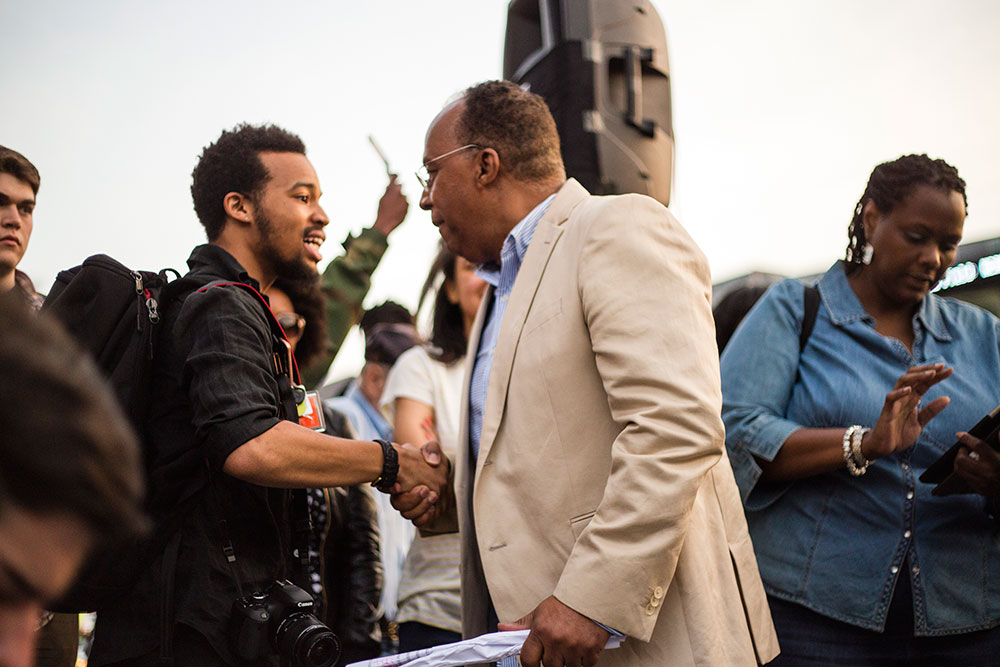
March 10, 2014 | Address at Temple University
Note: The 2014 termination of Dr. Monteiro from the African American Studies (AAS) Department of Temple University sparked a community campaign which linked his reinstatement to the fight against Temple’s gentrification of North Philadelphia. In this speech, Dr. Monteiro criticizes Temple as having become a neoliberal, globalist institution built on the ruin of the Black poor of North Philadelphia, reflecting the moral abdication of universities from being spaces for liberatory knowledge and free thought. Molefi Asante — a cultural nationalist and then chair of AAS at Temple — justified the racist firing of Dr. Monteiro by saying that he was not a scholar but “a communist apparatchik.” Asante’s anticommunism — harkening back to the McCarthyist attacks upon W.E.B. Du Bois and Paul Robeson — aimed to prevent his own colleague from making a living. Despite great personal cost, this period marked Dr. Monteiro’s transition to a fulltime educator and organizer with the Saturday Free School for Philosophy and Black Liberation.
We’re here today not because we want to disparage Temple, or its board of trustees, or its administration. We want to make Temple better. In recent decades, Temple has become a powerful institution with large and valuable real estate holdings as they gentrify North Central Philadelphia. Temple now has a global reach extending into Asia and Europe. It has an impressive faculty, a medical school, a business school, and a list of graduates with accomplishments in many fields. It sees itself as a 21st century global university and a global force. Pride, rather than the spirit of service to humanity, is the culture which guides most of the top administration of this university. They see themselves as part of the global 1 percent. We, on the other hand, constitute a part of the global 99 percent. Indeed, Temple is a powerful institution. But Temple is not a great institution. Temple cannot be great unless Temple commits itself to serve. Martin Luther King was absolutely right — we can all be great because we can all serve.
At the center of what we’re here for today is my reinstatement and to protest an unjust firing. And I’d like to underline: unjust firing. Without cause or explanation. But that’s only part of it. We’re here because justice demands that we be here and we’ll have to return here until justice is done. Temple has existed in North Philadelphia for over 100 years now. It is a neighbor to Black Philadelphia. Russell Conwell, the founder of Temple, founded this university upon the principle of serving the poor and working class. However, his vision was incomplete because he did not see the Black poor and the Black working class. My family grew up here in North Philadelphia. I still live in North Philadelphia. We have always been neighbors to Temple University. And while a few of us were admitted into Temple University, most of us who went to college, if we went to college, went to historically Black colleges and universities, and proudly so. But in spite of the fact that few of us could come to Temple, we did not see Temple as an enemy of the Black community. We saw Temple as a university with potential to do the right thing. And we saw most of the students at Temple as nearer to our socio-economic backgrounds than, for example, the University of Pennsylvania, which was in some far off land in West Philadelphia. Temple has never been the University of Pennsylvania. And it is a travesty for it to now attempt to be that, and to become that, changing its character. I want to come back to that in a minute.
But then in the late 1960s, Temple hired a president, Marvin Wachman, a Jewish socialist who had previously been the president of the university that I graduated from, Lincoln University. I was particularly proud that Temple had decided to appoint as its president not only a socialist, but an anti-racist. Marvin Wachman attempted to extend and deepen the philosophy of Russell Conwell. However, several presidents since Wachman have whittled away at a moral vision of inclusion and service to the poor and working class. We are therefore where we are today because of the abandonment of a vision of service to the working class. A university that wants to be a player in a global order that oppresses billions of people.
Along with the demand for my reinstatement with tenure is the demand that Dean Soufas be removed from her position. Her tenure has been troubled. It has been based upon a demonstrable misperception, a demonstrable lack of knowledge and a flawed racial philosophy. It is now time for a new beginning in the College of Liberal Arts. The College of Liberal Arts is the largest college in the university and arguably the most important college in the university. It prepares students to become citizens and activists in a world that needs their moral conscience. Without a College of Liberal Arts, any university becomes nothing but a vocational technical institute. Without a College of Liberal Arts, the art of thinking, the art of citizenship, the art of moral imperative and good faith action cannot exist. These are things that we learn. We are not born with these types of skills.
Even if one, for the sake of argument, says that Dean Soufas tried to do the right thing. Even if we allow that for the sake of argument, her management style, her flawed racial philosophy, her bullying, and on and on, burdened her administration. Her own statement that she did not see a Black community in the center of this great city — where Black people have made such a profound and beautiful contribution to what it is and what it will become. This all manifested again, a flawed racial philosophy, a philosophy about race that suggested that Black people had “made it” and that the poor were poor because there was something wrong with them — the people in Norris Homes and all of the neighbors who are around this university.
Temple strides the two poorest zip codes in the city of Philadelphia. And a poor zip code in the city of Philadelphia means that you have extremely poor people and extremely poor children. And as they build tall buildings, they look down upon poverty and don’t see it because they don’t see a Black community. But if you don’t see the Black community of Philadelphia, you’re saying they can’t be stakeholders in what this university becomes. You say they have no moral vision that has any significance for this university. You’re saying that they should forever be marginalized, in prison, impoverished and made unemployed.
But, to this problem of the pointing of fingers in the faces of Black men and this assumption that Black men are, in essence, a threat to academic normalcy. That if you want to take the African American studies department or the philosophy department or the sociology department or the College of Liberal Arts in a creative direction, well, think about eliminating the number of Black men. Because they represent something that is “pathological” and “abnormal” in American society. And therefore you can justify pointing your finger in the face of a Black colleague of yours. Where do we go from here? This will be a long struggle, and it should be. We have not done enough in the past. Too often we have been overly concerned with our own careers, with our own incomes, with our own families, and did not take account of the larger picture.
We let corporate types run the university, set the goals, establish the curriculum, fire and hire, as they decided who they wanted to tenure and kick out of the university, those who are unacceptable to them. Those who said that it is difficult to explain the action against me unless we also take into account what I stand for. Yes, I stand with Mumia Abu Jamal and have for over 30 years since he was arrested. But if that is so bad, well, I stood with Nelson Mandela when he was in prison and on the United States terrorist list, I’ve stood with Russell Maroon Shoatz and other political prisoners and prisoners of conscience like Chelsea Manning, like Edward Snowden, like Julian Assange.
So if it’s a question of, “Dr. Monteiro, you are too political” — well, if I’m too political in standing with Mumia and political prisoners and prisoners of conscience, then are you telling me I should not have stood with Nelson Mandela? Some will say, “You’re a Marxist and a socialist, that you teach W.E.B. Du Bois’s magnum opus, Black Reconstruction in America, that you teach C.L.R. James and Amiri Baraka.” Are you telling me that you can have a Department of African American studies without teaching the radical tradition and the traditions of socialism? And if that’s what you’re telling me, then you’re telling me that you want a department built upon a lie.
I live in North Philadelphia, have always lived in North Philadelphia and will continue to live in North Philadelphia. I don’t own a car. I ride the buses. And I ride the buses for the same reason that I live in the neighborhood that I always lived in. I like to be among ordinary people. I like to feel what they feel. I like to see how they’re looking from day to day. How is this society affecting them? I enjoy living in North Philadelphia. I like to live next to Black people, always have.
But I am not going to back up and say that my lifeworld should be transformed because rich people now want to inhabit the cities. I’m going to fight that. I’m going to fight it. And in fighting against gentrification, we are fighting against poverty. We’re fighting against the prison industrial complex. You know, there are a lot of people who want to study the prison industrial complex, but not study poverty. They want to study the prison industrial complex, but not study gentrification. They want to study the prison industrial complex, but not study the effect of neoliberal corporatized universities upon communities. These institutions are as negative in the life of communities as the prison industrial complex is. In other words, they break up communities in the same way that mass incarceration does.
Where do we go from here? I’ve thought about this and I would propose, as we do what we have to do, we’re going to have to think about a new Dean of the College of Liberal Arts. We have to. This is not retaliatory or revenge. It is a practical proposal based upon a job failure. The job was not done well.
You did not understand the environment that you were in. You didn’t understand the people who are your neighbors. You did not even understand your faculty. But what is the philosophical grounding of that person who would be our next Dean of the College of Liberal Arts? I would suggest that person proceed from a philosophical grounding that I call the “Russell Conwell-Marvin Wachman-W.E.B. Du Bois paradigm” for higher education. Russell Conwell’s commitment to the poor and working class be they immigrants and whites. Marvin Wachman’s socialism arising out of the European Holocaust against the Jews, coming to the United States and teaching and heading a historic Black college, Lincoln University, and then coming here to Temple to infuse that ideology and extend, as it were, Russell Conwell’s vision. But then higher education cannot be higher education without W.E.B. Du Bois, without his understanding of the function and purpose of higher education. And so I would propose that a project for all of us is that we think of the type of dean of the College of Liberal Arts that we need and that Philadelphia needs and that North Philadelphia needs. And that person should be acquainted when they come here with the philosophy of Russell Conwell, Marvin Wachman, and W.E.B. Du Bois. I don’t care how long your resume is, but if you don’t understand basic principles, you can’t do the job.
Finally, to my colleagues on the faculty here, join us. Join the almost 200 scholars who have signed a call for the reinstatement of Dr. Monteiro from around the country. Don’t be afraid — there’s cover. Cornel West, Angela Davis, Robin Kelley, Joe Fagan. I forget some of them. There’s so many. Two-hundred of them.
Join them. In joining them, we as a faculty join the cafeteria workers who are our colleagues. They’re not our servants. We join the security guards. We join the maintenance workers. An injury to one is an injury to all. Injustice anywhere is a threat to justice everywhere. If the workers in the cafeteria are making a less than livable wage, we on the faculty should be concerned. If their lives are difficult in Norris Homes, we on the faculty should be concerned. There is no hiding place. That’s what neoliberal capitalism teaches us in the first decade and a half of the 21st century, that if they come for the people in Norris Homes today, they’re coming for you tomorrow. Your PhD cannot shield you from the ravages of neoliberal capitalism. And lastly, let me say this in my own defense.
It has been said by some, even written in newspapers, that “Dr. Monteiro is not that important, that we can replace him with scores of professors. They’re out there. He hasn’t done that much. In fact, he hasn’t written a book.” They say that they’re moving in a new direction, ill-defined though it be. “And in this new direction, we don’t need the Black Radical Tradition.” I think to those people, we would ask that they come forward with their proposal, not just for African American Studies, but for the university as a whole. And if you think that African American Studies can go forward without the African American community, you must believe that you can have Black art and Black music without Black people.
African American Studies emerged out of the struggles of ordinary Black people who did not ask for anything and did not get anything. If we are professors, it is because of millions of unnamed Black people, many of whom became martyrs in the struggle for our freedom. We will win this battle. We must win this battle. The key to victory is unity in struggle. Unity of students with the Black community, of students in the Black community with the labor movement, the great labor movement of Philadelphia, with the clergy, Christian, Muslim, Buddhist, Jewish, Hare Krishna. This is the only way that we will win. And if we win this, it is but the beginning of a struggle for other victories. Thank you very much.
 Avant-Garde: A Journal of Peace, Democracy, and Science
Leave a comment