
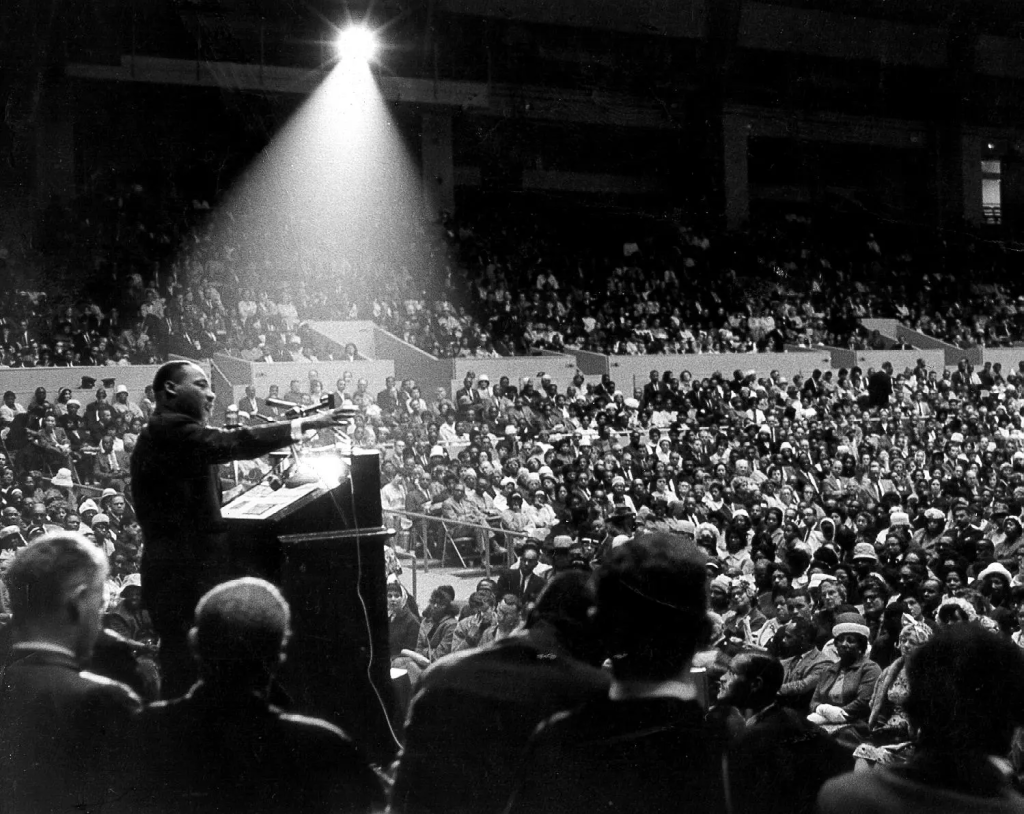
January 18, 2022 | Address for the Pennsylvania Human Relations Commission’s Martin Luther King Day celebration
Note: Reassessing the centrality of Martin Luther King Jr. to the American revolutionary process has been a key contribution of Dr. Monteiro. This has been a multidecade process, culminating in the Saturday Free School adopting him as the father of a new American people. This address is an emotional and spiritual reckoning with the lifework and murder of King in the context of the dire crisis of the American people.
Let me begin by making a confession. For several years, maybe since the nation has officially celebrated Martin Luther King’s birthday, I would awake each day, each of these days filled with a nagging anxiety and a sense of unhappiness. I would push those feelings behind me and get on with the day of celebration. Not really dealing with the cause of my feelings of anxiety and unhappiness, until this year, I confronted them. And it occurred to me that I’ve been for all these years grieving Martin Luther King’s death and the magnitude of its meaning to the life world of this nation and to Black folk.
And I believe that, like myself, the nation has not fully grieved the death of Martin Luther King Jr. And what it has meant for this nation. So, while we officially celebrate his birth, we push our national grief further into our collective subconsciousness. In a sense, we normalize our moral hypocrisy concerning King and our inability to confront what is, in fact, the troubles of our time and what Martin Luther King would have to say about them. In fact, if 50 years from now, or maybe 100 years from now, historians, philosophers, theologians, social psychologists, and other learned people gathered to diagnose what happened to America and what brought us to the moment that we are in now: I believe their diagnosis would say, in large part, the nation ended up divided, confused, and in moral chaos because of the assassination and death of Martin Luther King Jr. in 1968. An event that the nation has not recovered from and has left us without the moral leadership that he so eloquently provided. And so with his death, the nation has been left morally adrift.
We, as a nation and as a people are spiritually empty, morally confused, and intellectually and culturally in a state of decadence. All of this is witnessed by us all on a daily basis through the media, through films, through books, through popular culture. It is therefore reasonable, indeed existentially necessary to ask at this time, What would Martin Luther King say to our nation were he alive?
We must first acknowledge the depth and intensity of the crisis our nation is in. I would observe that this is the greatest crisis since the Civil War, and maybe the greatest crisis in the history of the nation. We could point to all of the structural and systemic factors and phenomena that point to this crisis.
But I think what demonstrates this crisis more than anything else is the state of the people and the consciousness of the people, especially of working people, the poor, young people, and the lower middle classes. Seventy percent of the American people say the nation is headed in the wrong direction. Eleven million people last year up and quit their jobs in the midst of what we are told is an “economic recovery” where wages are rising. Young people from all areas of the economic and social structure say they have no future under the existing system. All major U.S. institutions, from the presidency, the Congress, government generally, universities and professors, the news media, the military and on, face crises of legitimacy. That is to say, people don’t trust them or believe in their leadership.
People look upon their governmental leaders as self-serving, often as narcissists who put their personal interests ahead of national service. As such, in droves, people are withdrawing from the public sphere and from civil society. For the majority of American people, the most common experience at this time is grinding inflation, economic uncertainty, and violence at every level of society. People do not trust a popular culture that most people feel normalizes and promotes selfishness, individualism, materialism, and other values that most Americans wish to transcend and go beyond. In pop culture, there’s a primacy of the value of getting rich rather than uplifting the spirits of the people. It is what it is, and we are what we have become.
So what would King say? His message in the darkest times was a message of optimism and human possibility. He called for a radical revolution of values, of revolution that would lead to a society that could be defined as a Beloved Community and a world order that was, as he would put it, a World House, built upon peaceful coexistence rather than mutual annihilation between peoples, nations, and civilizations.
My topic today, “What would Martin Luther King say to a nation trapped in the wilderness of chaos and confusion?” That topic is inspired by King’s last book, Where Do We Go From Here: Chaos or Community? And it seems that in many ways we have chosen chaos over community. I draw upon three of King’s most important writings as a way of talking about what King would say to us: His “Letter from a Birmingham Jail,” written in April of 1963 while he was in prison for leading protests against segregation in the city of Birmingham, Alabama. Secondly, his speech for “A Time to Break Silence: Why I Oppose the War in Vietnam,” delivered at the historic Riverside Chapel in New York City on April 4, 1967, a year to the day before he was assassinated. And finally, his most delivered speech and sermon, “Three Dimensions of a Complete Life.”
Before going in a little more detail in these speeches, I want to say that we must acknowledge, if we are to be true to Martin Luther King Jr., that his body of work is an almost inexhaustible source of ideas for our time and this historic crisis. King speaks more to our time than do Jefferson, John Locke, Rousseau, Voltaire, or Lincoln, to name but a few. They were all democrats, with a small D, and radical for their time. But King goes beyond them and speaks to us in ways they cannot. King, in his body of work, expands upon and makes relevant fields of knowledge as varied as philosophy, theology, comparative religion, moral theory and practice, theories of democracy and democratic changes. For me to think of King otherwise, than as this great intellectual, and only as a civil rights or Black leader, as noble as those things are, is to not really see King and not see his relevance for this time and for the crisis that our nation faces. In fact, I believe it is a way to trivialize King and to deny the enormous meaning of his thinking and action for our time.
In fact, I would say that King, as a thinker and in terms of the history of human thought, is a great synthesizer. By which I mean he brings together great bodies of thought, everything from German idealism of the 18th and 19th century to Hindu philosophy and theories of Mahatma Gandhi, to theories of the Black church and Black Christianity, as represented by such thinkers as Howard Thurman and William Nelson, among others. King is this great synthesizer, and he synthesizes these great bodies of thought for the sake of bringing people together, for the sake and purpose of social change, to lift humanity from the stage of depression and crisis to freedom. Let me begin with King’s “Letter from a Birmingham Jail,” again authored in 1963 while he was leading protest against segregation in Birmingham, Alabama.
In a lot of ways, the “Letter from a Birmingham Jail” is a wake up call to the nation. Calling upon the nation, as he put it, to get on the right side of the world revolution. King defined the world revolution in terms of the zeitgeist, the spirit of that time, that all peoples and nations were striving for freedom. The nations of Africa and Asia were breaking the chains of colonialism. People were fighting for civil rights and human rights throughout the world. King called this a revolutionary time. And he called upon the American people not to be complacent, but to get on the right side of the world revolution. He also said this was like getting on the right side of history. He said that we had to be a part of humanity, not separate and apart from it. There was, he said in this letter, a fierce urgency now, an urgency to act. He said time waits for no one, and the moment to act comes only once in a while. And at times we sleep through a great revolution. He argued that we could not allow this moment.
The moment he was talking about was, of course, in the 1960s. I would say the same goes for now. We cannot allow this moment to pass. To allow it to pass would be to condemn ourselves to live in the dark shadow of disappointment. He insists in the “Letter from a Birmingham Jail” — and he was addressing seven clergymen from Birmingham who had written a letter to him asking that he call off the demonstrations for freedom — he said to them that you can’t be halfway for freedom and justice. You’re either for freedom and justice, or you’re not for it. He said there is no virtue in moral compromise.
He said to them that the Christian Bible was clear, the life of Christ was clear about what Christians should do in times of crisis and how Christians should address issues of oppression and injustice. Drawing upon the English poet John Donne, he says, no man is an island entire of itself. All life, he reminds us, is interrelated and we are all wrapped in a Single Garment of Destiny. He is saying, therefore there is no individualistic way to solve problems that are societal. For many, this is inconceivable. For wasn’t our nation founded upon individual freedom, including the freedom of speech and the freedom to carry a gun?
How can King say in the middle of the 20th century: that may have worked at the end of the 18th century, but in the world in which he and we live, we must recognize that we are all wrapped in a Single Garment of Destiny. And what affects one directly, affects us all indirectly. If there is injustice anywhere in the world, it threatens justice everywhere in the world. And so we must act, and we must act in ways that acknowledge that none of us are separate from all of us. We are part of humanity. He says, there are no great me’s and little you’s. There is no me above you. Hence we must find a collective way out. We must find a way out that does not make the me greater than the we. And we must see each one of us as part of a we, as part of a single destiny, a common struggle.
The logic of the “Letter from a Birmingham Jail” is further concretized in his magnificent speech of April 1967 at Riverside cathedral in New York City, the speech opposing the war in Vietnam. This was not an easy speech to give for him. By the time he gives his speech at Riverside Church, he had already made his position on the war in Vietnam known. He was against it. Many civil rights leaders, politicians, and newspapers, including the New York Times and Washington Post, came out against his opposition to the war in Vietnam. “How,” many said, “could Dr. King oppose President Lyndon Johnson’s war when it was Johnson who signed the Civil Rights Act of 1964 and the Voting Rights Act of 1965?”
Others said, and this might sound very strange today, that “peace and civil rights don’t mix,” that either you are a civil rights and Black leader, or you’re an anti-war and peace leader. The two don’t come together. King, of course, makes the opposite argument. That the struggle for justice is part and parcel of the struggle for peace. That the struggle for freedom and the struggles for peace are inseparable, and that violence and inhumanity being carried out by the U.S. military in Vietnam was a form of violence against the American people. He would say that the bombs dropped in Vietnam explode in the inner cities of Detroit and Philadelphia and Los Angeles and other cities. That it was the poor who were paying the price in this country for an adventure in Vietnam.
King would not only connect civil rights to anti-war, he would connect poverty to the fight against war. He would call for a radical reduction of the military budget and for guaranteed annual income for all Americans. He would say, and I’d like to quote from that speech, he said, “The war in Vietnam is but a symptom of a far deeper malady within the American spirit. And if we ignore this sobering reality, we will find ourselves organizing clergy and laymen concerned” — that was the organization that sponsored the speech — “committees for the next generation. They will be concerned about Guatemala and Peru. They will be concerned about Thailand and Cambodia. They will be concerned about Mozambique and South Africa. We will be marching for these and dozens other names and attending rallies without end unless there is a significant and profound change in American life and policy. Such thoughts take us beyond Vietnam, but not beyond our calling as sons of the living God.”
And then he will say, “I am convinced that if we are to get on the right side of the world revolution, we as a nation must undergo a radical revolution of values. We must rapidly begin to shift from a thing-oriented society to a person-oriented society. When machines and computers, profit motives and property rights are considered more important than people, the giant triplets of racism, materialism, and militarism are incapable of being conquered.” King in 1967 was speaking more clearly and more courageously to us in 2022 than any politician, any public intellectual, any clergyman on the scene today.
Lastly, I’d like to talk about a sermon that was given by King more often than any other in his career. The title of it is “Three Dimensions of a Complete Life.” It was his inaugural speech at his first church that he ministered in Montgomery, Alabama. My favorite version of it is when he gave it in 1962 at Yale University. In this sermon, or speech as it were, King said that all of us must strive to live complete lives. I interpret completeness to mean moral completeness. Becoming a whole human being and as such being able in whatever way we can to make a difference in the world and in our society. How else, except as complete human beings, can we address the problems of violence and uncertainty and despair and pessimism?
How can our lives be examples for those less educated, those more down the chain in despair and pessimism? How can our lives be examples unless they are complete? The question of a complete life confronts each and every one of us every day, if we are not to fall into the trap of hypocrisy and double standards and double speak. I think you all know the game. King says that the first dimension of a complete life is that dimension that focuses upon us as individuals, that we all want to live a long life. It’s very popular these days to talk about self-care. “My house, my gym membership, me.” King says there’s nothing wrong with that. There is value in caring about yourself, in loving yourself.
One of the great problems that we Black folk have faced over historical time is that we don’t value ourselves enough. We’ve been told so long that we are less than that. For many of us, this value has been internalized. That we are not as beautiful as other people, that our hair is not as good as other people’s, that our lips are too big, that we’re not as intelligent as other people. So we Black people must struggle to value ourselves as individuals. And King acknowledges that.
He said, the second dimension, however, is not just to love ourselves, but to love humanity. This is the Single Garment of Destiny level of a complete life. To change the conditions in which people live, especially the poor and oppressed, young people, those who are uneducated.
You know, in Philadelphia at one time in this city, almost everybody worked. And the most revered person in poor Black communities, in working class Black communities, was the working man and woman coming home from work. He or she was looked up to more than a professor, a doctor, lawyer, often. And at that time, the majority of people who worked in Philadelphia were in unions. Then came deindustrialization. Jobs left the city. They went to the South and ultimately out of the country. You can go around the city of Philadelphia, and you can see old factories that are abandoned, have been abandoned for years. You can drive by Dobbins Vocational School. This beautiful structure where young people would go to learn a skill, and they would leave high school with the assurance that they could get a job. People wanted jobs because they wanted to buy homes.
One of the things that made marriage such an appealing thing is that we could put two incomes together and we could buy a house. I don’t know how many people remember when Philadelphia was a homeowner city. New York, where everybody lived in an apartment, was something incomprehensible to a Philadelphian. In Philadelphia, we all owned homes, and people would buy a little small house with the hope of, in a couple of years, buying a larger house. And then once they bought a house, they wanted to buy a car. And people worked so they could improve their lives and educate their children and make for a better public education system. That seems like paradise today compared to the city of Philadelphia, which is broken. And nobody in government, in academia, in public life seems to have an answer to what’s going on in this city.
So King would say, the second dimension of a complete life is that dimension that puts humanity up front, the human struggle. No man is an island. To see the we before the me, to see me only in relationship to the we. To reject a culture of celebrity and money and excess, and thus the life of humility.
And then he said the third dimension. King said, this is the most difficult dimension to achieve. It is where we approach what is infinite, that which cannot be grasped by human intelligence. That dimension for which there is not a scientific explanation. In this dimension, it is the connection of the finite we — to the infinite. This is the cosmological dimension. It compels us to be humble, to be servants of something that we cannot see or touch.
King would quote the North African Pope, St. Augustine, who said, “Man is made for God.” Man is made to be humble. To see him and herself as part of a larger cosmic reality. And that in striving to go beyond the physical, the individual, and even the all-humanity, we strive for a level of goodness that most of us think is unrealizable, a level of commitment to more than just what we see as life. To recognize, and this is King, that some things are so important that you must be prepared to give up your life to achieve that. Because life does not conclude with the physical, with the immediate, what we can feel and touch.
Let me end with this. These are very serious times. All of you might not agree with me in my description and assessment of the crisis this country is in. Allow me to repeat it. This is the greatest crisis since the Civil War and maybe the greatest crisis in the history of the country. The people are divided without leadership. Morally confused people are retreating into their private lives. Churches are being shut down, even being sold. I find that very difficult to understand, the selling of a church, especially historic ones like Mother Zoar African Methodist Church. People are wandering the streets of this country. People don’t come out of their houses, homelessness is everywhere. It’s normalized. We accept it. This is unimaginable at any other time. If we were not living it, no one could have said to us that this great nation, this rich country, this powerful nation, would end up where we are today. You just couldn’t have. I mean, no one could have convinced you of it.
No one could have convinced me that Philadelphia would become a renter city rather than a homeowner city. I could never have believed, even though I grew up in a neighborhood where heroin and other drugs were everywhere and there was gang violence; but I can’t believe what I’m seeing in terms of violence in the city of Philadelphia. You could never have convinced me that we would not have a public education system in this city. You could not have told me that 46 percent of young people drop out of school before they graduate was believable. But here we are. And the question for us is, what is to be done?
And therefore, I think we must commit ourselves beyond this day of celebration and reverence to study King not as some eviscerated preacher who gave a couple of good speeches, but we must see him as the most important figure in American history since the Civil War. We must understand that if we are to come out of the crisis that we’re in — and all signs indicate that it could get much worse — we need the moral guidance, social thinking of Dr. Martin Luther King Jr.
America, be still and know. Be still and know that we are not God. We have to humble ourselves in order to change ourselves. I thank you once again for this opportunity. And if there are questions, I really would welcome answering them. Thank you.
 Avant-Garde: A Journal of Peace, Democracy, and Science
Leave a comment