
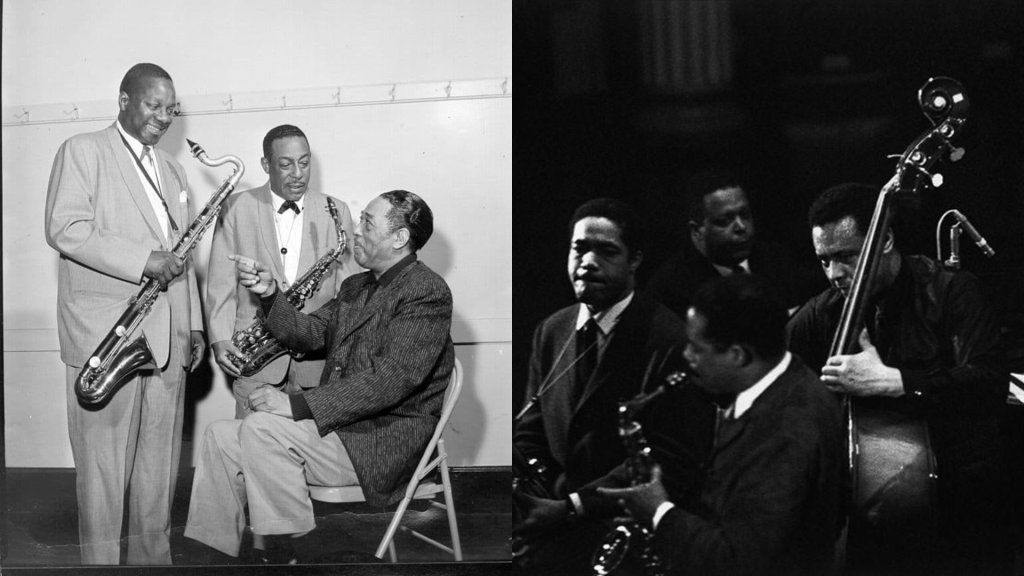
In 1974, Duke Ellington writes his final composition Three Black Kings (Ballet for Orchestra). This tribute to Martin Luther King Jr. grieves King’s 1968 assassination, and eulogizes him alongside Black Kings Balthazar and Solomon. Ellington described the Bible as containing “all the other books” and in his vision, Martin King is lifted up among the guiding stars of humanity’s sky. Ellington is discovering Truth, and modernizing it.
Just as we received the gift of one King, we received a single Duke. Or as he was affectionately called, The Duke of Ellington. Such men are the royals of our civilization; those who are instruments of all that is pure and futuristic in our young yet weary nation that struggles to be reimagined. Of the disparate sounds and strivings of the enslaved African, Duke articulated a new language, orchestrated the letters of America’s musical alphabet. All modern music to emerge from this country that can move the hearts and souls of men, women and children, has been shaped by the creative, intellectual efforts of Duke Ellington and the Ellington Orchestra.
Duke Ellington’s great achievements as a composer can be felt and appreciated by intuition. Mood Indigo, one of his most recognizable compositions, is arresting in its fresh beauty and understated complexity. Much of Ellington’s music has been heard in this way, remembered for its original beauty and sound. However, Ellington’s music cannot be known in its completeness until it is listened to consciously. Duke’s compositions express his revolutionary ideas and place him as one of the greatest writers of a new musical literature in the 20th century. His life and works extend from the revolutionary history of human consciousness and world movements in the struggle for freedom.
The revolutionary music created by Black folk has not just been forgotten today, it has been deliberately lost and misunderstood. The cultural landscape today is so commercial, so produced and lonely that it has shattered people’s imaginations of what is possible. That this music is not broadly known, and especially by youth, can only be explained by the decisions of an elite who have decided what parameters of culture and art are permitted. But in America, Black geniuses created great music, so that we may have, renew and create great music again.
America’s true music grounds itself in the Sorrow Songs, which W.E.B. Du Bois called the enslaved Black worker’s articulate message to the world. This message from Black folk is a modern vision of freedom, that if taken up by the world’s people will advance world civilization to a new height. Today it is the key to moving humanity from the worldview of the European Renaissance and everything white, to a more complete modernity whose origins are in the anti-slavery struggle; and it belongs to the world.
Duke Ellington and The Black Worker
The anti-slavery struggle culminated in the formal Emancipation of the enslaved proletariat by 1863. For two decades to follow, this newly freed people embarked on the journey of Reconstruction to build a new democracy that included the whole American people. The unfulfilled promises of this freedom movement were halted by the white supremacist social order and ushered this new people northward, into cities like Chicago, Detroit, Philadelphia and New York. Duke Ellington, born 1899, was raised at this inflection point in history and sought to tell this story of the African American’s heroic journey into modernity. In doing so, he was writing the story of the whole American people.
He composes Mood Indigo in 1930, “A story about a little girl and a little boy. They are about eight and the girl loves the boy. They never speak of it, of course, but she just likes the way he wears his hat. Every day he comes to her house at a certain time and she sits in her window and waits. Then one day he doesn’t come. Mood Indigo just tells how she feels.”
Mood Indigo reflects the uniquely modern vision emerging from Black people. This worldview poses the problem of how to develop as a human being within a Western society that weathers and dims the human spirit and cleaves the natural human instinct to love. It is a simple, almost folk story that expresses the interior life of any human being living through modernity who experiences the disappointments of it.
The coming of Emancipation made possible the existence of Black genius because there were newly possible, though still severely limited, social possibilities for the African American. Chattel slavery was legally obsolete, and Black people could only rise from what had been the lowest place a people had ever been forced into. As Black folk and their leaders rose to create this new freedom, the social system responded with new and unusually cruel forms of white supremacy such as the overturning of Reconstruction and brutalities of Jim Crow.
Duke watched and recognized the paradoxes of this moment in a white supremacist America’s development. His grandparents had been slaves in the South, and his parents labored serving white folk in segregated Washington D.C. But as America inevitably swung toward modern development, Black and white folk began to grow closer in their experiences and aspirations.
This may be most clearly seen in Harlem of the 1920s and 1930s, the backdrop to the early creative period of the Ellington Orchestra and Ellington’s composition Black and Tan Fantasy, named for the segregated Harlem night clubs. These Black and Tan clubs were crowded nightly with all white guests entertained by all Black performers, whose own friends were not allowed in. White folk needed and sought out Black art to redefine themselves in a society whose definitions were changing, but at the same time feared what had made Black art possible: this dark stranger’s true experience, and the greatness of his human will.
In 1923 Ellington moved north from Washington D.C. to New York. The group secured a residency at the Cotton Club in Harlem in 1927 and consolidated into a united orchestra. For the next few decades, Ellington focused his compositions on the story of Black people in America and their strivings for freedom, such as his first major symphony Black, Brown and Beige which he called “a tone parallel to the American Negro,” debuted at Carnegie Hall in 1943 but left unrecognized in its time.

Black people, above all the world’s people, learned from necessity to hew their humanity from stone in a white social order constructed on the assumption of their inhumanity. What emerged was a new way of seeing, knowing and acting, a criteria for the new human being. Black artists like Ellington and Charles Mingus saw at the start of the 20th century that the European framework could no longer meet the needs of reality. Its science, religion, art and philosophy fell short at the hem of the African American’s experience. In a modern America still overdetermined by European notions, love would suffer; and if love suffered, then generations of children and modern civilization itself would lose something vital. It was hard to know how high the price would be.
Mingus, in many ways Duke’s greatest successor, wrote of losing true love again and again as a young man, who because of the color line was always targeted by a social reality that could and would not permit him to live freely. Another love slipped away through his hands before he was ten, but “had this moment of pure love lasted forever, I’m sure they could both have survived all life’s problems.”
Ellington and the Afro Asiatic Future
In W.E.B. Du Bois’s 1928 novel Dark Princess, a Black man from the South named Matthew Towns holds a unique vision of the future, which he delivers to the world after encountering leaders of Afro Asian nations in Berlin. When he meets a young royal princess from India, there is perfect compatibility between the visions of these familiar strangers. These leaders from Egypt, India, China, Japan and Africa gather to solve the problem of imperialism, but their achievement depends on something Matthew alone knows: the formerly enslaved Black worker’s message to the world of how freedom for humanity can be achieved through resolving the problem of the color line.
“America is teaching the world one thing and only one thing of real value, and that is, that ability and capacity for culture is not the hereditary monopoly of a few, but the widespread possibility for the majority of mankind if they only have a decent chance in life.”
A cornerstone of the anti-slavery worldview is belief that it is the lowest of the low and not the elite and powerful who are the creators of civilization. This explains how Ellington and his musicians, directly out of the shadow of slavery, prophetically saw the unfolding freedom of the Afro Asiatic world in the 20th century.
It was entirely natural in his encounters with African and Asian people for Ellington to see Black folk reflected back to him in every face. In India he meets an ordinary man, “the blackest man I’ve ever seen in my life, and he has the most beautiful face I’ve ever seen. It is pure, completely positive, showing absolutely no sign of any susceptibility to any degree of negativity.” More than a color, black was a pure value emerging from moral depth, and so he saw black as simply the most beautiful.
“I want to see if this thing is true, if it can possibly be true that wallowing masses often conceal submerged kings.”
The orchestra was itself composed of submerged kings, men like Johnny Hodges, Harry Carney and Cootie Williams whose expressions of natural genius were made possible by the cradle of Ellington’s leadership. Without this opportunity, they would have remained in the soot of a white supremacist society that trapped its people in mediocrity, and especially trapped the possibilities of all who were Black.
Harry Carney was the longest-serving member of the orchestra. He was invited by Duke to join the orchestra when he was only 17 and for the next five decades remained until his death, “Of all of the groups that I’d heard, his was the most outstanding. And he was playing original compositions — things that you wouldn’t hear from anybody else but Ellington.” His involvement showed the deeply democratic character that explained the loyalty, united discipline and joyful creation of the orchestra. “Every time there was an addition to the band, the new instrumentalist seemed to give Duke new ideas and something to draw from and add in his writing.” All these men shared something in common, which was their knowledge of the color line and their determination to free humanity from it.

These musicians were talented artists who taught themselves and each other. Hodges and Carney were friends who grew up together in Boston in the 1920s, “We used to get together and listen to records. And, of course, I’ve always been a great admirer of Johnny. I was trying to play alto in the same vein, and I stuck as close to him as he would allow me. It did me an awful lot of good.” Duke composed with, around and for the unique voices of his musicians, such as the unforgettable features of Carney in Sophisticated Lady featuring Carney, or Hodges in Isfahan. “As Duke’s band grew and new members injected their personalities, he was inspired to write.” When Johnny Hodges died, Duke recognized “our band will never sound the same.” The musicians’ witness and the brilliant music they produced was evidence of how much Duke loved his musicians, and how much they loved him.
Not enough is known about the artistic contributions and lives of these musicians due to the need of a white supremacist society to obscure true, creative culture that has the power to topple and break all myths. If these men had been white, it would be taken for granted today that we know and celebrate their names. But if they had been white, they also could never have created this music. They would not have been able to see and know what they did. However, in a future where men are free from the color line, their music is known, celebrated and loved by the people forever. Ellington, along with his successors Charles Mingus and Sun Ra each saw this future freedom as a reality, and developed men in order to reach it.
When the Ellington orchestra first visited the Afro Asiatic world in 1963, everything that passed through the musical construction of their orchestra became modern. Upon their visit to India, an Indian newspaper expressed why Mood Indigo was “the mood of the century.” Their people, who were also struggling against British colonialism which had kept the people poor, miseducated and uneducated, resonated with the blue disappointments of the modern world.
In 1969 when the orchestra performed La Plus Belle Africaine in Africa, Ellington opened the performance by dedicating the composition to Africa, which he felt was right “after writing African music for 35 years.” He placed Black people as a cornerstone of the world’s people and actively articulated these connections, and created these new ties. In his suites and songs dedicated to the world, such as Mount Harissa for Lebanon or The Sleeping Lady And The Giant Who Watches Over Her for Mexico, a piece that personifies the myth of two mountains, Duke affirmed again and again that modernity was the birthright of colored civilizations.
Ellington, one of the most prolific composers in the history of American composition, created an amazing output of hundreds and thousands of works over his life. Among these, many were dedicated to civilizations across Africa, Asia and Latin America, reflecting how he bound his people with darker humanity as a whole. Every new composition arrived as a beautiful flower, respectfully gifted to each civilization and her people.
“If Mr. Towns’ assumption is true, and I believe it is, and recognized, as some time it must be, it will revolutionize the world.”
Charles Mingus, The Sacred Musician
Charles Mingus was the perfect inheritor of Duke Ellington’s language for a new moment in history. He came up in a time of individual virtuosity among Black musicians, which Ellington’s groundwork had made possible by giving the confidence and language for a later generation to inherit. Charlie Parker, Art Tatum, Bud Powell, Thelonious Monk, Max Roach, John Coltrane and Miles Davis and many others each became recognizable bandleaders and creators during the flowering of this music, when it touched the wider American and international consciousness. Among these giants, Mingus was exceptional in his genius as a composer and a creative, intellectual force who advanced art as modern and revolutionary.
By the 1940s, the white supremacist music industry began to consolidate into a system to control the artistic terms and depress the purity of the music, and keep Black artists poor. “I am Charles Mingus, half black man, not even white enough to pass for nothing but black. I am Charles Mingus, a famed jazzman, but not famed enough to make a living in this society.” It was a renaissance of Black genius, but under the yoke of an ever-evolving white supremacy, few of these geniuses survived and lived as they should have. This was white supremacy’s natural reaction to the flourishing of pure Black art that so fiercely challenged the myths of the color line. Charles Mingus articulated this threat and spent his life battling directly against it because he saw how high the stakes were. “If the people are separated from their music, they die.”
He modeled artistic integrity in a time when it was becoming increasingly difficult to do so. “Monk and Bird are dying for what they believe.” But he saw the changing American landscape clearly and how her people thirsted for higher moral and spiritual ideals. “I don’t know why they don’t want the kids to hear good music. Is it because it would make them healthy?” He created beautiful music to fill this void.
Despite the brutal pressures of a white commercial industry that encouraged Black musicians to sell out, Mingus was unbending in his commitment to Truth, Love and Beauty. He looked to the musicians that had walked before and with him, and felt it was his duty to heighten; to never betray the best of what they had given. “Bud, Fats, and Bird — they’re like saints to me. There won’t be many more of those guys, I don’t think. Like sacred musicians, they gave everything. I think they really thought they were telling the people — being like ministers in a way, to give the people the message, the spirit to live.”
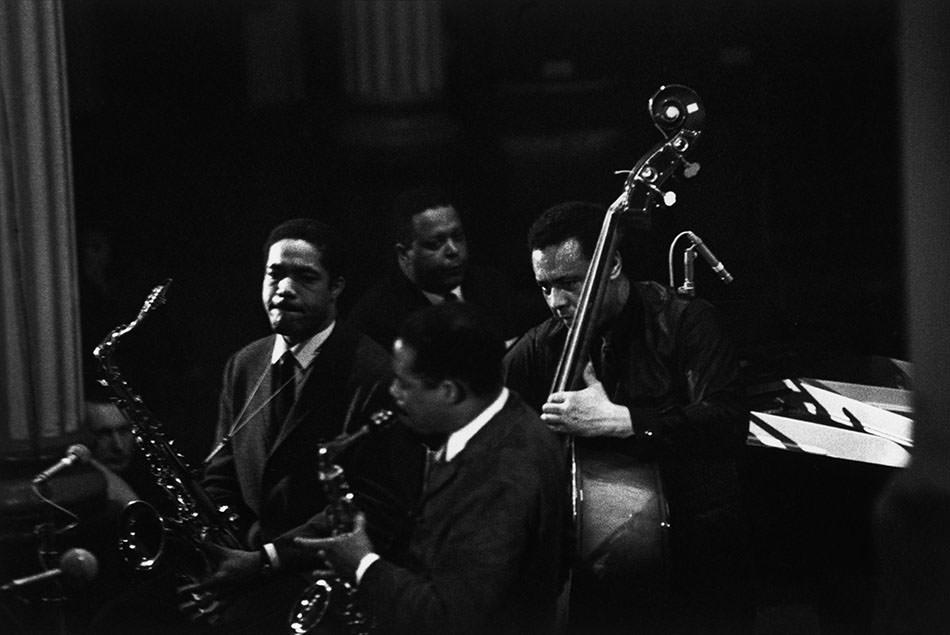
If Ellington protected the musicians of his orchestra, Mingus took the responsibility of protecting all musicians, the people and the music itself. He was fiercely protective of other Black musicians. In a public letter to Miles Davis in 1955, one of the best-paid jazz musicians at the time, Mingus wrote to his brother, “You’re playing the greatest Miles I’ve ever heard, and I’m sure you already know that you’re one of America’s truly great jazz stylists… Truly, Miles, I love you and want you to know you’re needed here.”
Miles Davis, who was far more popular among Black and white audiences, is a mirror to appreciate how special Charles Mingus really was. Davis was also an original voice and creative genius, but he did not have a concept of the sacred in the way Mingus did. With extreme gentleness Mingus wrote, “You’re too important a person in jazz to be less than extra careful about what you say about other musicians who are also trying to create.” At age 36, musician Eric Dolphy died tragically young due to racist untreatment when he fell into a diabetic coma in Berlin in 1964. Shortly before his death, he read a brutal attack from Miles on his music printed in Downbeat and was crestfallen, responding that he loved and respected Miles.
Mingus loved Eric Dolphy, with whom he’d worked closely. “Usually, when a man dies, you remember — or you say you remember — only the good things about him. With Eric, that’s all you could remember. I don’t remember any drags he did to anybody. The man was absolutely without a need to hurt.” “Eric Dolphy was a complete musician.” The passing of Eric Dolphy and other pure musicians like Bud Powell and Fats Navarro affected him deeply because he so much saw himself in them. And because their deaths were unjust and could have been prevented, if only man was willing to know man: “I’m beginning to feel even this earth is more than man needs for himself if he loved his brother.”
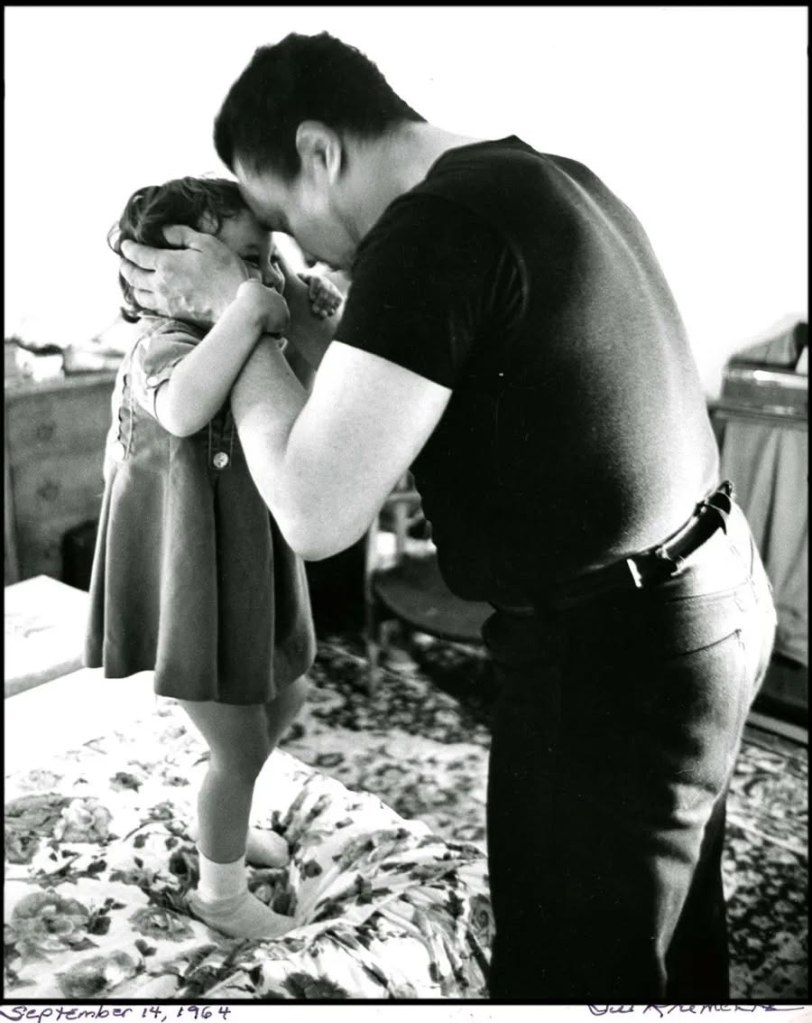
Charles Mingus was a guardian, defending all pure beings in a morally broken society. He loved them as he loved children, and he referenced children constantly because he loved them and he loved the future. He composed beautiful art that he wished for children to hear and know. In his 1972 Let My Children Hear Music he improvises a beautiful symphony Adagio Ma Non Troppo, showing what he believes the young are capable of hearing, knowing, creating, and what they deserve.
Mingus and The Modern Human Being
Most universally, Charles Mingus modeled how the individual human being can become modern without becoming white. He advanced the science of how to become deeply human in an inhuman society, deeply feeling in a society that rejects feeling, intuition and instinct. He grew up in Watts, Los Angeles, born 1922 to a Black and Chinese mother and Black and white father, and pursued a self-identity which emerged from the Black worldview as a modern identity, one that dealt with the future.
“It’s about a kid like you who believed.” Mingus recognized the moral necessity of developing his own unique humanity as an instrument of a higher message, “He was born believing but as he grew, everything around him, beginning with his parents and sisters and teachers, everybody seemed to say that what he believed wasn’t so…
“So somehow he became two personalities, one as sincere as the other, and then three, because he could stand off and watch the other two. The reason was that he suspected maybe the people who didn’t believe might be right, that there was nothing to believe in. But if he accepted this and put down the beautiful honest good things he’d lost out on all he could have gained if he’d never lost his belief in believing.
“He had to hold onto both believing in disbelief and believing in belief.”
W.E.B. Du Bois, born 1868 described the double consciousness of Black folk: “an American, a Negro; two souls, two thoughts, two unreconciled strivings; two warring ideals in one dark body, whose strength alone keeps it from being torn asunder.” Generations later, Mingus developed the idea of triple consciousness, a third personality who could stand off and witness the struggle between the Black soul and white society, unending until white supremacy ends. If being a Black man, and furthermore a Black revolutionary artist in a white supremacist society, Mingus needed to become three selves in order to survive, then this implied only struggle, or striving could unite these three into one, “Which one is real?” “They’re all real.”
The third consciousness, who “stands forever in the middle, unconcerned, unmoved, watching, waiting to be allowed to express what he sees to the other two” was like a God who saw that the fall of white civilization was inevitable, for it failed to sustain all that is human, and in time would reorder the world toward justice. To keep growing as a human being, apart from the bondage of white supremacy, Mingus recognized that man needed faith in this Black God. In 1959 he writes Self-Portrait in Three Colours, its tender beauty emerging from this faith and science of threes.
The future can only be inherited by leaving the white world, letting it go. In Pithecanthropus Erectus, composed 1956, Mingus tells how the myth of white supremacy crippled white civilization. “This composition is actually a jazz tone poem because it depicts musically my conception of the modern counterpart of the first man to stand erect.” The first modern man to stand erect, the white man, through dominion and rape subjugated the non-white peoples of the world, “but both his own failure to realize the inevitable emancipation of those he sought to enslave, and his greed in attempting to stand on a false security, deny him not only the right of ever being a man, but finally destroy him completely.”
It is from this departure point, the total exhaustion of white civilization and the creation of a new human being that has nothing to do with whiteness, that we then move to Sun Ra.
In Ellington, Mingus and Sun Ra’s imaginary, there stands a higher future awaiting humanity: civilization unbound by racism, poverty and war. It is toward this freedom that we reach and struggle.
This is part one of a two-part essay on the work and lives of composers Duke Ellington, Charles Mingus and Sun Ra.
Sources
- Interview with Johnny Hodges and Harry Carney in Downbeat Magazine, 1962
- Interview with Harry Carney in The World of Duke Ellington. Stanley Dance, 1970
- Dark Princess. W.E.B. Du Bois, 1928
- Beneath the Underdog. Charles Mingus, 1971
- Mingus Speaks. John Goodman, 2013
- Music is My Mistress. Duke Ellington, 1973
 Avant-Garde: A Journal of Peace, Democracy, and Science
Leave a comment