
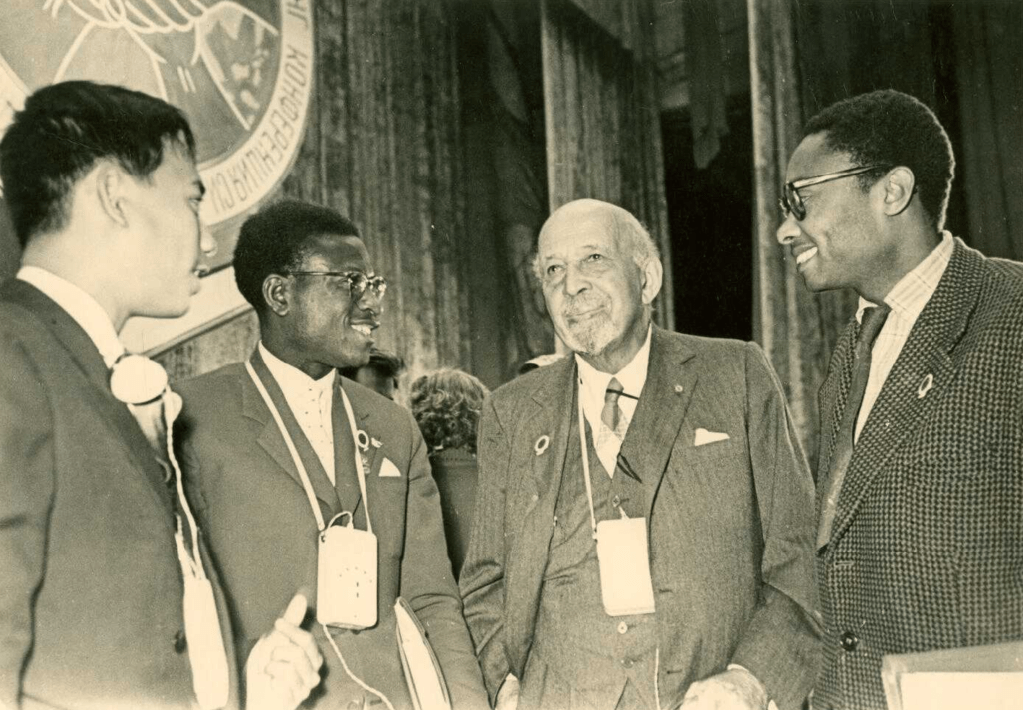
We are publishing the Vision Statement for the Saturday Free School’s research symposium, “W.E.B. Du Bois and the New World Movement of Thought: Towards a Shared Revolutionary Future,” in Philadelphia on June 24, 28-29, 2025.
W.E.B. Du Bois (1868-1963) enters the stage of world history at a new epoch of modernity, marked by the emancipation of four million Black workers from chattel slavery. He declares that the problem of the 20th century — i.e., the problem of modernity — is the problem of the Color Line. He thus identifies white supremacy as the principal obstacle in the way of the peoples of the world coming together in community and communion, working shoulder to shoulder to build a future deserving of the modern man, woman, and child. He expands the conception of modernity to include all of humanity, and particularly those millions of enslaved and colonized dark peoples of the world — now conscious, and restless to leave their mark on human thought and action in the modern world. He thus begins a New World Movement of Thought, which bends knowledge, science, and morality towards achieving the total freedom of all humanity.
In these dying days of Western civilization, when chaos presses in all around us, we turn to Du Bois for light.
Du Bois starts from the belief that knowledge is indispensable to the project of human freedom, and that the human being, who is the creator and agent of knowledge, must be studied and known in all his complexity. This requires not just science and reason, but also art — a creative and futuristic imaginary in which the human soul can find expression.
As a young man, he embarked on a project to combine history and philosophy to create the modern science of sociology, and deployed it to scientifically study Black America — the lifeworld and aspirations of those within the Veil, of whom he was bone of the bone and flesh of the flesh. In the spiritual strivings of Black folk, despised and rejected by their own countrymen, he saw a civilization in potentiality — the capacity for great beauty, art, and music that gives nobility and meaning to human life. He dared to go against the accepted wisdom of his time, boldly asserting that the historically constituted consciousness of Black folk — the Black Proletarian Imaginary — had a contribution to make to human knowledge.
Du Bois, in rooting himself in the Black poor, made an epistemic break from Western modes of knowing and thinking about the world — a transgression that rendered him persona non grata in the white world for most of the 20th century. He was attacked and trivialized; his life’s work suppressed and denied its rightful inheritance by new generations in new times. A Europe exhausted and devastated by the world wars ceded the mantle of Western civilization to the American empire, which further entrenched the Color Line and arrested the advance of knowledge and modernity by claiming both as the exclusive domain of white people.
The multifaceted crisis facing Western societies today must be seen as a crisis of Western civilization itself. The unchallenged hegemony of the U.S.-led world order is coming to an end, its legitimacy rejected by the world’s people in view of its utter failure to take humanity forward. In America, the deepening poverty, homelessness, and deaths of despair, the breakdown of communities and civil society, and the profound crisis of meaning and purpose in human lives, serve as a memento mori — signaling the death of white civilization and the standards it seeks to impose upon the world.
The mood of the nation is dark; confusion reigns in the thoughts of people. Wars and rumors of war are mirrored by inner shadows of hysteria, cynicism, and mental illness. Many of the basic assumptions we are taught to hold about the world, which give our lives coherence, are breaking apart. These are the signs, made jarringly real, of our crisis of civilization.
Nowhere is this crisis more apparent today than in the American University — a vital pillar of American Power and the de facto standard bearer of white civilization. The period of the Cold War saw the consolidation of the elite university as an indispensable instrument of the American State and its ruling elite. It exists to further the political, ideological, and military agenda of the American Empire. For 80 years the University has operated as the ultimate custodian and arbiter of all knowledge; it mirrors the medieval Catholic Church, which asserted divine authority to uphold the thousand-year reign of the Holy Roman Empire.
The University is where elite consensus is manufactured and white supremacist values codified in all streams of human thought. Its reach extends across all disciplines of the natural and social sciences. It claims the final authority on all questions of human importance — from the meaning of progress, freedom, and democracy, to a criteria for art, culture, and civilization, to justification for America’s forever wars and genocide. This consensus goes beyond America, and is championed by the westernized intelligentsia everywhere, ensuring that the world is made and remade in the image of the white man.
Last year, at our conference titled The Crisis of Knowledge & The American University, we claimed that this ideological consensus — which derives its authority not from the people or from history, but from a small minority of elites and experts — was too fragile to hold. This claim is favored by the events that have transpired between then and now. In the 2024 election, we saw the American people move decisively toward peace as they faced U.S. involvement in the Ukraine war and the Israeli genocide in Gaza. In enormous numbers, people rejected the dominant liberal consensus by voting to elect Donald Trump, who promised to end America’s forever wars.
Since assuming office, Trump has betrayed his own popular mandate and violated the will of the American people by plunging the U.S. to the brink of full-scale war against Iran. Trump will only destroy his own presidency by backing Israel and gambling with the lives of millions. The people of this nation cannot be placated by shallow rhetoric of American greatness — there remains among them a clear, insistent, and ever-growing call for peace. They know that the principal obstacle to their striving is the war-crazed ideology of the ruling elite.
The anti-elite sentiment of the American people is seen further manifest in an unprecedented lack of trust in institutions of higher education. The people have no use for the authority of experts who claim to speak for them but have nothing but contempt for them. This must be remembered when we assess the battle of elite universities like Harvard against the assault of the Trump administration. It must be said: Harvard is not engaged in a battle to defend democracy or freedom of speech — ideals incompatible with its reason for existing. Rather, Harvard and its like stand as principal bastions of Western civilization, and on trial is the West’s authority as the last word on human thought and knowledge.
The University has actively blocked the advance of knowledge, in its effort to keep humanity stranded in the epoch of Europe. Its best and most lauded theories — from string theory in physics to postmodernism and queer theory in the humanities — claim to be theories of everything, but explain nothing of the real world. It has nothing to offer to a young person who seeks to know the world, and to take responsibility for it. The only future that he or she can be promised is to become part of the ruling elite, who represent a dying civilizational ideal. The University is responsible for the cultural, moral, and cognitive manipulation of generations of young people, which is perhaps the most unforgivable of its crimes.
This should make us ask, is there any redemption for the American University? Why should it be defended? And since it is now clear that the University cannot take us forward, where should we turn for knowledge and science that can explain the world and its people, unmediated by the West?
In a time when humanity is more conscious of itself than ever before, it is the struggle of ideas which alone can take human knowledge and civilization forward. This research symposium is our optimistic contribution to that ideological struggle. We see ourselves as inheritors of Du Bois’s World Movement of Thought, and call on all American revolutionaries to join us in giving it new life in our times. Witnessing the collapse of Europe after World War II and the Great Depression, Du Bois sought an explanation in the history and philosophical assumptions of modern European civilization. Today, when the last flagbearer of Western civilization — the American State — is in collapse, we must choose to walk in Du Bois’s footsteps or condemn ourselves to the wrecking heap of history.
Du Bois did not reject modernity. Rather, he exposed how the need to justify slavery and colonialism corrupted Western knowledge and science. He demonstrated that the modern industrial world was built on the back of the Black worker — not a slave of antiquity, but an enslaved proletariat who possessed untold agency to alter the course of history. He saw the world in its movement and possibilities, laying the foundation for a new social science which sought not just laws of human development, but probed the realm of chance, the capacities of human action to defy laws.
Thus he saw that the great moral and philosophical questions facing the modern world could only be answered by dark humanity, overcoming the assumptions of white supremacy. Rather than a clash of civilizations, he championed dialogue and ideological exchange among civilizations. He remained in close contact with the anti-colonial struggles of Asia and Africa, and the world communist and peace movements. Ignored and trivialized in the West, Du Bois was embraced by the world’s peoples for his contributions to human knowledge and freedom, and the struggle for colored modernity.
The Du Boisian epistemology, rooted in the consciousness of the Black proletariat, explains the Chinese revolution, the Indian freedom struggle, and the national liberation struggles of Africa with a completeness that Marxism Leninism — arguably the most advanced of European revolutionary thought — cannot. It allows us to see the universal strivings that connect Afro-Asia to Afro-America in their shared struggle against a white supremacist world order, which is as much a struggle to create new human beings, new standards of human life, and new criteria for knowledge and civilization. It explains dark humanity’s great mobilization for peace in the 20th and 21st century: recognizing peace as the concrete democratic demand of a new stage of modernity, peace as inseparable from freedom, peace as the prerequisite for the full flowering of human genius and potential everywhere. All this, in turn, casts light on the heaving thoughts and hearts of the discontented, war-weary masses in America today.
Du Bois was indicted as an agent of the Soviet Union, and barred from traveling abroad, for daring to take a stand for peace in the McCarthy era. This would make him say, “Blessed are the peacemakers, for they shall be called communists.” Today, without the Soviet Union, the white left has conveniently reclaimed the flag of communism while becoming essentially indistinguishable in their ideology from the American ruling elite. Therefore, it has become acceptable, and in fact fashionable to invoke Du Bois in our times, but for an entirely counter-revolutionary purpose.
There is a redoubled effort by academics and leftists to reduce Du Bois to a harmless academic and use him to re-inscribe the Color Line by pushing fraudulent narratives of Black history in the name of postmodernism and Afrocentrism. This attempt to strip his life’s work of its revolutionary edge and from Peace is in service of producing counter-revolutionaries who perform radicalism, but are well adjusted to war, who do not know Du Bois or the people, and for whom Peace is merely an abstract talking point. We reject these attempts to distort Du Bois; we claim him as a hero for humanity, one whose ideas have given birth to a vast and growing all-humanity struggle for peace, freedom, and democracy.
Ideas are the most powerful weapon for a revolutionary, and the struggle for knowledge and philosophy in our time is a revolutionary political task. We must carve, out of the chaos of Western civilization, a new revolutionary epistemology that reveals in all its glory the breaking light of a new dawn — the epoch of humanity. This great experiment will not be conducted by academics and experts in the elite university. It will involve the creative participation of the world’s billions who are coming into their own and are ready to take up the revolutionary, democratic, and emancipatory struggle for a shared human future.
We call upon all people of conscience, artists, students, youth, and children to join us in treading new regions of thought — to seek, as Du Bois did, a new heaven and a new earth. Let us come awake to the spirit of our age.
 Avant-Garde: A Journal of Peace, Democracy, and Science
Leave a comment