
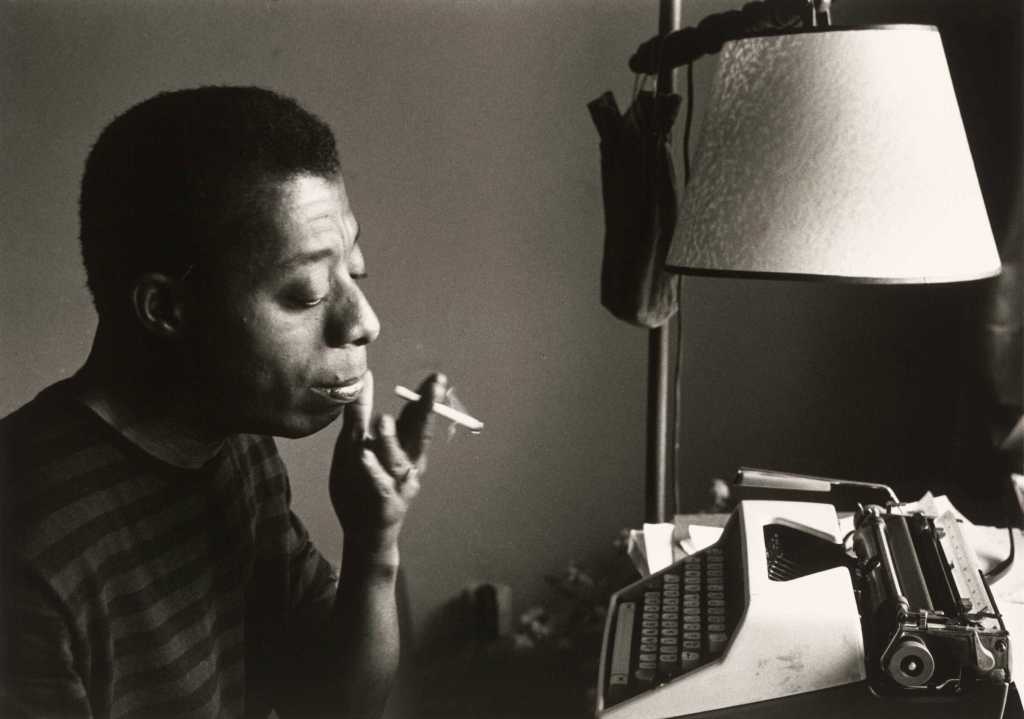
A complete century has passed since the birth of James Arthur Baldwin on August 2nd, 1924 in Harlem. We dedicate the Third Issue of Avant-Garde to Baldwin with the conviction that the next 100 years—the lives of our children, and our children’s children—may well be defined by his ideas, philosophy, language, and vision of our human future.
James Baldwin was a revolutionary. And not only for his time, but for ours: he sets the standard as an indispensable revolutionary thinker for the 21st century. For those who travel the road in search of profound social change, Baldwin is inescapable.
Small wonder, then, that the ruling class of this country is intent upon dominating the discourse surrounding Baldwin in this year of his centenary. By repackaging him as a fashionable commodity to fill five-minute television segments, they aim to destroy Baldwin and consign him to irrelevance in an imagined past. To this are added efforts to fabricate an image of Baldwin in the mold of a “queer writer,” an empty vessel for postmodern identity politics which emanate from elite cultural institutions.
As a seer of the American revolutionary process and a towering philosopher of freedom and consciousness, Baldwin is unknown and unwanted by career intellectuals, bourgeois liberals, and the Marxist Left alike. He is, however, fully known and loved by the people who produced him: the Black proletariat. He remains a prophet of, and for, the Black poor.
Indeed, Baldwin saw himself as a native son of the Black proletariat, an inheritor of his people’s journey from slavery to Emancipation and Reconstruction, through Jim Crow and the Great Migration. This chronology imbued Baldwin—as it did W.E.B. Du Bois, Paul Robeson, Langston Hughes, Lorraine Hansberry, Charles White, Diane Nash, James Lawson, and many others—with a unique vision into the lifeworld of Black folk, and further: into the vast human problem of America’s white supremacist social system.
Armed with this knowledge, Baldwin strode into the crucible of the Civil Rights Movement. As nonviolent armies waged pitched battles across the South and North to transform the public square and penetrate the human heart, so too did he force a rupture in the nation’s consciousness: to show white Americans how desperately they were imprisoned by whiteness—a false identity trapped in its own creation of the “inferior” Black race.
Baldwin knew the private lives of his countrymen, Black and white. He laid bare how white supremacy suffocates the democratic capacity of our citizenry, rendering us helplessly dependent upon a murderous regime of laws and myths to give us an infantile sense of reality—shielded from Black suffering, protected from the darker hordes massing at the empire’s gates. Today, Baldwin’s interrogation of white modernity, of the U.S. state and its pretensions of democracy, must be treated as a theoretical innovation in revolutionary science.
He emerged as God’s Revolutionary Voice in the wilderness of American society, bearing witness to the coming of a new people. He spoke of America becoming the Last White Nation: the last great empire, the final standard bearer of the Western epoch, and the bridge leading to far greater democratic vistas—toward a civilization of peace.
The battle over James Baldwin is thus a battle between the people’s consciousness and the ideology of the ruling elite. It is furthermore a battle for peace and the possibilities of revolutionary change.
In America and throughout our world, a titanic struggle is now taking place between the old and the new. These are dark days. Clouds of war gather, strike, and kill in Gaza; still greater storms of world war loom on the horizon. Humanity stands aghast at the depravity of Western civilization, whose principal representatives—the American ruling elite and their Zionist accomplices—would precipitate Armageddon in their desperate attempt to hold on to power, to hold back time itself.
Domestically, the United States hangs on the edge of several possibilities: the chasm of civil war, an unending night of prolonged social chaos, or revolutionary change. The American people see their nation in decline; they see and feel suffering everywhere; and in their overwhelming majority, they see their rulers and institutions as totally bankrupt. For the white poor, the wages of whiteness no longer pay as they once did. For the Black poor, the air stings and bleeds with an even more painful sense of betrayal.
No amount of propaganda can disguise the fact that the American empire’s hurtling path toward cataclysm and ruin could, in the end, bring the death of the American nation itself.
Here lies the crisis of our time. And it is for this crisis that Baldwin offers answers. For him, the role of the artist was the task of the revolutionary: to reveal the beloved to themselves. Alongside Martin Luther King Jr., James Baldwin matters today because he reveals to the people their own role as makers of history.
Who will take responsibility for this country and its future? Who will deliver our children from the jaws of a society designed to kill them? Baldwin clarifies the moral choice that compels each of us to say, with full faith: I will.
Far beneath the hulking spectacle of any electoral machine, he insisted that true democracy begins in the moral standards to which we hold ourselves. It begins when the despised and discontented realize that the battle of ideas—the scale of the future—belongs to them to decide. It begins, for instance, when a people says they will not pledge allegiance to a political party that proposes “Black freedom” is compatible with war, immiseration, and genocide.
Such is the spirit that fills the Year of James Baldwin: God’s Revolutionary Voice, the year-long crusade from which this Issue springs. With Baldwin as their meeting ground, the people of Philadelphia and other cities are discovering each other anew—are discovering their common destiny as inheritors of that revolution for which Baldwin stood. If we are to survive the storms ahead, if we are to renew ourselves as a people, it is the values of the Third American Revolution that will take us through.
This was a new type of revolution; it crystallized and birthed new understandings about human beings and their capacity for struggle. We have not yet unearthed the full weight and potential of our inheritance. Yet we do know this: Baldwin, equally with King and all the pioneers of the Black Freedom Movement, devoted his life to Love as the revolutionary antidote to transform an inhuman social order. That work, as Baldwin wrote, is not yet finished.
By the light of these agonizing hours, we pick up the mantle of James Baldwin: for he pierced through the human dimensions of our American problem and spoke, in the clearest terms, to mankind’s ongoing quest for freedom. He went to the mountaintop, and we seek to join him there. He is every one of us. Through Baldwin, we press forward into new regions of revolutionary thought.
Mark the time: James Baldwin lives; he breathes; he speaks again.
Avant-Garde, Issue 3
November 2024
 Avant-Garde: A Journal of Peace, Democracy, and Science
Leave a comment