
By Purba Chatterjee and Emily Dong.
On August 2, 2024, to celebrate James Baldwin on his hundredth birth anniversary, the Saturday Free School for Philosophy and Black Liberation premiered an original documentary titled “To Fulfill the Unfulfilled, to Answer the Unanswered: The Revolutionary James Baldwin.” The documentary strives to relocate James Baldwin—the Man and the Revolutionary—in the struggle that forged him, and clarify his role in our time as an indispensable theorist and philosopher for the American revolutionary process.
This clarification is timely, coming at an urgent moment when there is an ideological battle being waged by the ruling elite to redefine and narrow Baldwin’s legacy, and sever him from the Black Freedom Movement. This project attempts to reinvent Baldwin as a queer cultural icon for the ruling elite, for whom race and sexuality are mere identity categories, despite Baldwin himself never having identified as such. It separates him from the Black poor, whose suffering and whose right to freedom and dignity are at the center of his concern. What is deeply unfortunate is that some Black intellectuals are complicit in this attempt to assassinate Baldwin a hundred years after his birth by distorting his place in history and obscuring the substance of his message for our times.
The documentary establishes Baldwin, first and foremost, as a Revolutionary Black Man—inseparable from Martin Luther King Jr. and the Black Freedom Movement—who saw himself as a witness and freedom fighter in the struggle to transform the American people. Importantly, the documentary makes the assertion that in order to see Baldwin as a revolutionary theorist and philosopher, it is essential to identify the historical chronology that leads to his art, novels, essays, poems, plays, and theorizing.

By chronology, we mean a logic of historical development that informs theory and practice for one who enters the stage of history as an agent of change and freedom. Most people believe that America is the “land of freedom” founded by the bourgeois revolution of 1776 from British tyranny. Liberals believe that this bourgeois revolution achieved freedom and defend the Constitution which codified individual rights. Many other people who believe that there remains an unfinished task to defeat oppression and inequality in American society, from progressives to democratic socialists and leftists, say the only revolutionary possibility in America is a socialist restructuring of the state and society. Their chronology begins with the European revolutions of 1848, and is carried forward by the thought of Karl Marx and V.I. Lenin, which asserts that all history is the history of the class struggle.
In contrast, Baldwin’s chronology begins at the auction block with the enslaved proletariat—“the demolition, by Europe, of all human standards.” His revolutionary thinking goes back to Frederick Douglass and the anti-slavery struggle, to the defeat of Reconstruction—the second American revolution—necessitating a third American Revolution: the Black Freedom Movement of the ‘50s through the ‘70s. This chronology articulates the historically constituted consciousness of Black folk, grounded in the understanding that the American democratic revolution had failed them. It holds up to light the unanswered questions that Baldwin asks time and again through his writings: How is it that slavery ended, but Black people are not yet free? However, he asked the additional question, which is: Are white people free, if Black people are unfree?
The nation is in one of the deepest crises of its history. There are those among the ruling elite, academicians, and public intellectuals, who seek to give Baldwin an identity which he never claimed. The modern LGBTQ movement, rather than take up the mantle of Baldwin, has adopted ideas and strategies that diminish Baldwin and the struggle against white supremacy.
This calls for a reassessment of what freedom means and has meant in America, as well as what it can be made to mean through a people’s democratic revolution. At the same time, it is important to take a cold hard look at the queer movement, the freedom it offers, and what it says about whiteness and love. James Arthur Baldwin offers revolutionary answers to these questions by centering them on the Black poor, their great capacity for love and struggle, and the unfulfilled promise of the Black freedom movement.
Freedom
People in America believe that freedom is an individual’s ability, with all of one’s protected rights, to pursue and achieve the American Dream. In his 1965 debate with William Buckley, Baldwin dissects this assumption, asking: How can we in the West assume there is an American Dream, when one-ninth of the population has been excluded from it for four hundred years? If only white people, and most immigrants today, can materially achieve the American Dream while Black folk on the whole cannot, what is the price of this dream?
Baldwin contends that the great shock for a Black person was not his individual disaffection, demoralization, and impoverishment, but the realization that generation after generation, a whole people would suffer the same way with no way out:
“You are thirty by now, and nothing you have done has helped you escape the trap. But what is worse than that, is that nothing you have done, and as far as you can tell, nothing you can do, will save your son or your daughter from meeting the same disaster and not impossibly coming to the same end.”
Buckley’s answer to Baldwin represents the prevalent worldview of Americans to this day. For Buckley, the problem lies, not in the assumption of the American Dream, but in Black people. To him, their failure to climb up the ladder to the American Dream must be a mark of their own inferiority, for which the American Republic bears no responsibility. Thus, the condition of Black people in this country is a “Negro problem,” rather than a crisis and responsibility of all of America. This assumption is so entrenched in the consciousness of ordinary Americans that it becomes absolutely crucial to dismantle it in order to clearly see what freedom the American people will have to fight for today, and how.
The American State, founded by the revolutionary overthrow of British tyranny, was one of the world’s first modern “democracies” based upon the values of the European Enlightenment and a liberal political philosophy going back to John Locke. Locke proposed that men in nature have perfect freedom with God-given natural rights. Men give up some of their natural rights to leave nature and live in civil society, granting the State a common authority to protect the individual’s right to life, liberty, and prosperity. This is the social contract which is supposed to legitimize the American State and liberal democracy up till today, and the illusion that the citizen subject has certain inalienable freedoms protected under the Constitution.
However, this social contract was never guaranteed to Black people, even after Emancipation granted them limited citizenship rights. Although slavery was abolished, Black people were still denied the right to life, liberty, and the pursuit of happiness which citizenship under democracy promised. Baldwin describes this in his debate with Buckley: “It comes as a great shock around the age of five or six or seven to discover the flag to which you have pledged allegiance, along with everybody else, has not pledged allegiance to you.”
How has an idea such as the American Dream, which fails to explain the reality of Black folk, persisted? There exists an entire social system constructed on the principles of white supremacy which reproduces Black oppression over historical time through law, modes of production, institutions, ideas, and values. By treating Black people as a separate and inferior class of citizens, the American social contract does not seem contradictory to Democracy. Significantly, after Emancipation, the 1896 U.S. Supreme Court ruling in Plessy v. Ferguson made segregation constitutional and thereby granted legal protection to whiteness as a category. This codified the second-class citizenship of Black people.
The existence of a white supremacist social system, which must be surmounted, is the reason why—after the Emancipation Proclamation abolished slavery, Brown v. Board of Education desegregated schools, and the Civil Rights Movement successfully forced the passing of the 1964 Civil Rights Act and 1965 Voting Rights Act—Black people are still not free. There is still an unbending inequality that overdetermines the condition of a whole people, despite individual cases of economic success. One sinister manifestation is the disproportionate imprisonment of Black people, especially Black men; one-third of people in prison are Black, although only 13 percent of the population is Black. One in three Black men who are 40 years old today have either been to prison, are in prison, or will be in their lifetime. Almost half of the people serving life, life without parole, or “virtual life” sentences are Black. Thus prisons operate not to serve justice, or rehabilitate, but to remove and separate Black men from white society.
White people can choose to move to the suburbs or afford to send their children to private schools, while Black children fill “inner city” public schools. As long as it is Black children in those public schools, the schools will stay underfunded, understaffed, and at the bottom of the priority list. As long as it is Black children who are dying in the city’s streets, the city will not make it an imperative—until the problem affects white people past their threshold of comfort and safety. As long as Black people can be separated from society, society and white people feel no need to take responsibility for Black neighborhoods, schools, children, and lives.
The mechanisms of control of the white supremacist social system have evolved with time to preserve the myth of whiteness. Yet, today as at the time of its conception, it serves the singular purpose of ensuring that most Black people will never rise, always be excluded, and always be poor. Most liberals, social democrats, and leftists have no answers for this conundrum. Many believe socialism is the only solution, ignoring that the oppression of Black people is not only desired but necessary for the white supremacist social system. For as long as there is a bottom, defined by Black people, there can be the myth of progress in the U.S. Rather than the success of society being defined by the state of life, liberty, and opportunity for a whole American people, success is defined by “mobility”—which in essence comes down to the distance between you and Black people.
Twenty generations of Black people in poverty and failing to achieve the American Dream is proof that the American Dream is a lie, and its standards are not worthy of the American people. Baldwin continues that not only is the American Dream a lie, but the American Dream is predicated on the racial exclusion and oppression of Black people. White people had to invent the myth of white supremacy and a fake sense of reality based upon Black inferiority in order to justify this exclusion, even though—ironically, as Baldwin points out—this country, North and South, was built by Black people through the enslavement and exploitation of Black labor. The white supremacist social system ensures that the “inalienable rights” at the crux of liberal democracy only extend to the white individual’s rights to life, liberty, and prosperity, while Black folk perish in modern day ghettos.
Today, there are growing numbers of white poor people whose situation has never been more similar to that of the Black poor. This is the first time that the white poor are realizing that American democracy has failed them, too. The myth of bourgeois freedom is closer to failing in our time than ever before, which is why the ruling elite must invent a new way of reinforcing the myth. Immigrants from Asia, Africa, and Latin America are increasingly being used by the ruling elite to validate liberal democracy’s success and mask white supremacy with a multicultural face. Immigrants can purchase access to the social contract and individual freedoms which Black folk are excluded from, what Baldwin called the price of the ticket: buying into the white sense of reality. This sense of reality convinces immigrants that America, over their own civilization and homeland, is the land of freedom and opportunity, because by subscribing to the standards of whiteness they can achieve the American Dream. Asian immigrants in particular can achieve more economic success in a single generation than African Americans have been able to for centuries.
Immigrants may choose to believe that this is the land of freedom and opportunity. It may be for them but certainly will never be for Black people. By choosing whiteness, they are consenting to upholding an unjust social system and are morally complicit in the reproduction of Black oppression. The question which faces the American people, especially immigrants today, is whether your so-called freedom, predicated on your human brothers’ and sisters’ generational suffering, is worth it. That is the moral and revolutionary choice before the American people.

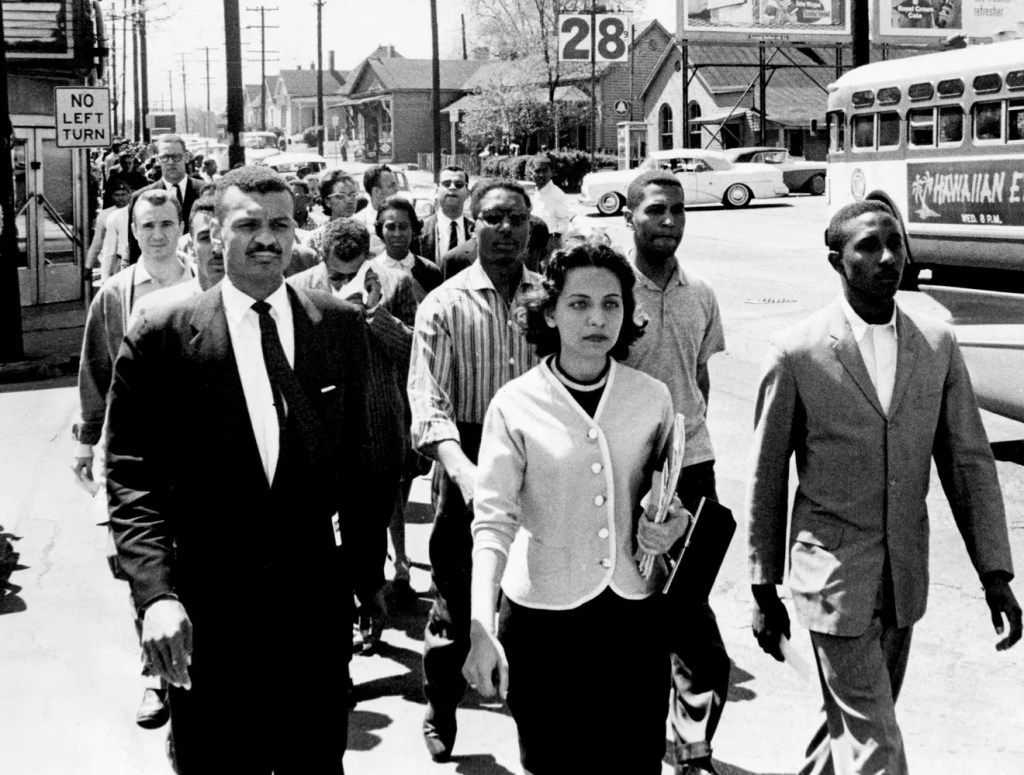
Left: Selma-to-Montgomery March for Voting Rights, 1965. Photo by Matt Herron. Right: Diane Nash and the Nashville Student Movement, 1960. Photo by Jack Corn, The Tennessean.
Baldwin rejected bourgeois freedom. For Baldwin, this Anglo-Saxon construal of freedom was insufficient to answer any questions about the future of his people and fulfill emancipatory democracy. For Baldwin, there was only revolutionary freedom. If the protection of “freedoms” in this society depends on the oppression, unfreedom, and suffering of Black people, the only real freedom is the freedom to change society.
It is important to recognize that what the American State does to Black people at home is the same thing it does to the dark billions abroad through neo-colonial exploitation and war. As Baldwin says,
“When Americans look out on the world, they see nothing but dark and menacing strangers who appear to have no sense of rhythm at all, nor any respect or affection for white people; and white Americans really do not know what to make of all this, except to increase the defense budget… When the American people, Nixon’s no-longer-silent majority, revile the Haitian, Cuban, Turk, Palestinian, Iranian, they are really cursing the nigger, and the nigger had better know it.”
This is how the American State’s unabashed support for Israel’s genocidal war on Gaza has to be seen: as a war in defense of white supremacy. Baldwin makes it clear that the “compulsive American dream of genocide” starts with the systematic destruction of Black folk. For Black folk, there is no such thing as individual freedom without the fight for the collective freedom of Black people. Thus, Baldwin would say that it was impossible to create “a separate peace” and that, “In America, I was free only in battle, never free to rest—and he who finds no way to rest cannot long survive the battle.” The task is for all Americans to adopt this definition of freedom—that no individual can be free for as long as society is unfree from white supremacy.
Thus, Black people have historically been at the vanguard of the struggle for freedom in America and as part of the world anti-colonial and freedom movements. Ironically, as Baldwin notes, it is Black folk, the oppressed and disinherited, who are the most free and inject new meaning into freedom. On the other hand, it is white folk who are the most unfree and must be helped through struggle to shed their ideological chains of white supremacy:
“It is not a question of whether they are going to give me any freedom. I am going to take my freedom. That problem is resolved. The real problem is the price. Not the price I will pay, but the price the country will pay. The price a white woman, man, boy, and girl will have to pay in themselves before they look on me as another human being. This metamorphosis is what we are driving toward, because without that we will perish—indeed, we are almost perishing now.”
Love, Identity & The Black Man
Celebrations centered around Baldwin’s 100th birthday at the New York Public Library, Schomburg Center, National Portrait Gallery, and National Museum of African American History and Culture expose a reinvigorated effort on the part of the ruling elite to repackage Baldwin as a voice of the LGBTQ movement. This portrayal of Baldwin as a “fragile queer black man,” traumatized by homophobia and unfree in his own lifetime, finally allowed to be “free” by the liberal intellectual in ours, is a grotesque project that trivializes Baldwin and disappears him from any serious investigation into the American crisis and its resolution. It is essential to investigate the agenda behind this ideological move and who it ultimately serves.
Firstly, the ruling elites’ need to “queer” Baldwin stems from the danger he poses to them as a revolutionary Black man. Denied human dignity and any claim to his women or children in the time of chattel slavery, brutalized and lynched in the Jim Crow South, and today as the most impoverished, disproportionately incarcerated, and reviled of American citizens, the Black man in America has found himself in constant battle with the white supremacist social system. Baldwin holds up to light this criminal conspiracy mounted by white society to emasculate and debase the Black man—lest he forget his place. He argues that no matter the method employed, “the fact of the castration [of the Negro] is an American fact.”

In conversations with Nikki Giovanni and Audre Lorde, Baldwin categorically rejects the feminist narrative characterizing Black men as abusive, misogynistic, and the principal cause for the misfortunes of Black women. He argues that while generations of injustice, indignity, and the denial of his manhood can stir rage and hatred in the Black man so potent that it often turns against him and his own, one can never lose sight of the fact that his condition is the intended outcome of an unjust social system that seeks to destroy him, and in the process destroy the Black woman, the Black child, and the Black family. In a letter to his 14 year old nephew, he insists that “it is not permissible that the authors of devastation should also be innocent. It is the innocence which constitutes the crime.” He urges his young nephew, on the brink of manhood, to never believe what white society said he was or could become, and trust instead the evidence of his own experience.
Baldwin speaks as a Black man who had been “carried into precinct basements often enough” to know that “every black man walking in this country pays a tremendous price for walking.” He had to leave America for Paris, not because he was queer, but because he was a Black man in mortal danger in the streets of Harlem. It is precisely his testimony as a Black man—forced to snatch his manhood and identity from the grasp of a criminal system and recreate himself on the basis of morality and a personal authority—that makes Baldwin invaluable for the American future. To celebrate him as a revolutionary Black man calls for a reckoning with the assumptions and attitudes that white Americans have conveniently hidden behind for so long. This of course, the ruling elite is not prepared to do.
Secondly, queering Baldwin is an attempt to create a false equivalence between Black suffering and queerness, and establish “queer resistance” as the logical successor of the Civil Rights Movement. There can be no equivalence—actual or moral—between the queer movement and the Black Freedom Movement. Queerness as a political movement derives its legitimacy from postmodern theory and its emphasis on the individual identity as the mediator of Truth, and the basis for all human social relationships. It aspires to a narrow bourgeois freedom for the individual to be accepted within society, but is unconcerned with the revolutionary emancipation of the people: freedom from poverty, indignity, and injustice. Ultimately, this is a default to Locke, and the supremacy of the individual over the human.
In an interview with Richard Goldstein, Baldwin argues, “The sexual question comes after the question of color… I think white gay people feel cheated because they were born, in principle, into a society in which they were supposed to be safe.” This stark inequality in the expectations of Black and white people from American society helps contextualize queerness within a white supremacist social system. The ideological framework of the queer movement embodies whiteness in its abdication of the moral responsibility to transform society, choosing instead to reach for decadence and personal safety within the confines of an unjust order. In a social system that protects whiteness, queerness is therefore a protected political identity.
Baldwin saw gender and sexual identity as part of the complexity of the universal human condition, but never as overdetermining the basis of human relationships. Sexual preference and love are not synonymous, and “only by becoming inhuman can the human being pretend that [sexuality and love] are.” Consider Giovanni’s Room, misrepresented in liberal discourse as a queer romance, and used among other arguments to justify the characterization of Baldwin as a queer author. Baldwin made it clear that Giovanni’s Room was not about homosexuality at all, but about what happens to someone if they cannot love anybody—man or woman. The inability to love makes one dangerous, because “you have no way of learning humility, no way of learning that other people suffer, and no way of learning how to use your suffering and theirs to get from one place to another.”
Love, for Baldwin, is the richest expression of the human striving to be fully human. Even romantic or sexual love for him is an opening—“a bondage which liberates you into something of the glory and suffering of the world.” He gave voice to the deepest implications of Black suffering, but also to the great capacity for beauty and love that came from the same source. Love was not a wish but a necessity for Black folk, to reclaim their humanity in the face of cruelty, and to strengthen the children against a loveless world that would attempt to destroy them. Baldwin says to his nephew, “if we had not loved each other none of us would have survived. And now you must survive because we love you, and for the sake of your children and your children’s children.”
In contrast, Baldwin saw whiteness as an anti-love and anti-human impulse—predicated as it is on the creation and then the subjugation of an inferior “other”—and therefore a moral choice that no American is compelled to make. By choosing whiteness, the white individual cuts himself off from broader humanity, and thereby surrenders his capacity to love and to achieve his own human possibilities. Baldwin believed that by choosing to exalt whiteness at the expense of the human being, American society had become profoundly loveless. Reflecting on the growing obsession with sexual identity in his time, Baldwin writes, “I am not certain, therefore, that the present sexual revolution is either sexual or a revolution. It strikes me as a reaction to the spiritual famine of American life.”
The highest stage of love for Baldwin is revolutionary love for humanity, which allows you to see yourself in another person and recognize that justice and freedom for one cannot be achieved without justice and freedom for all. In its heroic struggle to transform America, the Black Freedom Movement’s moral anchor was revolutionary love. Martin Luther King Jr., the great leader of the Third American Revolution, saw nonviolence as the truest expression of God’s love for all his children. For him, as for Baldwin, revolutionary love was the only antidote to the hate and division codified by a white supremacist social system destroying the humanity of Black and white folk alike.
The Last White Nation and Achieving Our Nation
Baldwin is not the voice of queer resistance, he is a revolutionary Black man with a message for our times. The postmodern capture of Baldwin by the queer movement is an insult to his deep and uncompromising commitment to the project of Black freedom, and to the revolutionary remaking of the American people. Equally unconscionable is the attempt to narrow his broad and liberatory vision of love into a narcissistic endeavor mediated by individual identity. These ideological positions must be recognized for what they are—an attack on the consciousness and revolutionary capacity of the people. The revolutionary James Baldwin must be excavated from the narrative hegemony of the ruling elite and restored to his rightful place in the struggle for human freedom.
The Black Freedom Movement fought, not just for equal citizenship and voting rights for Black people, but to radically transform American society by removing the basis of historic injustices against Black people, which is the myth of white supremacy. It saw itself as part of the world anti-colonial and peace movements—an articulation of dark humanity’s rejection of the values and standards of a white supremacist world order. King’s calls for a revolution of values is the call for the American people to break the cycle of the triple evils of racism, poverty, and war.

Baldwin helps us see that the future of the American revolutionary process lies in taking up the unfinished project of the Black Freedom movement. This calls for the undoing of ideas and values which reproduce whiteness and mediate human social relationships in America, i.e. the white supremacist social system. Baldwin asserts that white people, such as Buckley, who believed they were freed by liberal democracy, are prisoners in a house of bondage of their own making. They will remain unfree until they recognize that their freedom and future are intertwined with the freedom of Black folk and darker peoples of the world.
The Democratic Party claims to be the party of Black people and inheritor of the Black Freedom Movement, but defends the same unjust system and assumptions that the Black Freedom Struggle showed were bankrupt. The Democratic Party promises to protect one’s reproductive rights, the freedom “to love who you love,” freedom from fascism, all the while sending 2,000 pound bombs to Israel to murder Palestinian mothers and children. To immigrants, and a section of the Black middle and upper-middle class, it offers a seat at the welcome table with the ruling elite, on the condition of assimilating into and apologizing for the white supremacist social system. This requires them to turn their eyes away from the genocide in Gaza and from the long, continuing genocide of Black people at home, one child at a time.
Social democrats like Bernie Sanders, Alexandria Ocasio-Cortez, and United Auto Workers President Shawn Fain only go as far as proposing reforms within the white supremacist social system—to better hide its actual aims and ideologies—but never a revolutionary and epistemic break from it. Hence, their unconditional endorsement of the Democratic Party.
Freedom and Democracy have for too long been treated as mere talking points by the ruling elite of this country. Baldwin makes clear the revolutionary role of Black folk—especially the Black poor: not simply as an identity category to be pandered to by liberals and politicians, but as a world historic people who have been at the vanguard of colored modernity and the struggle against white supremacy. He presents all Americans, white Americans in particular, with the moral choice to reject whiteness in favor of a personal, human authority that reconnects them to their Black brothers and sisters, and, through them, to the world’s dark billions. Baldwin says this moral choice is the revolutionary choice. Finally, he leads us to locate the revolutionary task of our time as the struggle to make America the last white country—a condition to achieve a new civilization, a new political system, and a new economic system—and produce a new American People in the process.
 Avant-Garde: A Journal of Peace, Democracy, and Science
Leave a comment