
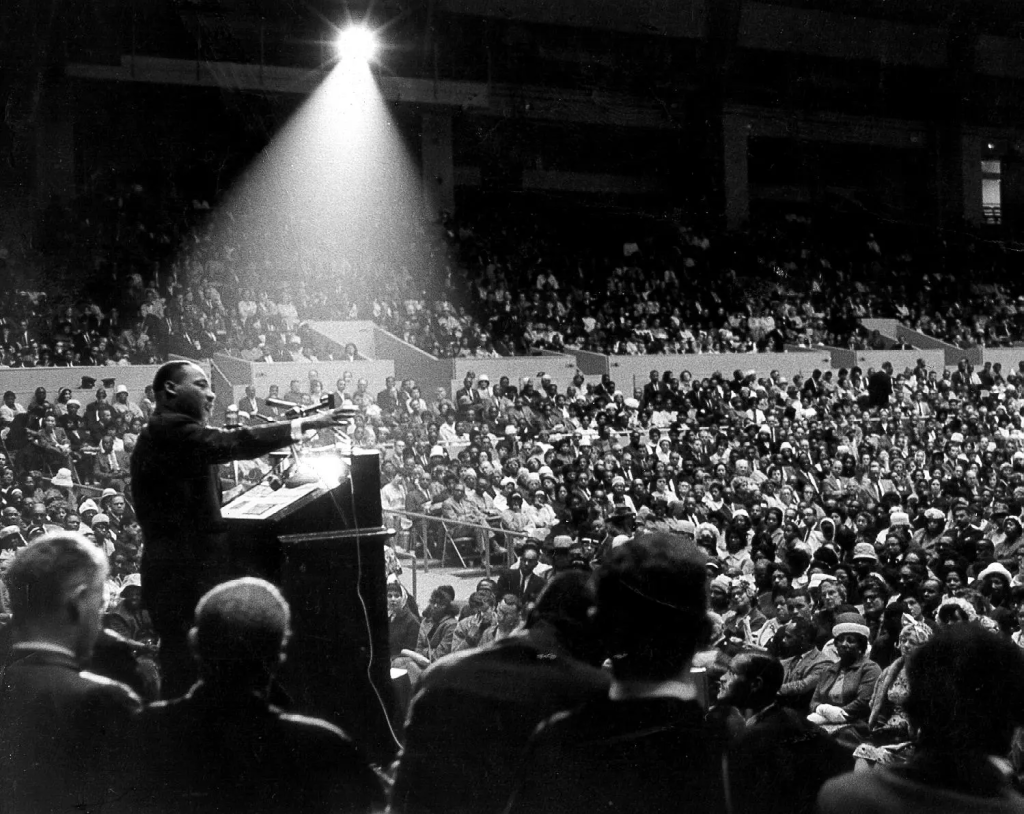
We are publishing a transcript of Dr. Anthony Monteiro’s opening remarks from the Saturday Free School’s December 9, 2023 session on The Year of James Baldwin and Deepening U.S. Political Crisis. The Free School meets every Saturday at 10:30 AM, and is streamed live on Facebook and YouTube.
Good morning everybody, it’s so good to be here. I want to first start with what is apparent to the world; that for the first time in America’s history, it is facing a crisis the magnitude of which is so profound that it looks almost existential for the ruling class of this country.
And the ruling class is acting as though it was so, even if most people on the Left do not understand it. And we’ll return to this concept of the Left, which is a self-definition by those who claim a certain “politics.” But a self-definition that has no relationship to the objective world and to the movement of humanity.
This is a really unprecedented crisis. And it is, I would say, irreversible. We are now in uncharted territory. We are on the cusp of, in the nation, a profound political realignment—Jeremiah will help us work through a very important essay that appeared in the Washington Post last Sunday by one of the most important ideologues of the ruling class, Robert Kagan. And probably we’ll talk a little bit about essays recently by Ed Luce in The Financial Times and this whole edition of The Atlantic dedicated to what they are calling the onset of a dictatorship in the United States.
The ruling class has pretty much conceded that Trump will be the next president. As we know in the Free School, we don’t see that as the worst of all possibilities. In fact for us the re-election of Biden would be the worst event, because it would continue the trajectory towards world war.
That having been said, all eyes in the world are upon Gaza and the Palestinian people. And there’s no human being with an ounce of moral integrity who does not feel the suffering of the Gazan people, especially the children; the infant Shahid, these martyrs for humanity. The bad news is the suffering. The good news is that the Israelis are being defeated on the ground in Gaza. The tactics of asymmetric warfare dating back, of course, to the Chinese Revolution and Mao’s concept of people’s war, further implemented in Korea by the forces led by Kim Il-Sung.
And then of course, probably the best known of these forms of warfare, the Vietnamese people. Who defeated the most powerful military on the planet at that time. And they did defeat them. The United States did not just withdraw, they were defeated. And it was an ignominious defeat; I’ll put it that way.
The world—and perhaps we can say that the world after October 7th suddenly became a different world, politically. Quickly, what we saw only in embryo, was crystallized. That is to say these new alliances, what we in the Free School call the Afro-Asiatic reconstitution of humanity. You know, it kind of first became apparent this year with the Iran-Saudi Arabia rapprochement. Which was brokered, by the way, by China—which had never been a player in Western Asia. I don’t think ever, in its long 5,000 year history.
It always looked upon itself as the Middle Kingdom. And in that sense it was never imperialist, because it said the world would come to it. It did not need to capture the world. And that knowledge, and science, and the printing press, and other things; where China felt itself to be the Middle Kingdom. But suddenly China is a major player in Western Asia, called by the British the “Middle East,” and it brokered this historic deal.
But then that deal becomes the center of something even deeper. Because both Iran and Saudi Arabia applied for, and are now members, of the BRICS nations. I think Saudi Arabia is applying for membership in the Shanghai Cooperation Organization. I believe that both nations are part of China’s Belt and Road Initiative, which links the world [through] maritime, [and also] through land rails and roads and infrastructure—a new Silk Road.
In the modern period, the meaning of this is attempted to be trivialized by Western politicians and think tanks, while at the same time quivering in their boots, recognizing what all of this means: a new world economy centered upon China and Asia, and not upon the United States and Europe.
Then this thing of Vladimir Putin. Just this week, traveling to the UAE, the United Arab Emirates, and Saudi Arabia. And being received in the most spectacular manner, where neither Biden nor Kamala Harris or Blinken or any of them would be welcomed. This is so important because it’s, you know—as I always thought, to look at Russia as anything but an Asian nation would be to misconceive it. It is an Asian nation; all you have to do is go there.
I was there when it was the Soviet Union. It is more Asian than European. They say “Eurasian” nation, but it’s Asian. In fact, the Russian language is a combination of Asian and, not European so much as Eastern European languages—that’s what we mean when we talk about the Slavic language groups.
Russia as an Asian nation. Bound strategically to China, the major Asian economic and military power. But then bound to Iran and North Korea. Well, I mean like they say, this is a beautiful thing. Or as they say in Philadelphia, “It’s a beautiful thang.” It’s a beautiful thing to observe this transition. Then, the alliance of Arab nations. Augmented by the Organization of Islamic Cooperation, which meant jointly, condemning the United States and Israel.
Israel is losing on the ground in Gaza. It will lose if the war is widened. It cannot defeat Hezbollah, and it will not defeat Iran. And once Turkey is brought into it, you’re looking at a combination of political and military forces perhaps never assembled in the Asiatic world.
This is a phenomenal moment of realignment. People talk about a two-state solution; yes a two-state solution, conditioned upon three things. One, a two-state solution based upon the borders that existed before the so-called Six-Day War in 1967. That is an uncompromisable position. The second thing is the demilitarization of Israel and the denazification of Israel. And I think we cannot say anything other than that the Israeli regime is a Nazi regime. That it is carrying out genocide, targeting civilians in Gaza and targeting especially children and women. Only Nazis do this.
And again, as we’ve said here in the Free School, Nazism is not genetically, ethnically, or religiously coded. So in other words you can be a Jew, a Zionist whose family was victimized in the Jewish Holocaust by the Nazis, and yourself become a Nazi. They are not immune to it, and we see it in full manifestation. And any Jew that at this late date wants to apologize to this has to be called out, and is being called out by Jewish people.
And let me tell you all something, you know, I had given up on American Jews, on white Jews. I’d given up on them, even though being in the Communist Party I was mentored by Jewish revolutionaries; I’ve told the story before. You know, here in Philadelphia every year under the leadership of two, I think Ukrainian Jews, Dave and Sarah Milgram, very short and very steeled revolutionaries—every year here in Philly we would celebrate the Warsaw Ghetto uprising of 1944. My education in the history of Jewish people came from Jewish communists. However, the Jewish people were captured by a Zionist, oligarchic, pro-imperialist leadership. Ruthless; I had no idea of how ruthless they were towards their own people.
This leadership, who by the way stand out in the fact that they abandoned the Rosenbergs, Julius and Ethel Rosenberg, who were executed on some trumped up charges of having given nuclear secrets to the Soviet Union. They were electrocuted on the same day in 1953. And it was only the Left of the Jewish people, and the Left in general that stood up for them. What became the “leadership” of the Jewish American people turned their backs, went the other way and said that the Communist, the leftist in the Jewish community was the past; the future was with American imperialism.
And so it was shocking to me, and so I gave up on them, I gave up on American Jews. Outside of certain people that I knew and I could trust, the majority I didn’t want anything to do with. I said, “You all have sold out. You are backstabbers; you’re morally corrupt. And Zionist.”
The other thing is, I took personally—I even take it today personally—their targeted attacks upon the Black struggle. That is part of the filthy history of Zionism. And of course, you know, we see part of their ruthlessness in their attacks—and their cowardice by the way—upon the students at elite universities who are demonstrating.
To call these students anti-semites is, first of all, to smear legitimate protests and speech; to turn legitimate concerns, deeply moral concerns of young people into “evil”—by older, richer, powerful people—is the act of cowards. And so on.
By the way, you know, I looked at some of the Congressional hearing on anti-semitism at elite universities like Harvard, MIT, the University of Pennsylvania—and of course we’ll talk about Cornell—at elite universities. And to say, “These students don’t know what they’re talking about. These students have been lured by the professors to espouse anti-semitism”; but then, no sooner than they get those words out of their mouths, here comes Jewish Voice for Peace saying, “We are Jews. And you are Zionists. And we, in the name of the Jewish religion and the politics of humanity, separate ourselves from the American Jewish Congress, the ADL,” and interestingly—a lot of people don’t know this—“the Southern Poverty Law Center,” which is not about poverty or the South or any of that; it’s a Zionist front, you know.
And now they are exposed. And the other thing, the interesting thing is the Hasidic Jews. I don’t know if many people are familiar with them. You know, they look different, and they are different. They are a sect within Judaism that emerges in Eastern Europe, Ukraine and Poland maybe 200 years ago. And they are Jews of the Torah. They are religious Jews and not Zionists. Zionism is not a religious movement. And so for the Zionists to claim that Israel is a Jewish state—in other words, a state guided by the Torah—is an insult to the religion of Judaism.
And that’s the way the Hassidim are taking it. And they have come forward shouting at demonstrations the slogan, “From the river to the sea, Palestine will be free.” I mean. Really. In Brooklyn. And they’re highly organized, and disciplined, and so on. And they’re in the forefront of the struggle, along the Jewish Voice for Peace, “Not in my name”—I mean, I’m just overwhelmed sometimes, to tears, to see this. Because I had grieved what the Jewish people had become. And now they are reclaiming what they should be. And to reclaim that means what we’re going to talk about—their return to Martin Luther King and the Black Freedom Movement.
There is no reclaiming of American Jewry without Martin Luther King and the Black Freedom Movement; of course we could throw in there James Baldwin—the whole Black tradition. Politically and spiritually, right now, they’re not strong enough. Too much has been lost over the last 60 years. You know, like Martin Luther King said, silence is betrayal. And what it does—is leaves a deep wound.
So all the Jews who were silent over all this time are so wounded that to heal, as a people, first step: oppose the Zionist regime. But then to go forward, they have to return to the only consistently American hope. And that is the Black Freedom Movement. I’ll come back to that. But with young Jews abandoning Biden, and with African Americans—you know, you take a city like Philadelphia, 40% of Black people identify themselves as Muslim. Now whether or not everybody understands everything or whether or not—you know, like they say, “I’m a five percent Muslim.” “Well I’m a Nation of Islam Muslim” or “I’m a Sunni of this tradition out of Pakistan”—I mean, we got them all here in Philadelphia.
You know, it’s a very interesting thing which at the same time is a judgment upon the failure of the Christian church, the Black Christian Church. Because you know, Black folk seek that spiritual grounding. You know, religion plays a huge role—you anti-Christian; it’s hard to be pro-Black. You know, you might say you are, but Black people ain’t gonna trust because you’re disrespecting the fundamental narrative of Black people. I don’t care whether it’s King of Baldwin, or for that matter Du Bois. They all understand this; we’ll come back to that in a minute.
This movement of young people and Black people out of the Democratic Party. And it’s not just about Biden, and Biden can tell Black people all day long how much his administration has done for us. “Look at the infrastructure, y’all are working more than you ever worked before, unemployment is lower and we are doing all this for y’all.” And Black people said it’s too little too late, dog. We don’t trust you.
I think, in a conservative estimate, 30% of Black men will not vote for Biden. How many of them will vote for Trump, how many will vote for RFK, how many will not vote—however you look at it, 30% of them will not vote for Biden, which is a vote against war and austerity, against the ruling elite. And here’s what we have to understand and be able to do what they call realpolitik, real politics, ain’t no bullshit politics; the real deal.
Trump is, whether he wants it completely or not, the vessel of opposition of tens of millions, if not a hundred million Americans who see him and will push him to a further confrontation with the ruling elite of this country. Hence the 2024 election is a referendum on whether or not the ruling class can rule and whether or not the people are prepared to accept their rule.
Gramsci said, “The old is dying and the new cannot yet be born.” But I think we can say today the old is dying and the new is being born. And so I guess, you know, I’m gonna talk about the Free School. I was just saying to Emily and Serafina that I cannot think of the Free School without thinking of Martin Luther King Jr.
I don’t know that there’s any organization or institution in this country, maybe in this world, that is so shaped by Martin Luther King as is the Free School.
And until this becomes a more generalized movement to recapture the re-grounding of our movement in King and the Third American Revolution, it will be difficult to go forward. I want to explain that further, but only to say that no less a revolutionary than Henry Winston and the book Strategy for a Black Agenda was a defense of the Black Freedom Movement and Martin Luther King. He saw what few others saw, and it created, I have to tell you—I think you guys might find this interesting—it created a tension within the Communist Party; it really did.
There were those who said, “Well why didn’t he name his book Strategy for a Class Agenda?” you know what I’m saying? That would have been easy, because you wouldn’t have said anything new or different. You would not have spoken to the American situation, you see what I’m saying? You may have been speaking to something that looked kind of like America, but had missed the essential quality of the American revolutionary trajectory.
Let me just say something about that, having kind of lived through some of this, and then having reflected—not understanding at all at the time, you know what I’m saying; I’m around these these experienced and committed revolutionaries, many of whom had done serious time in the penitentiary—of course Winston had lost his sight. And then he continued on, continued to fight, et cetera.
So you know, I’m a young boy and I was always raised to be polite and respect my elders so I’m not gonna stand up—and say, “Well you don’t know what you talking about”—I accepted, not only because they were my elders, but because they showed to me what I had never seen. What a revolutionary that had a long-term vision looked like. And how you stand in the long game; I saw it. Went to prison, came out of prison. “Ain’t nothing changed. I lost my sight, and I still got my vision. Let’s fight, let’s keep it on.
But the tension was over whether the struggle was “race”—which was not the way Winston articulated it—or whether it was “class”—another way to put it. Because there is a default position even up ‘til today within the Left, especially whites in the Left, that “class” is another way of talking about white.
You see what I’m saying, “Oh, I believe in the class struggle.” That’s another way of a person saying, “Well the majority of the working class is white. So the class struggle is a white thing, more or less.” That’s the default position. It’s inescapable. But the center of gravity of the American movement of class and national liberation; the center of gravity has always been the Black Freedom Movement. That’s what Du Bois discovers in Black Reconstruction. It articulates the class struggle under American conditions. It is not Karl Marx studying the factory system in England, or the class struggle in France, or the peasant movement in Germany—all good, but it’s a form of what is called “misplaced concreteness,” to take that and try to superimpose it on this, you see what I’m saying?
And so, to recenter the revolutionary project in the United States meant the imaginative leap carried out by Henry Winston and a cadre of Black communists, among them of course the great Paul Robeson, the great W.E.B. Du Bois, Louise Thompson Patterson. To re-anchor the movement of this country. But then its re-anchorage had to look at the current conditions—in that time that Winston became the chairman of the party—in the nation, and how the American people were being transformed. That’s what we mean by the long game. If it’s just a matter of—and I’m down with the UAW; I hope y’all won what the leaders of UAW say you won. I’m a little skeptical, but we’ll see. I’m down with UPS. Y’all still got the two tier wage system which is a threat to all of the workers, but I hope you won what you say you won. But even if you got everything that you wanted, it is still not sufficient.
So as many social democrats and recent discoverers of “the working class” by which they mean the white worker, you know, with some Black people on the sideline that go along with us, you know. Even if all of that is won, it is not enough. We will remain in the narrow tunnel of class reductionism. A working class without a vision, without a leadership.
Winston understood King. Most leftists, many communists, did not understand King. You’ll often hear people say, “Well we have to understand the radical King as opposed to the reformist King.” Well, most people that make that claim have never read King. They dismissed him and trivialized him out the gate.
Let me put it this way, to trivialize King in the United States is like Italian revolutionaries trivializing Gramsci. To trivialize Gramsci is to take the heart and soul out of the Italian revolutionary movement. To trivialize King as a reformist and an anti-revolutionary and an assimilationist, as the Afro-centrists have done, is to make of him what you want him to be.
There are these two sides: the “class struggle” camp, it’s almost a joke to be around some of these people you know, “We’re upholding the class struggle”—really? I don’t think so, money, I really don’t think so. You’re upholding what you believe in; there is no objective criteria for that belief. There’s nothing objective. It’s subjective—“This is the class struggle.” Well why is it the class struggle? Because I’m in DSA or I’m in PSL, I’m a Trotskysite, you know, or I’m something like that. And I’ve read Karl Marx and I went to college and therefore I am able to make that judgment. But you don’t understand what the class struggle is. It is not the trade union struggle, it is not an economic thing primarily.
And so Winston understood Martin Luther King and that the Southern Freedom Movement propelled the working class forward. And was the most important movement since the organizing of the unorganized in the 1930s, and it went beyond that by the way—of breaking down the barriers of discrimination against Black and non-white workers in the working class.
An example is in the 1970s when Black workers took the United States Steel—the largest steel producer in the country at the time—and the United States Steel workers to court for discrimination against Black workers. And it was true. The companies did it intentionally and openly; the union went along with it. Where Black workers were disproportionately in the hardest, heaviest, dirtiest, most dangerous jobs in this steel industry and could not move up the ladder. But that comes on the heels of the Civil Rights Movement, and it was a fight to unite the working class across the color line.
Even if that were all that it did, there was the other thing that there had never been such a period of organizing workers in the South as in the period of the Southern Freedom Movement. Not spoken of by many of the historians of the labor movement in the United States except Philip Foner. It is like it never happened. More Southern workers, Black and white, were organized during the period of the Black Freedom Movement than any time previous to that.
So here we’re beginning to understand what the grounding and anchorage of the class struggle is. It is not what you think it is. It is this movement that said: in freeing working people, we will remake the nation. And this is the great Martin Luther King.
I don’t know how to even think about the Saturday Free School without situating ourselves within the ideas of Martin Luther King and the Black Freedom Movement. We are revolutionaries because we uphold and defend the Third American Revolution. There is no American revolutionary that is not anchored and rooted in the American people. And if you care about the American people, the freedom of the working class, Black people, you have to defend the Third American Revolution.
People say, “Well it’s not a revolution.” Well what do you mean by a revolution? “A revolution seeks to take power from one class to another, you know.” Well how do you know that that’s not what was going on here? Is it because it was led by Black people?—and that’s part of the problem. See, I’m going to use Michelle’s language—the white imaginary blinds one to the centrality of the Black Freedom Movement. “I’m gonna hold on to whiteness if it kills me. And it is killing me.”
“I’m a white revolutionary.” Well I think those two terms are contradictory. This is Baldwin, of course. There is no white revolution; there is no white revolutionary. Every revolutionary seeks to topple whiteness, that’s part of the revolutionary process. To the extent that white people abandon whiteness—to that extent, can they see the way forward. Stay white, you stay blinded. Stay white, you stay infantile. Abandon whiteness, you become mature, you mature. People say, “Well white people are the majority.” Well when did revolutionaries base their strategy on majorities? As though the question is an election. You take DSA, their whole thing is “We’re going to be the left wing of the Democratic party.” Now we see where that done got y’all. Y’all the left wing of what? Frankly, there is no left wing of the Democratic Party and I think Bernie Sanders proves that to you every single day.
And so this whole nickel and dime game of “I’m gonna run for city council as a progressive socialist in Philadelphia.” Well like I said, go ahead with your bad self; don’t be calling me to ask for support, I don’t support you. In fact, you’re just becoming another part of the Black misleadership class. But this idea of gradualism, incrementalism where there are no revolutionary leaps, there are no imaginative leaps, there are no ideological transformations. Where you don’t ask of the masses anything but to vote for you. You see, that type of framing of things is not only not progressive, it’s anti-revolutionary.
Now, the Saturday Free School. We’re on the cusp of 2024, the greatest crisis in America’s political history. Where Jeremiah, when he talks about Robert Kagan, will show Kagan surrendering. He surrenders—you know, very interesting, the psychology of the essay. He surrenders then he says, “No, I’m not surrendering.” And then another paragraph, “I’m giving up, I can’t fight this.” And then, “No, I’m not giving up.” The guy, he’s gone into a schizophrenic meltdown. But he represents the ruling class.
So we in the Free School look at the next year not afraid, but with confidence that a new world is coming into being. The great moment of demonstrations—and this is a great moment. By the way, the American people are more anti-war now than they were at the height of the anti-Vietnam War protests. The American people have literally said, “We ain’t gonna study war no more.” One poll showed that 70% of the people said that they would not join the American military to fight for “their country.” Young people want nothing to do with the American military or with war, and in fact distrust the ruling class to make any decisions about their lives.
I was of the generation that was being drafted to go to Vietnam. I knew what it was like for parents to say, “Well go ahead over there, and then you’ll come back. But if you don’t go into the draft, you’ll threaten your well-being getting a job,” and all that type of thing. In fact, my parents were split. My father’s Cape Verdean, he never became a citizen because he did not go to fight in World War II, so you could never become a citizen. So he was always, as immigrants are generally, they want to go by the rules, and be more American than Americans and show white Americans how good they are and all that. And that still plagues the Cape Verdean side of my family.
But my mother, they’re from South Carolina—that’s a whole different thing. They came out of South Carolina, you know, running because they had insulted or beat up a white man, they had to flee, you know what I’m saying. So my mother said, you know, “No, Tony, you don’t have to go [to Vietnam].” And I didn’t, and I stood up to it. I was drafted twice.
We were told that we had to show patriotism. That to get ahead, we as a people had to prove to the nation that we were deserving of it. You see what I’m saying? That’s what we used to think a lot. That we were deserving of white people, not the opposite. Well Baldwin changed all that. He demolished that thinking. So we wanted to fight in wars and come back and say, “Look, we fought in your war. Give us freedom.” And it never happened.
Today that discussion would not take place in any household, family, community, church—Black, white, Latino, Asian, or otherwise in this country. That discussion ain’t even on the table. The country don’t want war, don’t want to fight in these wars, and as soon as they can get a little bit of information, they turn against the ruling class. Part of the problem with this moment in Gaza and so on is these fool ass politicians trying to grandstand—a bunch of punks, you know, I mean really.
“Oh, we want to give Israel all that they need.” Oh really?
“Oh, we want war with Iran.” For real? Be careful what you wish for, punk. You understand?
The character of the ruling class has changed. When a ruling class loses its grip, you see a bunch of punk ass motherfuckers. That’s all they are. The interesting thing, the American people are not afraid of them like they were. It’s just like a cat that’s been around the neighborhood, he done bullied everybody—in fact I was talking to one of my neighbors, you know, Monk became one of the most vicious drug dealers in our neighborhood. So I was talking one of my longtime neighbors this morning, he said yeah man Monk tried to kill me, he put out a hit on me. I said, “Monk put out a hit on you, what?” But I’m just saying, Monk was a bully. He was a hell of a drug dealer but he was a bully and a killer, they murdered people in my neighborhood.
So I’m saying. What happens when the bully can’t intimidate people no more? When the ordinary person says, “Well hey man, you used to take my lunch money, you used to slap me upside the head when we was in elementary school, in junior high school.” Hey homie, I done grew up, and I’m gonna left hook you if you try to put your hands up on me. Or the woman married or in a relationship with a bully, and then she realized that he ain’t who she thought he was. And now I’m gonna take your heart.
This is what we’re looking at. A punk class. The character of this ruling class, who at one time could threaten nations like the Congo and say, “If your leader Patrice Lumumba don’t act like we want him to act, we’ll kill him.” Amilcar Cabral, “We’ll kill you, man, who you fucking with.” That kind of thing.
Them threats don’t mean nothing no more. Look at Niger. Look at Burkina Faso—small countries, ain’t got that much. They said, “But look, if we ain’t got nothing, we got our heart. And if you come up in here, hands will be thrown, we’re gonna fight you.” This is all over the world and in this country don’t nobody fear American imperialism. Erdogan of Turkey said look at it here—Israel threaten us with nuclear weapons, we got a partner named Pakistan. They got them [nuclear weapons] and they’ll give them to us to use on you, so don’t even come here with that. I mean, it done got down to that. It’s streetwide. Now I’m taking my turn back.
I laugh sometimes when I listen to Alexander Mercouris and the Duran, I mean it’s all good. He’s geostrategic, I mean, I love it, but that ain’t the whole story Alexander. You know, you talking all that perfect British English, so nice and shit. And what’s his name, Brian Berletic, they really got fucked up when Hamas made that move, ‘cause they’re only up here; they don’t think about the revolutionary forces on the ground, which can change the whole configuration.
And then they said, “Oh Hamas was down with the Muslim Brotherhood, and they was killing people.” All that shit that Alexander Mercouris was talking about turned out not to be true. Like a friend of mine, I was over at his crib. And his old lady was saying, “Well dig, man, but we have to condemn what Hamas did.” I said, “Well what did Hamas do?” He said, “Well you know”—”No, I don’t. And you don’t, either.” You know what the Israelis and the American media said they did; you know what they did. Come to find out, what they did was take down the Israeli military, the Golani Brigades. Them motherfuckers sitting right outside the Strip, heavily armed. Hamas stepped to them. And they ran.
Okay, now, the Free School. You know, Emily made the statement that—because we’re always comparing Chicago and Philadelphia—a lot of people, from Chicago, they say, “Well Chicago is the Midwest Philly.” A lot of people from Philly say that Philly is the East Coast Chicago. And if you know the two cities, you can make that claim. Music-wise I think Chicago got a lot, they got blues, and jazz. But we got our thing, which might be a little heavier than Chicago, you understand. You know, Chicago got Earth, Wind & Fire, you’ve got to give them all due respect. But here you got Trane, and Lee Morgan, McCoy Tyner; I mean, this is a heavy situation.
But this is a poor city, pretty much dirty city, gritty city. Vastly unequal city. But—and this is Emily—what Philly has that Chicago doesn’t, is the Saturday Free School.
People talk about “Doc, your students”—first of all, they’re not my students. And I’m saying, oldhead, you don’t have to call me no “Doc,” call me what you always did: Tony. You know, so they call me “Doc,” I try to get them to stop, but I’m bound to that; these are not my students.
I’m involved in a collective. What we have, and Chicago doesn’t, Cleveland doesn’t, New York definitely doesn’t, is a Saturday Free School. That now going on 12 years has impacted ideological relationships in this city. I could see the difference over these years because I’ve been here all my life.
I knew at some point that the proponents of identity politics and fake revolution were going to push back against us, and they did—always trying to trivialize us; I said to one cat who called me, he wanted to know about our Year of Baldwin, and how he could become a part of it. And forgive me if I was not being polite enough, but I said, “Well first of all, for me to have a relationship with you, I got to trust you.” You have done things to build distrust. Starting with the fact that you asked me to meet with you about doing something in the school district, and then I didn’t hear from you for two years. And the next time I see you, you aligned with what I call the “Saturday fake school”; a picture of Du Bois, to use the image of Du Bois to undermine the work of Du Bois and the ideas of Du Bois.
And you know, he was polite, and he said, “Man look, I’m sorry.” You understand? I could have gotten real street and ugly—”sorry”? You know, but I didn’t. And he said, “Well do you want me to quit the Saturday fake school?”—he didn’t call it that—I said “no, man. Don’t do anything on my behalf, because of me. But the fact of the matter is”—and I said this to him—”we in the Free School have been doing Du Bois for over 10 years. I’ve been doing it for 30-some years in Philly. Why was it so easy for you and other Black people to align with a white man that never wrote, spoke, said anything about Du Bois, but y’all down with that; you never come to anything that the Free School does.”
I said, “Now, I don’t want you to come. Y’all do what you do.” But don’t come to me about the Year of Baldwin, which are alliances based upon trust, not transactions. We’re not looking for anything from the [Philadelphia] School Board, we don’t need funding. We’re not doing that. But to us and for us, trust is everything.
This brings us to how we approach this year. We decided in our planning group, and the planning is going forward, I think quite well. We’re still working on the vision statement, which has to be calibrated in a certain way to account for both the crisis and the way forward, and how Baldwin is central to the way forward.
The Year of Baldwin will not be a City Council resolution as was the case with the Year of Du Bois. We don’t want to be entangled with the politicians and the political structure of this city which has deteriorated and become morally more corrupt since 2018. Because we want to be able to say, “We don’t support Joe Biden,” and we don’t want y’all coming back and saying, “Well we didn’t support you so you could take a political…”—no, we’re taking a political stance because Baldwin, a revolutionary, took a political stance.
So we’re going to the grassroots. The other thing is, to place Baldwin as a person speaking to the current and contemporary crisis of the United States.
Especially his concept of America being the last white nation. What is the significance and meaning of that?
Or his idea of achieving our nation, what did he mean?
And no sooner than we go to Baldwin; we go to who might be his intellectual and spiritual mentor, Martin Luther King Jr.
We are right, and I think in this Year of Baldwin, we have to say it over and over and over again. That Martin Luther King is the father of a new nation. It’s not a hard conclusion to arrive at. Martin Luther King is the father of a new nation. Martin Luther King is as important, if not more so, than Thomas Jefferson or Abraham Lincoln.
And so the Free School—I often feel like saying to people, “Let me reintroduce myself, if you don’t mind.” Like Jay-Z. “Put some respect on my name.” For those who don’t know and did not want to know, who thought we would disappear in the helter and skelter of all this bullshit politics and shit, we’re still here. We’re still here.
And not only do we still hold our same values, but we hold them more strongly. We’re more confident in the values that we hold. For a lot of people that don’t know, we’ve always stood up for a revolutionary synthesis, a synthesis that made central to everything—of knowledge, of philosophy, of epistemology, politics—the Black Freedom Movement. That we believe that the nation needs a cultural revolution away from the culture of materiality, music to make money, art to be paid for.
We uphold the music of the Black Freedom Movement, including its manifestations in jazz and avant-garde jazz, and in the great Rhythm and Blues music, by the way which I trace from 1960.
We talk about Rhythm and Blues; that music is qualitatively different than most of our music that preceded it, while based in it. So we want a cultural revolution. We want, in this Year of Baldwin, the American people to understand completely what whiteness is as an instrument of class oppression and class disunity.
This is what we come to the people with, and I think it’s a winning recipe.
If y’all don’t mind, could I just play something by Martin Luther King? This is part of a sermon that he gave. It was probably his most delivered sermon. This one, the one I like most, and this is an excerpt from this—I don’t know why I like it most but I do like it most. This is the one given at Yale University in 1962. He gave it mainly as sermons in a church, and he said there are three dimensions; now, this excerpt begins with his conclusions about the second dimension. And then he goes to the third dimension, which is a way of helping us understand King’s idea of the colony of time and the empire of eternity.
As you know, we in the Free School have been dealing with the issue of time quite a bit. Winston and Huey Newton’s construals of time. Einstein’s idea of time. Time as a material, social force. But King considers it in a different way. I just want y’all to hear this.
No one has ever spoken like that before, or since. It’s a genius of mind… I’ll stop there.
 Avant-Garde: A Journal of Peace, Democracy, and Science
Leave a comment