
We are publishing a transcript of Dr. Anthony Monteiro’s opening remarks from the Saturday Free School’s November 25, 2023 session on a New and Emerging Peace Movement. The Free School meets every Saturday at 10:30 AM, and is streamed live on Facebook and YouTube
There’s no more appropriate time than the time we’re living through to talk about a new world peace movement and a new world democracy. To even think or speak of the future, it is necessary to understand this crisis.
By understanding it I mean that we do not just understand it as a passing moment. In other words, like the mainstream media kind of talks about the Gaza genocide; what they will say is that, “Well who will rule Gaza after Israel ‘destroys Hamas’”—which doesn’t look like they’re destroying Hamas as much as they’re carrying out a murderous genocide against innocent people, in particular babies and children and young people and defenseless people. That is not the question at all.
I think the more important questions are not whether the Palestinian and Gazan people will survive, but will the Israeli state itself survive. There are growing indications that even in this moment of the most heightened propaganda on the part of the Israeli government and the U.S. government, that growing numbers of Israeli people are speaking out against this war, against this genocide and saying that they want their family members back. And the Israeli government and military are threatening the lives of the hostages. So it is not whether or not Hamas will survive, but whether the Israeli government will survive.
That in itself is a marker for, and an indication of, the depth of the crisis. And of course the Netanyahu government and in particular its far-right Nazi part, are committed to carrying out this war as long as possible as a way of keeping Netanyahu in power and ultimately preventing him from being put on trial and sent to jail. So war is a political tactic of the far-right, Nazi elements of Israeli society and of the Israeli government. And I think world humanity, including hundreds of thousands, maybe millions of Americans have arrived at a conclusion that the Israeli government is no better than, and looks very similar to, the Hitler regime in Germany. I would agree with that assessment, and the longer this goes on, the more people arrive at that conclusion; even concluding that there will never be peace in the Middle East, and there will never be peace between the Palestinian and Israeli people until the Israeli regime is undone.
International law, going back over 50 years since the so-called Six-Day War where Israel took large parts of Jordan and Syria, Lebanon and Egypt, and began a long process of occupation of Palestinian lands. Inscribed in international law and [U.N.] Security Council and General Assembly resolutions is that the only real resolution to the Arab-Israeli conflict and the Palestinian-Israeli conflict is a two-state solution where Israel withdraws to the borders prior to the Six-Day War in 1967. So when you hear diplomats calling for a two-state solution, what they are appealing to is existing international law.
Some people say, “From the river to the sea, Palestine will be free.” That’s a slogan emerging from certain parts of the peace movement. But that is not the position that international law will uphold. And so from a diplomatic standpoint, international law calls for Israel to withdraw from occupied territories going back to 1967. Within those borders of Israel, a Palestinian state would emerge in all of the West Bank, all of Gaza. And that presumably the Palestinian people would have free and internationally organized elections to choose who will be their government. Obviously the Palestinian Authority has lost a lot of legitimacy among Palestinians both in Gaza and the West Bank, but also Hamas and other organizations that have led the resistance have gained in legitimacy among Palestinian people. To work that out, it would be necessary to have elections. The key thing is that Israel withdraw to the 1967 borders.
We have never been closer to that being realized in the 50-some years since the Israeli war against the Arab nations in 1967. We’re closer to that now. And the diplomatic conditions in the world have sidelined the United States as the key player, diplomatically, in the Middle East. And this is what is really throwing them off and driving them crazy. The United States thought that it could, first of all, divide the Muslim and Arab world between “moderates” and “radicals” by their definition, and that the U.S. would be the key negotiator in whatever went on between Arabs and Israelis, Israelis and Palestinians.
I can’t tell you how big this has been. And of course the U.S. role has been, over the last 55, 56 years, nothing but obstruction, and arming of Israel beyond anything that Israel needs to defend itself. We cannot speak enough about that. So any Israeli war against Arabs is ultimately an American war, a proxy war against Arabs and Muslims.
You see, Islam is not one thing. Islam is not just Arab nations. Arabs are not only Muslims, but they’re Christians, and there are small groups of Jews among Arabs. Then, there is Sunni Islam as a broad category which does not define the politics of a nation. For example, Egypt and Turkey are Sunni nations. That is, the majority of believers adhere to the Sunni tenets of Islam.
That having been said, Turkey and Egypt are very different. Modern-day Turkey was previously the Ottoman Empire, you know. And the Ottomans, culturally and civilizationally, are more similar to the Turkic-speaking people in Central Asia and parts of Russia. That’s why it’s called Turkey; because of the language, the Turkic language.
The Egyptian Sunni Muslims speak Arabic. Arabic is the language; Arabic is an Afro-Asiatic language, you know, which emerges out of that point of civilizational conjunction of North Africa and West Asia. The other thing is, that Turkey having been an empire—the Ottoman Empire—up until the conclusion of World War I, when Turkey had a democratic revolution led by a man by the name of Ataturk. Turkey is a member of the North Atlantic Treaty Organization.
Egypt was never that. It was considered a part, not of the “developed nations”—the E.U., NATO, aligned with the United States against the Soviet Union, et cetera. Egypt has never been in that position. However, on this question, the two Muslim nations are united. But even more is the great Shia Islamic power in Iran.
Iran, modern-day Iran is the inheritor, in a certain sense, of the Persian empire, which influenced parts of India, parts of China, Russia. And so there are Shia Muslims far beyond the borders of Iran. But now we have this joining of Sunni nations where for example—in Turkey, Erdoğan the president declares himself and presents himself as a devout Muslim, you know, which is both religion and civilization. Raisi, the president of Iran, presents himself as a devout Shia Muslim. As does El-Sisi, the president of Egypt, as a devout Sunni Muslim.
But then from the standpoint of the West and the United States, to add insult to injury, the major Sunni nation—because it is the protector of the holy sites of Islam—Saudi Arabia, last spring—united with the great Shia power who the West was hoping, these two Muslim nations, would always be at odds.
Here, you get the former Ottoman Empire, which colonized much of what we call Western Asia. Many of the modern-day States including Syria, Lebanon, to a certain extent Jordan, have come out of the former Ottoman Empire—which if you want to go back further, is the old Roman Empire. And of course the Crusades, which we won’t get all into right now.
But here you have a former colonial power and the Ottoman Empire, now Turkey; Sunni Muslim united with Egypt, a nation which variously had been occupied, colonized by western nations, especially Britain. But also I think to a certain extent, the Ottoman Empire. These two united, and then they’re united with Saudi Arabia. And all of them united with Iran.
Now, this is deeper than just ideology, statecraft and other things. Because Turkey is a major military power. As is Iran. Over the last 30 years at least, Iran has built up one of the most sophisticated, technologically advanced militaries in the whole world; as is the case with Turkey.
Israel and the United States’ trump card was always to threaten Iran and the Arab nations with the threat of complete destruction, including nuclear destruction of their societies if they dared to attack Israel. Well, when we look at the military balance, even Israel’s nuclear arsenal could not deter the missile capabilities of Turkey and Iran. That Iran alone with what it has could destroy Israel as a nation, and possibly, through its missile defense capability, deter nuclear weapons coming from Israel towards Iran—no one wants that, but I think in the calculus that we’re now looking at, not only are Israel and the United States isolated—a point I want to come back to. And they are.
They have never, in 75 years, been this isolated; Israel always had the sympathy of large parts of the world, including large parts of the Muslim world for what happened in the Holocaust, what the German Nazis did to the European Jews. Many in the socialist community felt that Jews coming from Europe and Russia would be socialist. That a socialist state, a socialist Jewish state, side by side with a potential socialist Palestinian state, would create a zone of peace and progress in the Middle East. However the Zionists—and this history of Zionism which we don’t have time to go into right now—its evolutions to what it has become—the Zionist had a different perspective. They wanted to settle and establish a colonial imperialist and capitalist state at odds with the rest of the Middle East and with the financial, military, and other backing of the United States.
This didn’t happen all at once. In the Truman administration in the late 40s, there was a lot of skepticism about a state of Israel because they felt it would be aligned to the Soviet Union. And that was a possibility. And that’s what Du Bois and others were seeing as well. But things went another way, which gradually led to what we have today. And gradually, the world saying to Israel, “Our hearts were open to you as victims of this horrendous crime of Nazism. But our empathy and our sympathy for you does not mean that we don’t have a moral grounding. And that what you are now doing, and what you have been doing to the Palestinians, is morally equivalent.” I want to use the word moral equivalency, because things don’t always have to be equivalent in quantitative terms to be a moral equivalency. Moral equivalency has to do more with what is a moral law, what is an international legal standard. I’ll come back to that.
This coming together of the Muslim world, which is very important, was manifested about a week and a half ago at a meeting of the Organisation of Islamic Cooperation where 57 Arab and Muslim majority nations signed on to a singular declaration declaring the call for ceasefire which is against the interests of Israel because they want Gaza, they want to push all the Palestinians out of Gaza, and those who don’t leave, they want to kill.
The call for ceasefire is a call for an end to the Israeli aggression. That’s fundamentally what it is. They did not condemn Hamas, but they called for a two-state solution. Fifty-seven heads of government and heads of state, constituting the Organisation of Islamic Cooperation signed on to this. Fifty-seven.
Then, the BRICS nations, BRICS-plus-six; the six nations that recently joined BRICS. And they are heavily weighted towards Muslim nations. Iran, Saudi Arabia, United Arab Emirates, and Egypt. Four of the most important nations in Western Asia and North Africa. They sit on top of a lot of oil. But also, they manage major straits and canals for the transport of oil and other things from the Mediterranean to the Red Sea and down the South Atlantic; in the case of Egypt, the Suez Canal. In the case of Iran, the Straits of Hormuz. Shut the Straits of Hormuz down, you shut down 30% of the oil that comes into world markets and that fuels, you know, the economies of the world.
So war with Iran is in effect a war with the world economy, it is a war on the world economy. Now if the United States and Israel want to take it there, they will have to be held responsible for its economic, political, and other consequences. The United States has sent aircraft carriers and submarines equipped with nuclear-tipped missiles and all of this to the Red Sea and to the Western Mediterranean. And this show of gunboat diplomacy is supposed to intimidate everybody. But what happened is nobody got intimidated. It’s literally like them saying, “Well bring it on. Let’s see if you can survive our weapons.” And an aircraft carrier is a sitting duck anyway, I don’t know why they still have those things. I mean, what Iran has, what Turkey has, even what Hezbollah has; but we’ll come back to that.
Then the BRICS nations come out with a statement, of course they would, given BRICS-plus-six. But then South Africa, to everybody’s joy and some surprise, at least for me given some other things, has come to the fore in this whole thing, breaking diplomatic relations with Israel. Really huge. Kicking, you know, unceremoniously kicking the Israeli Ambassador and everybody associated with Israeli consulates out of the country.
Now Israel, knowing that this was coming because it was a vote in the South African parliament where 80% of the members of South Africa’s parliament voted to kick the Israeli ambassador out and break diplomatic relations. Well the Israelis—”Oh we’re not going to let you black n-words kick us out, we’re gonna leave before you can do that.” Hometown, so what? The same effect: get out.
Then, in South America: several nations downgraded their diplomatic presence of Israel in their countries. Including Colombia, of course Venezuela; I think [Bolivia], you know, kicked the Israeli ambassador out, broke diplomatic relations. Let me just say what this means.
When you break diplomatic relations, it means that nations are in a hostile relation with each other. Does that make sense? It is a statement of unbridgeable hostilities. That’s one. The fact that nations, and I don’t know the number at this time, are breaking diplomatic ties with Israel, is very important. Saudi Arabia said all talks leading towards a rapprochement with Israel are off, that’s ended. Even Jordan, which in some ways is a vassal state of Israel and the United States, withdrew its diplomats from Israel.
Now on top of all of this, you have the Chinese becoming the major player and diplomatic player in this whole thing, pushing the U.S. to the side. And the Chinese government operates with the good will of the majority of the world’s nations. The Organisation of Islamic Cooperation, the Arab League, and others have not contested China’s role as a fair player in this whole situation—and, well you might say, impartial. That as diplomats they can be trusted in ways that the United States can no longer be trusted. This is huge, again, because the United States believes that it should be the diplomat par excellence of matters in the Middle East because of their relationship with Israel. Now China is replacing them.
Wang Yi, the foreign minister of China has called for a world peace conference. When, where, how, the details are not clear. But it is not a remote idea, of a world peace council. The conditions are right for it. Whether it will occur under the U.N. auspices or whether something else, it’s hard to say.
China and Russia have been very active in the U.N. General Assembly and in the U.N. Security Council. A couple weeks ago Russia introduced a resolution for a ceasefire. The West, led by the United States, vetoed it. Then the small island nation of Malta, who I think, currently is the chairman of the Security Council, introduced a humanitarian pause, without limits, which is a ceasefire maybe. And it passed the U.N. Security Council with the United States and maybe Britain abstaining. And Russia abstained on the basis that it did not include a ceasefire. But it was not opposed, in substance, to a prolonged humanitarian pause.
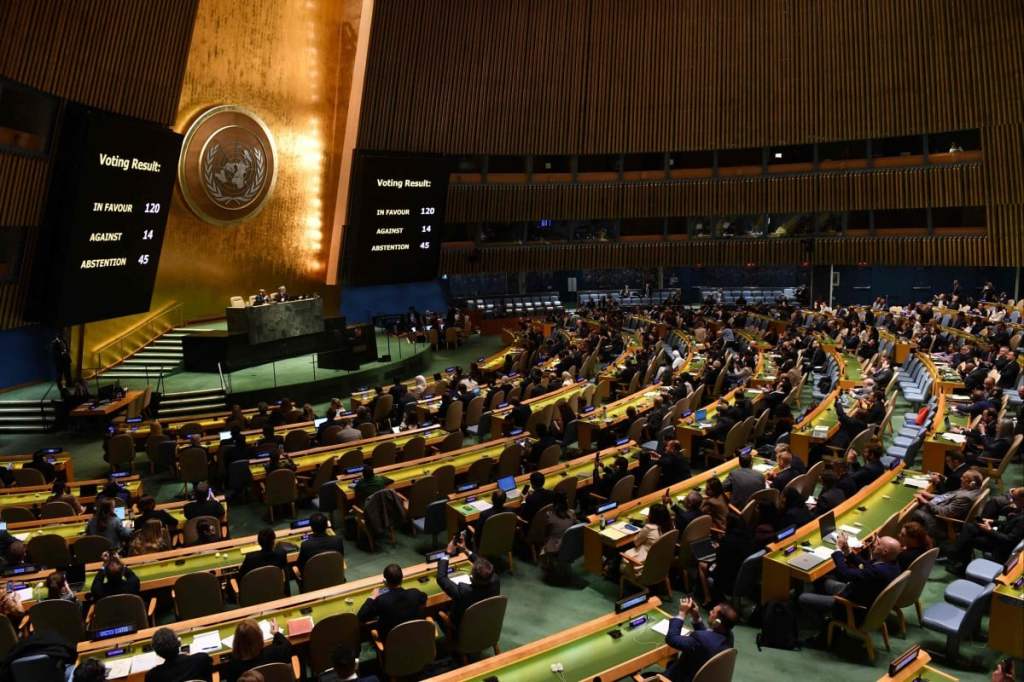
That’s the U.N. Security Council. At other levels, where the West doesn’t have veto power, they’ve gone far beyond what could be realized in the U.N. Security Council. However, a couple of weeks before the Security Council passed the Maltese resolution, the General Assembly voted. A hundred and twenty, a little bit more, to 44 abstentions and 14 opposing, passed the resolution for ceasefire. But because the General Assembly does not have mechanisms of enforcement of their resolutions, it is just a statement of the views of the majority of nations.
The Security Council, sadly, is where the power of enforcement rests. However, 120 [votes for ceasefire], 44 abstentions; why the abstentions, you’d have to go to the various nations, you know. But, only 14 nations voted against it. And among the 14 that voted against it are small micro-nations like Micronesia in the Pacific, that, you know, literally live off of U.S. donations. So, if they don’t vote with the United States they go hungry for a month, you know what I’m saying; the U.S. cuts them off.
But all of the major powers, constituting probably 90% of the world’s population, voted for a ceasefire. That’s at the level of states. What about the level of people? And here we have something very important happening, and I think this is a common united peace sentiment, pro-Palestinian sentiment among the majority of the eight billion people on the planet. The weight of humanity is against Israel, against the United States, and against imperialist control of the world and the world’s population. This is a rupture, a break, unprecedented in the history of the world since the end of World War II, where the people of the world in their billions are, I believe, deciding the future of the world. More than what states do, although the two are interconnected. Every day throughout the world and in almost every country of the world, there are demonstrations against the Israeli genocide, and increasingly in favor of the rights of the Palestinian people to self-determination and to resist oppression.
I would like to say, resistance to oppression is not always a pretty thing, because oppression is not pretty. And there are a lot of emotions tied up in the relationships between the oppressors and the oppressed, nowhere more intense than among the Palestinians. Now of course, you know, you hear people say—well this is not the main line of the demonstrators—“Well, I’m against what Israel is doing. But I’m also against what Hamas did.” To which I always ask the question, “Well, what did Hamas do?” ‘Cause I’d like to know. And maybe you know something that I don’t know. One thing we do know; and this is hugely important, that not only did Hamas and it’s allied resistance fighters overcome the technological conditions of the containment of the Gazan people; that is, you know, everything from drones flying over constantly, surveillance cameras, the electronic wall, several walls of fence, and so on.
Nowhere has there been such a containment and control of 2.3 million people. Not even the Nazi concentration camps were this controlled and such. They overcame that, and by the way, you know when we discussed that frontpage article a few weeks ago in the New York Times where they were trying to figure out how this happened, I think one conclusion that the Israelis may have reached, the Israeli government, military and others, is that there had to be people inside the Israeli military that betrayed the military. Now this could have been, you know, anti-Netanyahu forces who wanted a crisis that would bring him down. There could be people in the Israeli government and Israeli military who went from pro-war to pro-peace and are disgusted with what Israel is doing to Gaza and the West Bank, who opposed the Nazi elements in Israel, who want all Palestinians pushed out of the West Bank, Gaza, and this idea of a Greater Israel.
But I am of the opinion that Hamas had too much information, not to have had information supplied to them from within the Israeli government. They knew where to go, they knew how to attack, they knew where the intelligence centers, nodes were around Gaza. They knew even where to go and get the computers that had all the information. But then, and this is what is quite significant; and it remains even in the military situation in Gaza at this time, that—and I got this from Scott Ritter—that Hamas took on and routed; by the word “routed” we mean had them running for their lives.
Some of the most professional, hardened, best-trained elements in the Israeli army, the so-called Golani Brigades. Who had fought in most of the wars, had fought in Lebanon against Hezbollah; so they’re hardened, they’re well organized. Hamas stepped to them and forced them to flee. They were routed. And then, they went on—Hamas and the allied resistance fighters, to take over at least eight Israeli military bases around Gaza. Okay.
So the first target. This is why I always ask, “What did Hamas do?” Do you know what they did? Then, they took on the armed and militarized kibbutzes. These are the extreme elements of Israeli society. Again I use the n-word, Nazi elements. They’re highly armed and they exist for the purpose, in a certain sense, of if there is an uprising in Gaza, these people from these kibbutzes would go into Gaza and kill people wholesale. That’s what they exist for.
When Hamas stepped to these kibbutzim, they, heavily armed, began to go into battle against Hamas. And most of them lost. By the time the Israeli military arrived and got itself back together; by the way, the Israeli military has not gotten itself back together. The Israeli military just went buckwild crazy, firing on everything that they thought was Hamas. And it’s estimated that—now they brought it down to 1,200, remember it was 1,400 people? Now it’s down to 1,200 and they ain’t explained why it’s less now—but anyway, the Israeli army killed something like 200 of its own people. Israeli citizens know this happened. The Israeli government fired on its own military forces, presuming that Hamas was all, you know, up in there. Trying to kill Hamas, they killed their own people. They killed a lot of innocent citizens. Now, I don’t know the geography of what went on in that concert, you know, partying, drinking, doing cocaine, whatever they were doing; you know, partying, Like It’s 1999 to quote Prince.
And whether or not Hamas, or just random Palestinians who said, “Now I’m going to get revenge; you killed my mother in 2015, now I’m gonna kill you.” You know, and that you can’t control. Once the gate, the defense was broached, people just went through, you know. And that’s the Frantz Fanon situation, the cleansing—”I have to avenge my mother so that she can rest in peace.” “My father will not forgive me if I do not avenge my mother’s death.” You know, that type of thing. And there is support for that type of view in certain readings of the Holy Quran.
But that was not Hamas. Hamas is not ISIS.
And here, I have a complete a disagreement with Alexander Mercouris and the Duran and with Brian Berletic, you know, that there is somehow a direct lineal connection between Hamas, the Muslim Brotherhood, the Israeli Netanyahu’s government, and ISIS. I don’t think that’s the case. Obviously, by what they were able to carry out militarily, and again, using asymmetric warfare, mobility, and other things to defeat the Israeli army.
They are not another Muslim Brotherhood organization. They are not an Islamic organization in that sense. And let’s be real, Hamas has made important and disastrous mistakes on the world scale, most significantly their position against Assad in Syria, you know. But anyway, that’s for another day. That doesn’t define October 7.
Now, the military situation is very, very important. Because in understanding the military situation, the world is able to recognize the intensity of Palestinian resistance. And just like Erdogan the president of Turkey said, Hamas is not a terrorist organization. It is a national liberation movement. That is basically what the South African government said: we see Hamas as a brother national liberation movement. Hamas, however, has no standing under international law at this point. But that’s not consequential.
People see a just struggle. And frankly, what South Africa will argue as it takes Israel to the International Criminal Court, which it is doing, is that not only is this an attack upon the civilians of Gaza. It is an attack upon freedom and the right to resist, and the struggle for national liberation. Just to make a point, the concept of the right to self-determination is enshrined in the U.N. Charter and in international law. This is not made up, and so on. And so for nations such as those in Latin America, such as those in Africa and other places, saying that the struggle of the Palestinian and Gazan peoples is a just struggle; I underline just in the sense of just and unjust war, you see what I’m saying? Just, and unjust war. And when diplomats use it, they are using it in the framework of international law.
The U.S. and Israel are totally isolated. The Israeli army suffered, they say, “Oh the 1,400 or 1,200 people, Israel has never suffered this level of casualties in its history. And not since the Holocaust have so many Israelis been killed,” you see what I’m saying? You know, the deep structure of the argument itself suggests that the Israelis have the right to kill, because they’ve killed far more than 1,200 or 1,400 Palestinians and other Arabs over its 75-year history.
But the defeat that the Israeli army and some of its best detachments and units suffered on October 7th took at least a month for the Israeli Army and political structure to regroup, to mount an “offensive against Hamas” in Gaza. In the meantime, while the army is regrouping, the Air Force, supplied with new missiles, new drones, and missiles by the United States, waged a genocide against the Palestinian people. That genocide itself was a manifestation of the desperation of the Israeli military and government. They went crazy, and they’re still crazy. And you know, I’m often quoting this: “Whom the gods would destroy they first make mad.”
The Israeli regime has gone completely crazy. And that’s why the regime and the state are so fragmented and split. And Israeli society is so split that one wonders, once this war is over, and I’m going to explain what I mean when the war is over—can the Israeli state survive?
The other side of that is, will the American people put up with billions of dollars going to Israel to kill Palestinians? Will the American people—I’m going to suggest, no they won’t. And they will cast Biden out of office before they let more billions go to kill Palestinians.
The Israelis went crazy. And they killed everything that was moving, they bombed hospitals, and the world was watching. And it is their arrogance to think that they have so much control over the U.S. and world media, that they have the moral high ground. So they thought that they had the right to take revenge by bombing hospitals, by bombing children. And people have seen these children. The world will never forget it.
It is hubris and it is madness to continue this, where you know, in any situation you face an existential crisis in life. You know, the imminence of death, let us say. You know, you have options in the way you handle that crisis. You can go mad, you can act like a crazy person, you know say, “Okay I have an imminent crisis, I’m going to die soon, let me shoot all the heroin I can,” you know. Or you can say, “I will live with purpose.”
Israel sees no future for itself. And the more the world has turned on Israel, the more vicious they have become. A sign of madness. A sign of desperation. The Gazan people are suffering, the young Shahid, the Martyr, martyrdom.
And every death in Gaza is the death of a martyr. And the world understands that. These are people and children and babies dying for the cause of the freedom of their people. This is hugely important. So now, Gazans and Palestinians have the moral high ground in the global narrative. This is a huge shift. A huge shift.
So the Israelis eventually have gone into Gaza. But it’s not like they rushed up in there. They went in, came out, went in again. They were trying to gauge their military operations based upon what Hamas did. They don’t know where Hamas is. They know they’re in underground tunnels, but they’re in other places. Hamas and the Israelis don’t reveal the deaths of their soldiers, but so many people are saying that the losses are unacceptable in terms of what Israelis expect. Again, they have been socialized to believe that they can kill, and will kill, and never die. This idea of invincibility which is built into the political culture of Israel. Now you will die, and you are dying. And your technology cannot escape our maneuverability. You’re going in there with tanks like you’re fighting a conventional army, and we’re waging non-conventional, or asymmetric warfare.
In other words, we can draw you in as a trap and then surround you and destroy your tank, you know. So you’re responding to us, the guerrilla fighters, and we’re not responding to you. That’s why Israel will go in there with all that big willy talk, and all they can kill are civilians. ‘Cause the military is waiting its time, biding its time, and will force the stronger army to respond to them. That’s been going on the whole history of people’s war, of guerrilla war, that’s the playbook.
And by the way, it’s questionable whether or not a determined asymmetric army can even be defeated. We don’t know that it’s ever been defeated. It wasn’t defeated—the People’s Liberation Army in China wasn’t defeated and they were asymmetric. The Vietnamese were not defeated. The Koreans were not, and all of them were asymmetric, and all of them were heavily bombed. North Korea, what they did there. So it’s questionable whether a determined people’s guerrilla army can be defeated, because the record is they’re always winning. And in this case, Hamas which has anywhere from 30,000 to 40,000 fighters—and then not all men by the way; men and women, above ground and in tunnels, insinuated in with the Gazan people, and people, new Shahids are created, a new militancy, a new anger, new commitment by the Gazan people to resist, to attack Israel, you know. They’re hidden in the rubble, they’re hidden in tunnels, you know. And the determination. See, and this is the psychological dimension.
First of all, the Gazans know that the world is with them. “So if I die, I will not have died in vain, I will be known to the world for my sacrifice,” you know what I’m saying. And they know that now. And every young person in Gaza that can do anything against the Israelis are going to do it.
Tens of thousands into Hamas, Islamic Jihad, and other organizations; tens of thousands of new recruits have come into their ranks. But this is the history of people’s warfare. Once the guerrilla forces—if they can survive the first wave of attacks upon them, you know what I’m saying—like the bombing you see in Gaza, like the Israeli army coming into town. Once they survive the first blows of the enemy, they get stronger. It’s a dialectical process, so that’s what is happening. Now there are people who know military matters, who are saying that Israel will be defeated in Gaza. I agree with that opinion. The Israeli army will be defeated. The defeat will not just be because of the military operations of Hamas, but because the politics in Israel will increasingly begin to say, “We want our hostages back but we also don’t want our sons and daughters to die in a senseless genocidal war in Gaza.” So you get two psychologies, where the Gazans are saying, “Bring it on. We want to fight you. If you think you can kill us without dying, we have another thing to tell you.” So you get a high motivation on the Palestinian side and a low motivation on the Israeli side. And you know, frankly, it’s a beautiful thing to see.
Now, Hezbollah, the party of God. Hezbollah, since 2006 when they defeated the Israelis; the Israelis went up into Lebanon and they were gonna destroy Hezbollah, went up there and suffered a terrible defeat. They don’t want to mess with Hezbollah. I mean, it’s just that simple. And Hezbollah now has almost as many missiles as Israel has. The thing about missiles; increasingly, warfare is fought with missiles—long-range, guided, accurate missiles—and with drones. Rather than even planes. Hezbollah has both the military capability to fight a conventional war with Israel, but also the capacity to fight an asymmetric war with Israel. But it also has the technological capacity to reach Tel Aviv and other major cities in Israel. So if Israel thinks that it can wage a war on two fronts—that is, Gaza, and Israel’s northern border with Hezbollah—they don’t have it.
They don’t have the backing of the Israeli people. Nor is the Israeli army motivated to die. “For what,” they say, and rightfully so. For what? But if that were not enough, Israel is looking at a three-front war. Gaza: determined resistance fighters. And I mean, you know, it’s the quality, the human factor.
Gaza, Hamas, and the allied organizations are pumped up and ready to fight the Israeli army; and understand—and this is what is hugely important—that what they do can reshape the world’s relationships between nations and people. A defeat of unprecedented proportions for an imperialist power like the United States and a proxy Israel. A defeat of that magnitude is world historic. And Hamas knows it. It motivates them to fight.
And then you have Hezbollah looking at the same thing. To defeat the Israeli army is to liberate those parts of Lebanon that have been occupied by Israel since 1967.
Now, the West Bank. The West Bank is governed and ruled by thugs and Nazis who have set up settlements and who are heavily armed and regularly killed, brutalized, raped in prison. Palestinians on the West Bank. Now, an uprising on the West Bank—so you got three fronts.
Then you got, standing on in the background, Iran and Turkey, two of the most powerful militaries in the world, whose leadership is committed to the defeat of Israel. Then of course all of the diplomatic moves that I’ve spoken about.
Here is what was unexpected. No one could have seen it coming in this form. The rise of a movement in the United States.
You know, we in the Free School have said the American people are more anti-war than they were at the height of the Vietnam War struggle. Well, you know, only by looking at certain polls and by a sense of the American people could we project that or think that way. But now the evidence is in. Every day in the United States, there’s a demonstration, a rally, whatever in support of a ceasefire—which is in actuality, increasingly, support for the Palestinian people.
Increasingly the American people are saying, and for the first time: “The struggle of the Palestinian people is a just struggle. The Israelis are an oppressor and they’re carrying out genocide.” People are going to jail. Huge marches. State Department officials, Congressional interns all over the place; people are resigning from their jobs, writing long letters with hundreds of State Department officials condemning the Biden administration.
And then, these college campuses. Thirty-four organizations at Harvard. At Cornell, at the University of Pennsylvania. So much so that the state, the Biden administration is going after the students. Called them anti-semitic, although a big part of them are Jewish. And such.
Then you have the emergence of Jewish Voices for Peace, that has gone to the front of the struggle against the Israeli government. And this is hugely important because you take away from the Zionists one of their key claims that all Jews are united behind Israel. Now you get Jewish Voices for Peace saying, “No, we’re not united behind Israel, we’re united behind the Palestinian struggle.” Jews, young Jewish people, you know.
And then, Jewish people, the Jewish community in the United States—again, a very powerful community, only about 2%, 3% of the whole population but at the level of the elites. Almost dominant in certain areas. The Jewish establishment—ADL and all of that, American Jewish Congress, the influence of Jews and Zionists in Hollywood and the academy and banking and all of that has meant nothing to the student movement and to Jewish Voices for Peace. This is unprecedented.
But then 70% of young people—potential voters that the Democrats and Biden need to win the election in 2024. Seventy percent of 18 to 35, 39 years old people are against Biden’s policy of embracing Israel. And it’s not similar, but in other age cohorts it’s an opposition that we’ve never seen. Then on top of that, a poll comes out. And I think we mentioned this a couple Free Schools ago. Seventy percent of those polled said they would not fight in a war to defend the United States. Let’s say it’s not 70%, let’s say it’s 60%. You can’t build a war-fighting army for perpetual war when over half of the people do not support war and are saying, “We ain’t gonna study war no more. Do something about the crisis in this country.”
But that young population is very important also, because they become the recruits into the army and the Air Force, the military, you know I’m saying, if 70% of them have turned against U.S. foreign policy.
Richard Haass, as we have mentioned, was absolutely right. He said, “I’m not kept up at night thinking about ‘foreign threats’ to U.S. interests.” He said the greatest threat to U.S. interests—which is to be read as U.S. military, an imperialist foreign policy—the greatest threat is from within the United States. Homeboy could never have been more accurate, although he didn’t see Gaza coming.
The American people are enemies of the American war-making machine. No amount of propaganda and terrorism can change this. Let me end, this is what I’m kind of leading up to.
All of these variables and elements considered, what is emerging is a world peace movement of a new type. This is quite significant, and is not the same as diplomacy.
The peoples of the world are driving their governments and saying that “If you continue to pursue this policy of supporting genocide carried out by Israel, we will bring the government down.” The Spanish and [Belgian] governments recently, in the last couple of days, came out attacking the Israeli government. These are European nations, members of the E.U., members of NATO. The people are driving this. Biden could be driven out of office because of this. This was inconceivable.
Then throughout the world, world humanity is saying these unjust genocidal wars have to end. And if it takes Chinese diplomacy or whatever to bring this about, so be it. If China is on the side of peace, we’re on the side of China. This is big. Small dynamics, where something like the Gaza genocide and China coming as a mediator for peace have created very favorable positions, very favorable attitudes of millions, and millions, and millions of people towards China, including in the United States.
“China wants peace. We want a ceasefire; China wants a ceasefire—we’re more down with China than we are with our own government. While our own government wants a war with China, tension with China.”
I call this a world peace movement of a new type. The consciousness of the people of the world is at a level that we have never seen.
There are elections throughout the world in 2024. Maybe the most important one is the United States. I think there’s going to be one in England. India has one. This is a touchy thing, and I don’t know what the polling data is showing in India, but Modi has probably lost something, and will lose some support as a result of him embracing Netanyahu, you know. It’s what we call in the Black community a hell of an Uncle Tom move. I have to say, it is disgraceful for India—let me put it this way, the government of India—to act in this way. But there are elections in December for local state governments in India. And I just read an article which said that the Congress Party is challenging the BJP in states where the BJP has a stronghold. Well I’m not all that down with the neoliberals and neocons in the Congress Party in India, but I’m not down with Modi also. And I think BJP needs to be spanked, and wake up and say you can’t be a friend of a genocidist regime like Israel and an enemy of a peace government like China, you know.
Democracy and World Peace. What this crisis is creating conditions for is a new global democracy where all of the regimes that claim to be democratic are now becoming more illegitimate among the peoples of the world. No nation [more] than the United States. Remember out the gate when the Biden administration came to power, the first thing they said is that a foreign policy is based on a struggle with authoritarian governments in the name of democracy. That bullshit is out the window now as the U.S. embraces a genocidist regime in Israel, and as it tries to hold on to a corrupt, neo-Nazi regime in the Ukraine.
The United States does not have the moral authority to claim that it is defending democracy. So a new democracy, a new world order based on democracy, we’re on the cusp of. How it will come about, it’s hard to say. There perhaps will be back and forth and many disappointments, but there’s no question.
We’ve moved beyond the so-called unipolar world where the United States is a so-called indispensable nation, where the rules that the United States sets for the world supplant international law—all that shit is over, gone. And people are looking at governments like China, like Russia, like North Korea as foundations of a new world democracy. And that the claims of the West that they represent democracy, no longer hold weight with the majority of the people of the world.
The United States is in a crisis. As things look now, the Biden regime, which is the most war-like, neocon, anti-U.S. people regime perhaps in our history. The worst ones, like the Nixon government; to a certain extent Reagan—there’s nothing that comes close to what these people are about, provocateurs and war-makers.
As they wage war abroad, they wage war against the American people. King is right: the bombs dropped in Gaza explode in poor communities all over this country.
As things look, the Biden government will be brought down. The situation only gets worse for it, its polling numbers will not increase. This is not an election about abortion, this is not an election about climate change, this is not an election about election denial. 2024 will be an election the essence of which, for the people, is: can the ruling class continue to rule? Can we, the people, afford for this ruling class to continue to rule? And people will decide how they will vote in the end based on that.
 Avant-Garde: A Journal of Peace, Democracy, and Science
Leave a comment