
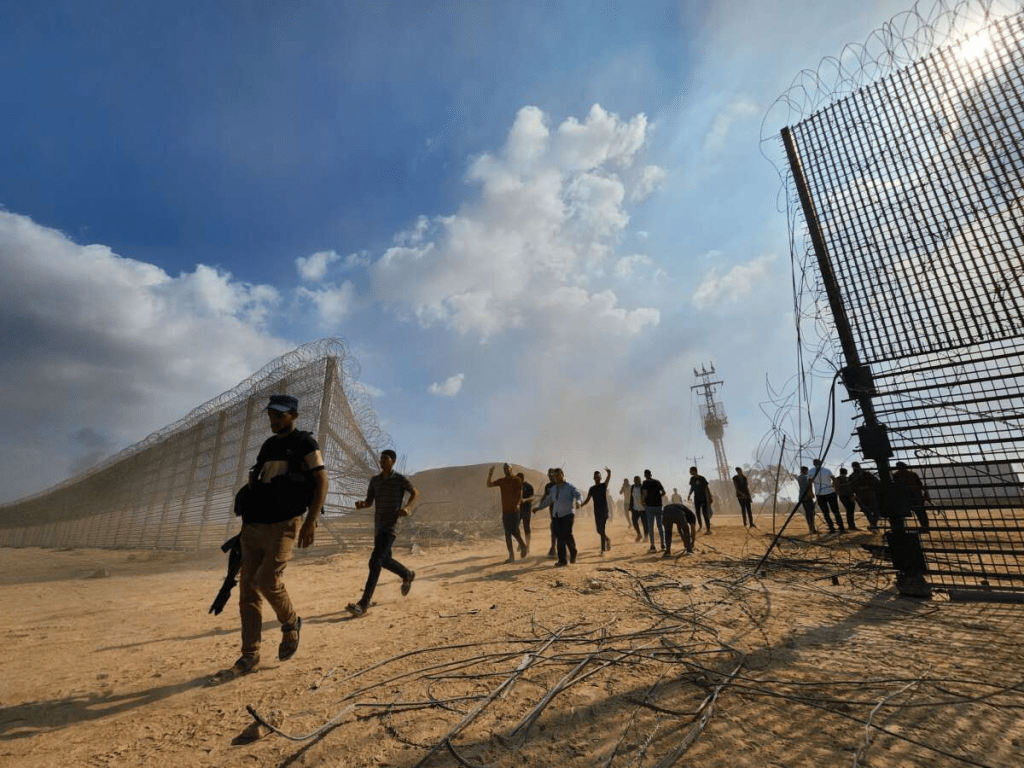
We are publishing a transcript of Dr. Anthony Monteiro’s opening remarks from the Saturday Free School’s October 14, 2023 session on Israel’s War on Gaza. The Free School meets every Saturday at 10:30 AM, and is streamed live on Facebook and YouTube.
We all know what the current situation is, in a certain sense. I want to start with what happened last Saturday (October 7th). In fact, while we were in Free School there was this breach of the fence and the wall—which is electrified—that surrounds Gaza and separates it from Israel. And so you have two worlds, side by side. In Gaza 80% of the people live in poverty. Fifty percent are unemployed, and I’m certain that if you get to young men it’s even higher because that’s the way the oppressor operates—humiliate the men and leave the women and children to themselves. And on the other side you have these Kibbutzim, you have these well-fed, more or less rich or well-to-do Jews who are also identified as white. Palestinians are not, and do not identify as white. So it is a color line.
However, last week the wall was breached. The Hamas fighters took over at least eight Israeli military bases and outposts. And all of this was done while at the same time shutting down the whole network of electronic surveillance of almost every Palestinian in Gaza. How was it done? Now there’s an article on the front page of The New York Times this morning which I highly recommend, because it does in fact begin to show how important and strategic this event was.
The Israelis and the West are trying to say, “This is an attack upon civilization.” Which is really them saying this was an attack upon white people and whiteness and that it must be punished. And this is what we see going on, I’ll come back to this, but it has not fooled the majority of people in the world.
And, you know, the Zionists are always trying to control the narrative space and this claim that “They hate us because we’re Jews,” and hence it’s anti-semitic. The fact of the matter is they hate you because you’re the oppressor, no matter what your religion or ethnicity is. Any oppressor is hated by the oppressed.
But this event of last Saturday, carried out by approximately 2,000 Hamas fighters, which according to all accounts—they are highly trained, highly organized, and had some capabilities militarily that no one thought they had. And that meant the pre-planning for the event itself, where they had more knowledge and information about the intelligence—both electronic and human intelligence—of Israelis, than the Israelis thought they had.
According to this New York Times article, the first targets of the assault were the intelligence command centers. Once they had taken them over, the Israelis were blinded. They could not see what was going on. Now Scott Ritter says all of this was possible because the Israelis had become reliant upon artificial intelligence. I think that’s only a part of it. But what happened; once they had seized the command centers in the intelligence centers, the Hamas fighters then went about attacking the military bases. And according to the New York Times article today, they say at least eight were overrun, which meant more intelligence fell into their hands as well as weapons and other things.
It was an example of what is called asymmetric warfare, where the weaker plays upon and takes advantage of the “strengths”—which can be flipped into weaknesses—of their opponents. Asymmetric warfare is what we have seen in so many national liberation struggles including the Chinese struggle, Mao’s concept of people’s war. Of course in Vietnam and in Korea, in the Korean War.
In the face of having flipped the relationship of power and strategic strengths from the stronger now to the weaker—and it happens every time practically—the oppressor which has now been shown to be not so powerful, then resorts to bombing. Korea, Vietnam, and now with Israel and Gaza. And what they tried to do is not—because they now know, I mean after 70 years or more of experience with asymmetric warfare. The oppressing and colonizing forces now know that these bombings only drive the masses closer to the revolutionaries. You know, after the shock and trauma—and it is. I mean, the Gazan people are going through tremendous shock and trauma—this is a war against ordinary people.
It is genocidal, it is a war crime, and it is racist. But after that initial shock, the people then find their way to the revolutionaries.
I want to talk about Frantz Fanon and his concept of the psychology of the oppressor and the psychology of the oppressed. These events have fundamentally changed the political and military equation between Israel and the Palestinians. Not that the Palestinians have won, but the Israels, the IDF, the Israeli Defense Forces suffered what I would call a strategic defeat.
The relationship between the Palestinians and the Israelis, including the Israeli population, will never be the same. I analogize it to the Tet Offensive of 1968 in Vietnam. You know, for the most part, between around 1965-64 and 1968, the National Liberation forces, which had been called by the West “the Vietcong,” meaning the Vietnam communists—they were not all communists, it was a united front—you know, were waging hit-and-run, late night attacks upon the army of the United States. At that point Ho Chi Minh and the army of North Vietnam did not engage because they were not convinced or certain about the political military character of the Vietcong or the National Liberation Front.
However with the Tet Offensive, just like this situation with Hamas and Israel, the U.S. Army did not see it coming. They couldn’t figure out where it came from. And very similarly, suddenly sporadic hit-and-run activities, mainly at night because most of the fighters, you know, worked in their fields by day, or worked for the U.S. military or other jobs. But by night they would be guerillas.
In this instance, we saw a unified political and military uprising. After the Tet Offensive—while the United States military took back important physical gains, they never reversed the politics of the war in Vietnam. After the Tet Offensive, the North Vietnamese government committed themselves to the fighting in the South. And that opened up a very interesting thing called the Ho Chi Minh Trail, which then brought Cambodia into the war and the great Prince Norodom Sihanouk, who allowed the North Vietnamese to use pathways in Cambodia, and then coming into Vietnam. The famous Ho Chi Minh Trail. And it changed the geography of the war in Vietnam, and six years later it’s over; but the United States had been losing, had gone to a situation of Vietnamization of the struggle. And once they went there it was over, because the South Vietnamese Army was not an army that wanted to fight. And the United States was in this gradual removing of its troops, and so on.
So the Tet Offensive changed the politics and the military and geography of the war in Vietnam. I think this did the same.
Just, you know, and this is not yet proven—because the Israelis and Western governments, well first of all they have realized how vulnerable the Israeli military is to Hamas. That’s a bad feeling when you’ve always assumed that you were the strongest military in the Middle East, that you were invulnerable. And of course their promise to be able to protect the Israeli people, so arrogantly they would move Kibbutzim, these communities, right up next to Gaza. You know, and while you got swimming pools and having, you know, big Woodstock-type concerts and stuff, these people are on lockdown 24/7.
And of course, we’ll get to it later, the souls of young men. I’ll come to that in a minute.
So arrogant, because they thought the IDF could protect them. And they had all of these military outputs, heavily-armed. And every Israeli is armed, the Kibbutzim are armed to the teeth. But see, the thing is, how did they break out of that fence, which is electrified? I mean, there were so many tactical obstacles that they had to surmount; it was masterful. And the Israeli population now feels vulnerable and frightened, you know, as they should be.
But the point I wanted to make, again, is that now the West—because the Israelis, who I have to say, you know, at some point, the oppressor is driven mad. You know, the arrogance to think that you can forever oppress a group of people. Suddenly, you can’t.
So this was a strategic victory. Nothing close to this has happened in that part of the world since 2006: the war between Hezbollah and Israel. Where Hezbollah—and you’ll hear in the news, “Well they’re Shiite, and the Hamas are Sunni, and you know, and they don’t get along.”
Well, that’s what you say. They might differ religiously, but they might not differ in terms of military strategy. What might occur, if the Israelis go into Gaza—I’m going to talk about that—with all of these tanks, all of these soldiers, most of whom don’t want to fight—but they were sitting outside of Gaza for I think now four days, all these tanks, you know, “We’re going to go in.”
So Blinken goes in and says, you know, “Chill. Because you might make a bad situation even worse.”
Which is true. If the Israeli army goes into Gaza, which has its own difficulties for them—you know, urban guerrilla warfare is not set up for tanks and that type of thing and the type of equipment the Israeli army has. They don’t know the traps that’ll be set for them; they don’t know anything that will happen.
And given what Hamas just showed, the Israelis are being very cautious. But more than the military situation is the world, which we’ve said is transforming from a unipolar to a multipolar—what we call an Afro-Asiatic reconfiguration of the world. BRICS, which now includes Saudi Arabia and the United Arab Emirates, as well as South Africa, you know what I’m saying—BRICS plus six. The Shanghai Cooperation Organization, the various alliances between Asian countries but also between Asian and African countries. The crisis of neo-colonialism, and we’ll get to the United States in a minute.
We’re in a new and more positive situation. The Israelis are going to go in, to Gaza, but they’re not going to go in like they want to go in, and they’re going to find a way to come out.
And they might not go in; I still think it’s 50-50 that they will go in there.
Because the United States and the West are saying, “Hey man, don’t do anything stupid, ‘cause it’s going to be on us. Because we have armed y’all, you know. And don’t do anything to set off a wider regional war that would bring Hezbollah and maybe Iran into it. And don’t do anything so stupid that it will affect the global economy by affecting the price of oil.”
You know, once you get beyond all of the hooplah on CNN and MSNBC and you know, after you peel the onion back, you see how rotten to the core Israeli society is, and how it was broken.
Now just a couple of other quick things—according to the New York Times article they have documents captured from certain of the Hamas fighters which show they’ve been planning this for about a year. But here is the issue: how did they penetrate Israeli intelligence?
Nobody has written this, I’m just speculating. Usually when something like this happens, people inside are cooperating with Hamas and the Palestinians. In other words, there are Israelis who were cooperating with Hamas.
This makes Israelis feel even more vulnerable. And also over the spring and summer of this year, there were these huge demonstrations of hundreds of thousands of Israelis protesting the Netanyahu government and its proposal to change, you know, the Supreme Court and the Constitution.
Never has Israeli society been divided like this, never. So it’s already brittle. Netanyahu is a very unpopular prime minister. If he is defeated in the next election, he could go to jail. And all of this is affecting the psychology of the Israeli people.
So who are the persons inside the Israeli intelligence and military that may have given information to Hamas? I just say all of this, again, to say—without having all of the details—that the political and military battlefield has changed qualitatively.
Now, the Israeli government is in shambles. In fact I think the political crisis in Israel is deeper than the one in this country. And we know how deep this is. Netanyahu is less popular than Biden is; he threw together a government of the most extreme Zionists and really crazy people. And then, by the way, carried out a provocation which was the trigger to what happened last Saturday.
And these settlers keep doing this: going up and violating Al-Aqsa Mosque, the third most holy site in world Islam. They keep on doing it, and then went so far as to say, “We want to destroy Al-Aqsa and build the temple.” There’s supposedly an ancient Hebrew temple that was on this mount. And they want to go and tear down Al-Aqsa Mosque, which has been there for well over a thousand years, and rebuild this synagogue.
That is a blow to Muslims all over the world, but it seems to be the trigger. And these people in the Netanyahu cabinet—by the way, you know, Netanyahu’s from Philadelphia. Yeah, from Cheltenham, went to high school there.
Let me just continue. So that was kind of a trigger. And so when Hamas carries out this, I think they call it an “Al-Aqsa Flood,” which is, you know, the mosque. So that resonates with Muslims all over the world. Because then they’re saying, “We are standing up to protect the third holiest site in Islam.” Which cannot be ruled out as an important thing in the psychology of warfare and resistance. Which means that now you’ve got a billion and a half people who have utter contempt for the Israeli regime. And they don’t hate you ‘cause you’re Jews, they hate you because you are oppressors and because of your disrespect of Islam.
Okay. The world has changed. The nations of the Middle East, who suffered one of the most humiliating defeats in the history of any group of people in 1967 when the Israelis launched war against Egypt and Syria, the two most powerful Arab nations at that time, and have occupied lands of Egypt, of Syria, of Lebanon, of Jordan since that time; over 50 years. And have been intransigent, and have become increasingly intransigent about the Palestinian question. Where from time to time in the most arrogant way they say, “Well the Palestinian homeland is in Jordan.” Not the land that you all have taken and continue to expand on.
But the world has changed; the people of the world have changed. Yesterday throughout the world, especially in the Muslim world and the Arab world, there were huge demonstrations of millions of people marching in solidarity with the Palestinian people. Huge demonstrations. But then there were demonstrations in the United States and throughout the West. In New York there was a demonstration of several thousand people—I don’t know, it’s hard to find out—but at least several thousand people in Manhattan and Brooklyn, led by—and this is very significant—Jewish Voices for Peace.
And now the fragmenting, or the separation of those Jews who are literally saying—and I’m going to put this in Baldwian terms—“We have to save our souls. Why should we carry the blood of the Palestinian people on our hands when these are the actions produced by a racist regime?” Now, a lot of these young Jewish students have been involved in anti-racist marches, anti-racist conferences, you know, and so on—to the extent that they understand the anti-racist struggle.
But anyway, how can you say, “Well I’m against racism in Minneapolis when it comes to George Floyd, but I don’t see the same thing, even worse, happening to Palestinians.” That kind of moral inconsistency. So at Harvard University—and this is highly significant—30 student organizations came together behind a statement saying that Israel was responsible for what took place. They did not compromise, and we’ll come back to this thing—did Hamas carry out crimes against humanity?—I want to come back to that.
Even if there were excesses, and I am not going to concede that. But I’m saying, even if there were, these students, 30 student organizations said, “Israel is responsible.” This has never happened.
At the University of Pennsylvania there was a Palestinian Writers Conference a couple weeks ago. And in the wake of what happened last Saturday and going forward, a big donor to Wharton School of Business—he and his wife have given 50 million dollars—said that he wants the president of the University of Pennsylvania and the President Chairman of the Board of Trustees to step down because they allowed this conference that had in it—and this is now the Zionist narrative—“anti-Semites.” And people who had made statements against the state of Israel—like that makes you anti-Semite. The conflation of things, you know.
And the fact that the president of the University of Pennsylvania last Monday issued a statement celebrating last Monday, which in some quarters is known as Columbus Day—she wrote a message to the university celebrating Indigenous People’s Day and did not include a statement condemning Hamas. So this rich “philanthropist, hedge fund, casino capitalist” operator called for her to be fired and for the head of the Board of Trustees—which set off a battle within the Board of Trustees—but nonetheless the president has not apologized, nor has the head of the Board of Trustees.
But then a big donor to Harvard, Jewish, said that he wanted the president and the administration at Harvard to reveal all of the names of the students that signed on to this statement because he wanted to know who they were so he would never hire them, right. The president of Harvard, who now is black woman, but it’s not because she’s a black woman, said, “We’re not going to do that—at least at Harvard, we have to uphold the right of freedom of speech.”
This is very significant politically. Because it looks a lot like early student protests at places like Harvard and Columbia in the early days of the student movement against the war in Vietnam.
Now, you know Antony Blinken and Lloyd Austin, the Secretary of Defense, they ran over to Israel. The United States has sent into the Eastern Mediterranean the largest aircraft carrier in the world, the Gerald R. Ford. Now, it just isn’t like an aircraft carrier, it’s an aircraft carrier battle group: including cruisers, battleships and submarines, to the Eastern Mediterranean.
Well obviously, this has nothing to do with Gaza, but everything to do with Iran. Again, the Biden administration pushing the envelope, entering into brinksmanship because if they want a wider war, it could happen but it would affect the whole world economy including the United States, driving inflation up—which by the way went up last month, 3.7%—and crashing the U.S. economy at a time when the U.S. cannot put together a government, or at least in the House of Representatives.
The other thing is that Blinken went to Jordan on this “diplomatic trip” because the United States wants Jordan to house the 101st Airborne Division of the United States Army. The 101st Airborne is a highly trained war machine. It consists of maybe a little more than 10,000 troops. To put that in Jordan—and I don’t know whether it’s been agreed to and settled—means that it would be a strike force against Iran, and it would mean that the United States would be a part of a war between Israel and Iran. Which means, then, that the war would not just be Iran versus Israel and the United States. It would mean Hezbollah, Hamas—who knows where it would go. But it could again bring the world closer to nuclear war.
The other thing is that in the midst of all of this, the BRICS countries—Russia, Iran and Saudi Arabia—are carrying out diplomatic initiatives on their own. This is highly significant and that’s why I think Blinken went on this trip to all of these Arab countries to try to explain the American position. I don’t think he was too effective because he was in Israel first and running off at the mouth, you know what I’m saying, all of that B.S.
They heard it, they know what that represents. And of course the Saudi government of Mohammed bin Salman and them people are not down with the Biden administration at all. So we have alternative tracks of negotiation, and for the first time the United States—the first time in over 50 years, maybe 70 years—that the United States is not the key diplomatic player in the Middle East.
One might suggest the U.S. might be being sidelined. And that Russia and the BRICS countries, BRICS plus six countries, and the Shanghai Cooperation Organization and potentially China will have the great weight in negotiation. First of all, when the matter is taken to the United Nations General Assembly and to the Security Council—to the Council first and then the General Assembly—the majority overwhelmingly will side with BRICS, Shanghai Cooperation Organization in their initiatives for peace. And by the way, a two-state solution which is, I mean, I can’t tell you the blow that this would be to the regime in Israel.
Over the last 50 years they have encroached more and more on Palestinian land, now in the West Bank setting up these settlements. I mean, stuff that under international law is considered crimes against humanity, genocide, war crimes, so on down the line, you know.
Okay, I just want to end on this. The claim that Hamas carried out rapes, beheadings, random murders of individual Israelis—if all of that occurred; I don’t think all of it occurred—there were excesses, I think, in the killing of civilians. Were these the Hamas army, which is highly disciplined?—I don’t think so.
I think this was an outpouring of anger. Once that wall was breached, you know, people literally from the hood went over there and said, “You killed my mother, you killed my father.” And this is where Frantz Fanon is very significant: the psychology of the oppressed and the psychology of the oppressor. In many ways what looks to be the same in essence is not. Frantz Fanon is the Martiniquan psychiatrist who studied the Algerian War for national liberation. And in two books, Black Skin, White Masks, and then the book that he’s best known for, Wretched of the Earth, he talks about how violence of the oppressed is a cleansing.
I want to just focus upon the men of the oppressed group, because they are targets for many reasons. We see it here among black men. They are humiliated, they are the poorest among the oppressed, they are the most humiliated, they’re looked down upon even in their own communities. And so in Gaza as in the United States, they take on certain pathological dysfunctional behaviors. One is to get strung out on alcohol or drugs or other things which is kind of a slow death. “I have nothing to live for, I ain’t going to get a job, I can’t be educated. All I can do is hang out in the street.” So a lot of people—and they have drugs over and in Gaza—they become addicted to alcohol and drugs.
The other thing is that the oppressed, especially the males, have high rates of suicide. Sometimes O.D.’d, sometimes straight-up suicide. But the other side of this, the other form of suicide is to kill another black man; “I’m not worth shit, you ain’t worth shit. You going to disrespect me, Imma kill you, Imma hurt you.” That’s in Gaza, that’s over here.
The other form of behavior is to brutalize women, you know, that gender divide happens. And that’s manufactured, you know. The same guy, “I love my mother, I love my mother.” But why you beating your wife up like this? “Cause she didn’t listen to me. Don’t nobody respect me.” You can hear it when you ask the guy beating up his girlfriend or his wife. “Why’d you beat her up?” “‘Cause I told her to do something and she didn’t do it.”
You know, in other words, somebody has to hear that “I’m going to be the man, I’m going to be a man if nothing else in my house.” But would you want somebody to do that to your mother? “No, nobody better not do that to my mother.” Well, but you see the dilemma, the paradox. All of these pathological and negative behaviors result from extreme poverty and degradation.
But then there is another alternative. That is, violence directed against your oppressor. That’s what Fanon talks about, and how it is cleansing. To cut the throat of the French occupier in Algeria, you know what I’m saying, to kill in the name of freedom; Fanon says it is cleansing. Now, but that is not the behavior of the disciplined revolutionary—that is the individual freeing and cleansing himself. And of course when the violence is turned out towards the oppressor, the young man that carries it out is celebrated in his community. Especially the women, the grassroots women, you know, “Yeah, you did right.” Even if he dies, he’s seen as a martyr, because he’s not inflicting violence internally.
Now, so one can clearly understand all of that now organized into a disciplined military force. And that’s what we saw. Now, I just would end on this. While Fanon’s diagnosis is absolutely right, the solution, I think, is closer to Baldwin.
Israelis, and most Jews in the world have forgotten how to love. They know how to hate. They don’t know how to love. They need Baldwin—the Israeli people need Baldwin more than they need air. What they have done to the Palestinians is hateful and evil. And so, the large march—and in the front of it is Jewish Voices for Peace. They could easily have put “Jewish Voices to Save Our Souls.” [Asking themselves,] “Is this what we have become?”
My last point: there was an article in the Financial Times last week—I’ll find it in a minute—where this writer is asking the question: What does Israel do now? Now that we can no longer externalize our deep pathologies and say it’s all because somebody over there forced me to do this; Hamas forced me to carry out these war crimes in Gaza, I had to do it. Now, you can’t do it; you have to look inward. What have the Jewish people become? And why does the world look upon them with utter contempt? Including in the United States—I’ve often talked about this. But I’ll stop there.
 Avant-Garde: A Journal of Peace, Democracy, and Science
Leave a comment