
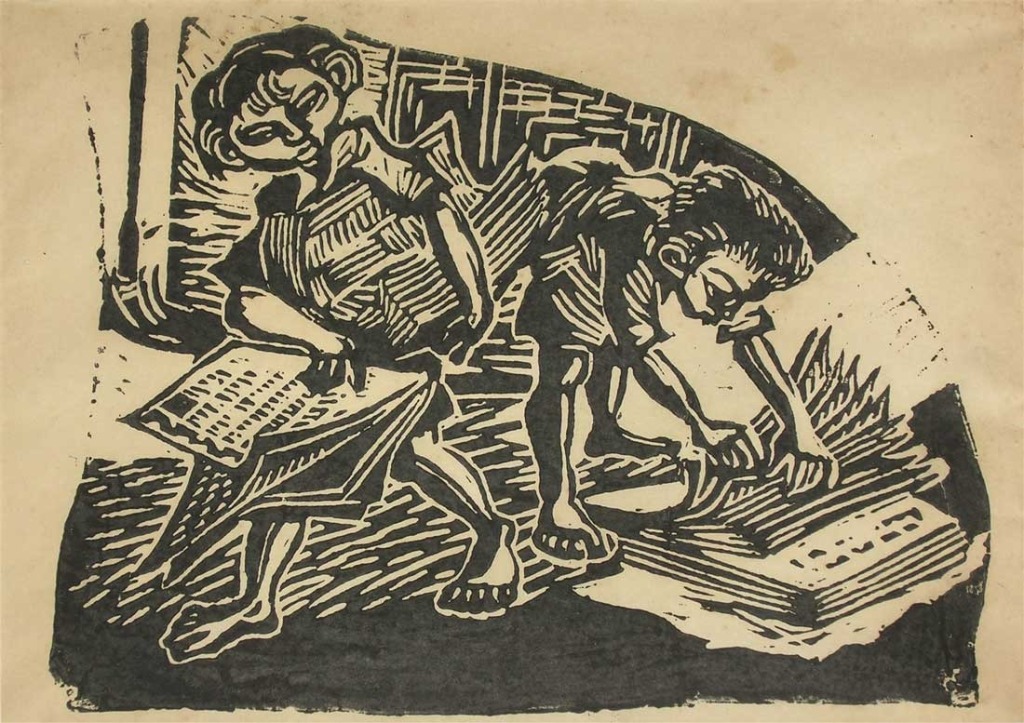
India has become the most populous nation in the world. We are a young nation, with 65% of Indians being under 35 years old and 26% below 15 years of age. There are around 254 million young Indians between the ages of 15 and 24 years. You know this to be true if you take a walk in any Indian town or city. Children are everywhere. There are young ones with naked bottoms stumbling alongside their mothers in faded but colorful saris as they go from shop to shop asking for money. They are small clay things being carried brusquely in the strong arms of their working father, their heads swaying and matching the rhythm of his long steps. Or they are playing in piles of cement at construction sites, every moment a risk to be alive. Metal wires and broken bottles become their play-things and they grow up in tin sheds where one room serves as kitchen, bathroom and bedroom for the whole family.
When slightly older they run around on the streets, some beg, their hair matted and brown. The ones who are blessed with working parents neatly accompany their fathers to buy daily provisions, shy and hiding between and around their legs. Sometimes you may see two or even three of them sandwiched between their parents on a two-wheeler, precariously dangling to every side as they zip through traffic.
It is perhaps the youth of this nation who make my heart hurt the most. They are so beautiful, slender from age and hunger, wiry and strong willed. Yet in their eyes one sees hurt, doubt and a forced indifference. They have not yet hardened to the world, yet they know its hostility and harshness. I sometimes see a young man working in a trash collection truck, his feet soiled from rotten fluid. He makes sure to never look directly into the faces who casually hand him their day’s scraps and trash. I wonder, how does this young man view the world? He belongs around books in sunshine and open spaces with his peers, yet so many remain indifferent to his suffering. What does it do to a young man such as him to have all the beauty stripped from his life? To live day in and out surrounded by garbage and the refuse of others?
I see young men who work in cafeterias and restaurants, cleaning tables with grimy rags and bringing food. Their clothes are fine from wear and sweat, their faces bright from youth and dull from poverty. They dart from one corner to the other, always on their feet. Is there someone in their life who can guide and protect them? When you smile at them they blush, unaccustomed to kindness.
Children of the poor know from an early age that much of the city they live in is not built for them. They look on at cafes and restaurants they do not have access to. They know that even if by some chance they happened to have enough money for a meal at one of these places, they would be chased away for they look poor.
There are also the young men and women who are being educated in a way that their parents could not be. They stand at bus stops, waiting to be taken to university, more self assured and straight-backed. They are often told that they are not intelligent enough, not capable enough because they have committed the crime of being brown skinned and born in a nation that has not yet come to terms with itself. At home they are constrained by a family and clan structure contorted by colonialism that tries to keep them limited. Yet, they persevere.
They are filled with life, dance and music. There is rhythm in their movement and sharpness in their thought. These children are our future, they are a part of each of us. In a nation still grappling with the white view of itself, how we feel about them reflects how we feel about ourselves. Whether we acknowledge or not, we are wrapped in a single garment of destiny. Do we hate ourselves so much that we are comfortable with the dehumanization of our children? Have we believed what the West has taught us about ourselves?
Indian society has a smaller number of children who grow up in the Westernized and economically stable middle class. There are also young people that work and study their way into the more elite institutions of our nation through democratic opportunity. These young people are constantly compared by their mentors, and are comparing themselves to the white ideal they see in advertisements, films, music and sometimes even to white individuals they meet.
They compare their broad noses and frizzy hair to the blonde and blue images staring at them through their phones. Many Indian families now have relatives who live in the US and Europe who act in ways that are superior and more self assured. This comparison is crippling. These young people could become the vanguard for democratic change in our nation, yet they are stuck in a cycle of self depreciation, imitation and paralyzing insecurity. Am I capable of understanding the world, thinking originally? They are taught that thought and innovation is the domain of the white world, and they could never catch up to it.
South Asian poet Muhammad Iqbal had written for his son Javed, jahan hai tere liye tu nahi jahan ke liye. The world is for you, it is not you who is for the world. Iqbal was a towering philosopher of the Indian freedom movement. We must take direction from Iqbal, and work towards a society that has only one privileged class—children. Children and youth do not belong in the workplace, they must be protected from exploitative practices that are justified as being better than their alternative fate. Our society must be geared towards the development of what W.E.B. Du Bois called the immortal child.
Iqbal believed that the development of the individual self was essential for liberation. He said to his son, tu agar mera nahi banta na ban apna toh ban. If you cannot belong to me, don’t, but belong to yourself. The children of our nation must be given freedom to pursue an education and develop their capabilities unhindered by poverty. They must be told that they are worthy and capable. There is nothing beyond their reach, and everything can be accomplished through an emboldening of the self, determination and work. We must tell them, khudi ko kar buland itna ki har taqdir se pahle, khuda bande se khud puchhe bata teri raza kya hai. Make yourself so bold, that before every destiny, God himself asks you, what is your wish.
They must be told that the world that surrounds them is wrong and unjust, that the older people who put them down are not speaking the truth, but rather responding to the experience of their own lives. They should not and must not be believed. If one looks closely, none of them follow the standards they so loudly proclaim. Children must be taught that their future, and the future of our nation depends crucially on what they feel is their own worth. That each one of them must struggle with this, and it will not be easy, but that they are capable. We must teach our children that they are the ones that can make and remake this nation, and indeed this nation cannot be made without them.
Most importantly, we must love the children of our nation. It is children that best represent the human universal. Is it possible to truly love anyone, even your own children, if one does not love all children? Our collective future depends so crucially on our ability to love one another, and we must realize this before we can achieve our country.
 Avant-Garde: A Journal of Peace, Democracy, and Science
Leave a comment