
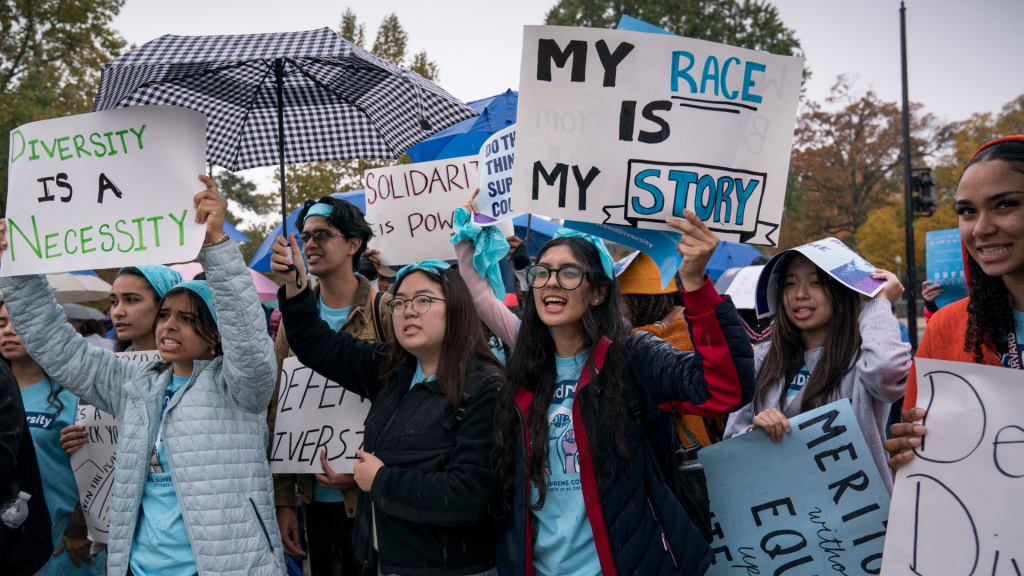
We are publishing a transcript of Dr. Anthony Monteiro’s opening remarks from the Saturday Free School’s July 1, 2023 session on the Supreme Court Affirmative Action Decision and the Decline of the Left. The Free School meets every Saturday at 10:30 AM, and is streamed live on Facebook and YouTube.
Good morning to everybody. I just wanted to talk a little bit about the Supreme Court decision, and if we’re not careful we could be talking about Supreme Court decisions for the next six months. Part of that is because of the role of the U.S. Supreme Court in American politics which is probably unique in modern societies, and that goes back to the beginnings of this country – the American Revolution, where there was not just the freeing of the nation and the establishment of an independent state and nation, but in doing so a constitution was written in 1787 and was finally passed by those who could vote in 1789.
What is significant – and I think this helps us to understand the function and role of law in American politics – the American Constitution was the first constitution of a modern nation. The British or English Revolution did not produce a constitution. The French Revolution, which comes about thirteen years after the start of the American Revolution, does produce a constitution. However the constitution does not assume the significance in the political life of France as the American Constitution does in the political life of the United States.
The word constitution should be taken seriously. It is from the word “to constitute.” In other words, the American Constitution constituted – it was the legal constitution of the state. And it was the parameters and the conditions upon which the ruling elite would govern, which is to say it was not the will of an individual or a small group; it was not capricious, but it was law-based.
And it was around the law that a broad consensus of the people could be established. It seems common sense today, but if you go back over two hundred, three hundred years ago it was an act of revolutionary defiance. It was not a royal family, it was not a king, it was not an individual strong man. It was a nation which was governed – and you’ll hear this all the time – governed by laws. That is not to be trivialized or taken as insignificant in spite of the fact that for most of the history of the country, I would say up to the Civil Rights Movement, the nation in one or another way lived in violation of the Constitution.
The American Constitution is in other contexts referred to as the fundamental law. If you go for example, maybe to the Soviet Union, the old Soviet Union – they referred to their constitution as the fundamental law, and that’s what a constitution is. It is the law upon which all other laws are based. So if a law, for example in a state, is challenged on the basis of the Constitution of the United States and the Supreme Court rules in favor of one side or the other, they’re literally saying that that particular law is either in accordance with the fundamental law of the Constitution or it is not.
Now in France, for example, you will have the First Republic, the Second, the Third, the Fourth Republic, I think they’re up to the Fifth one now. And in each republic they can rewrite the constitution. That is not the practice in the United States. In the United States the practice is to amend the Constitution, to add to the Constitution and make it part of the fundamental law of the country.
For example, after the original Constitution, the first ten amendments to the Constitution are viewed as a concession to the democratic masses. For example, we hear all this talk – the First Amendment, freedom of speech. And obviously the radical democratic forces were saying to the elites that, “We have freedom of speech which is also freedom of organization, freedom of conscience, freedom of religion – all of those possibilities. Either we have that, or we will wage a revolution against you like the one that was waged against the British.”
And there are ten of these first amendments. The second we’re familiar with, the right to bear arms – we could go on and on and on. There were other amendments to the Constitution, but the Constitution has never been formally rewritten. There have been times where revolutionaries have called for a new Constitution of the United States.
Famously, and I think the last real attempt at this, was the Black Panther Party’s Revolutionary People’s Constitutional Convention held here in Philadelphia in 1970, where Huey P. Newton proclaimed the need for a new Constitution of the United States. For all kinds of reasons it was never carried through. However, great political events have led to changes or amendments to the American Constitution. Most significantly, the Second American Revolution, what is called the Civil War. More Americans died in the Civil War than any war, before or since, that the United States has been involved in. Some people estimate up to 700,000.
Nothing is more bitter, nothing is more long-term in terms of the wounds that go unhealed than a civil war. People and nations recover more easily from foreign invasion than they do from a civil war. It’s like a family, they sometimes never get back together. The bitterness is so deep, the sense of betrayal is so deep.
But the Second American Revolution, which continues to resonate up till today, produced the most important amendments to the American Constitution. The 13th Amendment, which outlawed slavery – in other words, slavery is unconstitutional, it violates the fundamental law of the country. This is huge. Because the first writing of the Constitution did not oppose slavery. In fact it gave certain special rights to slave owners, specifically the right to vote for their slaves.
But [the 14th Amendment]: this is the important one, and almost every constitutional question since the 14th Amendment and 1868 – not all, but overarchingly, constitutional questions engage the 14th Amendment and in particular the equality clause and the due process clause. What the 14th Amendment established is the foundation of modern American citizenship.
Now, it is more than significant, and I think it makes the case that the Free School is making. Frankly, as I thought about this over the last couple of days, it makes the point that [Free School member] Edy Barraza made in his presentation to the [intercivilizational] festival. The case that Du Bois would make in Souls of Black Folk: the problem of the twentieth century is the problem of the color line. That the most important questions of democracy emanate from the struggle to extend [rights to], and having embraced by democratic principles, the African American people.
The 14th Amendment comes out of the struggle against slavery. Most of the history of the 14th Amendment has in one or another way involved black rights. The Third American Revolution, and it is – and this makes the case that it was a Third American Revolution – sought to uphold and extend the meaning of the 14th Amendment, what it means to be a citizen in the United States. And how the state as the overarching state, or the particular governments of various states, cannot ever violate the citizenship rights of people who were formerly enslaved.
That doesn’t mean it hasn’t happened. That doesn’t mean it doesn’t continue to happen, especially as it relates to the prison industrial complex, the death penalty, and matters such as that. There are still huge constitutional questions that have to be argued out relative to the rights of black people to be safe, to be protected against police brutality, unjust imprisonment, long terms of imprisonment that do not apply to anybody but black people, and so on.
So the 14th Amendment, which established citizenship for black people, opened the door to citizenship for all people, including the 19th Amendment which extended the right to vote, established as a constitutional right, the right to vote for women. Again, it flows out of the 14th Amendment and the struggle for black freedom. That was then, it continues to be the case today.
Now, just let me make a comparative – I talked about France and how with each republic they can change and have changed their constitution. The Soviet Union, in writing its constitution in the 1920s pretty much stayed with it as their fundamental law until the collapse of the Soviet Union. However when you take a place like China, I don’t think law occupies the same place in their society as it does in ours. One, because I think that consensus-building among the people in China occurs through political and ideological processes which assume that the state is an agency of the people. And that the people need not be protected from the state or from strategic actors in the society.
It’s a different assumption here. The assumption in the West and in the U.S. Revolution is that the citizen had to be protected from the state. That’s based upon the history of feudal autocracy, aristocracies, kings and that type of thing. Where all power flowed from the monarch and not from below. The assumption of the Chinese state is that the people need not fear the state, the state is an agency of the people. And that’s why I’ve often used the term that frankly I got from earlier discussions during the time of the Soviet Union and other socialist countries: the state of the whole people.
And the state of the whole people is not a state of one class or the other. In the United States we have a bourgeois regime of law. The state does not assume to be an agency of the people – in fact it is almost an admission that we need a regime of law to protect the individual from potential and actual excesses of the state.
But then you take smaller countries where the possibilities of democracy are greater – direct democracy. China, 1.4 billion people. India, 1.5 billion people. You cannot have so much a direct democracy as much as a representative democracy. The law plays a bigger role in China than let us say in North Korea, a country of twenty-six, twenty-five million people, where institutions of civil society can play a larger role in the democratic functioning, not just of the state, but of society.
The same could be argued with respect to Cuba – thirteen, fourteen million people. The rule of the people can be far better realized in a direct democratic sense than in a representative democratic sense. So in North Korea and Cuba, you get two things going on at the same time. The representative institutions like the parliament and so on, and both countries have that, but then you have direct democracy. And in the day-to-day lifeworld of politics and let’s say in North Korea or Cuba, the people have the opportunity, not only to be involved, but to express their opinions. “Fidel Castro is our leader, we affirm this in our day-to-day political activity.” It doesn’t mean that everybody agrees with Fidel Castro. “Kim Jong Un is our leader because we affirm it regularly, not only in the political institutions but in the institutions of civil society.”
Marien Ngouabi of the People’s Republic of the Congo, when he talks about the Crucial Triad of the state, the people’s organization, and the vanguard party – what he was referencing is an emerging democracy based upon a building and constantly emerging consensus of the people. This kind of democracy – People’s Republic of Congo, North Korea, Cuba – is more grassroots. In fact, I would think that in countries like that you would find less political alienation than you might find in let us say a huge country like China or India or the United States for that matter.
Representative democracies, when they hit a crisis, there’s this great problem of involvement. People don’t have a way to express themselves through civil society because there is no civil society as such. Now, having said that, law and politics play a particular and unique role in the United States. Let me put that another way: law, politics, and race. So if you look at the trajectory of American history, of American constitutional and legal history, of American political history, you can almost always see this interconnectedness of these three variables.
Now this brings us to the most current rulings: the Dobbs decision overturning abortion as a federal protection – this is very important – the overturning which is very different in quality to the overturning of affirmative action programs. And this is what I want to get to, as relates to elite universities.
So, you know, I’m not one of these people – “The sky is falling, the sky is falling, the Supreme Court overturned affirmative action.” It overturned affirmative action programs in about a hundred elite universities. Out of some four thousand universities, this applies particularly and uniquely to one hundred elite universities, by which I mean the Ivy Leagues, like what they always talk about Harvard, so-called elite of the elite. But that’s not the only one. Of course Yale, Princeton, Stanford. Elite universities.
But these elite universities can find other remedies to have a diverse student body. Now the question is, when did affirmative action first arise? It didn’t arise in the 1950s, 1940s, not even in the 1960s. Affirmative action programs, I want to underline programs, arose in the 1970s.
Obviously the impetus was to give teeth or substance to the Civil Rights Act of 1964. The other thing – and this is the ruling class now looking at its future and its capacity to govern and rule – the need to diversify, racially in particular, the ruling elite of the country. This is why the elite universities are so important. Example: eight of the nine members of the U.S. Supreme Court got their law degrees from Harvard University. Most of your elites these days have done professional education – business school, law school, medical school – at an Ivy League or another elite university.
Now, does that make them smarter? Does that mean they are more qualified to rule and govern the country? Not at all. “Why do I want to go to Harvard?” – I’m not saying me in particular. But why would a person want to go to Harvard Law School? Well, because Harvard Law School, like Harvard undergraduate school, and maybe Cornell I don’t know, is a finishing school in reality. “What do I learn there?” Well, I learn some important things. But more than anything I rub shoulders with professors and other students who are connected to networks of elites.
So if I go to Harvard Law School I can be dumb as a doornail, but a Harvard law degree means that major law firms, major government institutions are looking for people like me. I’m talking about a black person like me that graduates from Harvard Law School. One, I’ll tend to talk more like a white person. I can think like white elites think. I have manners, I’m polite. You know, I have been reformed and reshaped as an elite.
So these universities do not produce more intelligent people or more capable people, or even more creative people. I mean, really less creative people. But they produce elites: white, black and Asian and Hispanic. So what was this fight over? First of all the case was argued with different optics. The last great affirmative action case was in 1978, which was called the Bakke decision and it had to do with the University of California, I think Berkeley’s medical school. And in that case 1978, only a few years after these programs had become instituted, the Supreme Court decided that race could be a factor considered, but not the only factor.
And so you know, elite universities who design their curricula, their student body to meet the needs of the ruling elite – if in a transforming and changing world where Africa and Asia are no longer colonized – well if the United States is going to lead the world, we can’t appear to be a racially discriminatory country, you have to have some blacks who think like, talk like, and represent interests of the white elite. The same thing in journalism, there were no black reporters to speak of at The New York Times and Washington Post or Wall Street Journal, or other major newspapers. Well, now you have black columnists, associate editors, and so on. And what do they say and how do they think? Well, they don’t think that much differently from white elites.
Now, here we come with the last affirmative action case which overturned affirmative action programs particularly at elite universities. No group of people have been so intent upon achieving elite status as have Asians. I’m not talking about all Asians, but it is spectacular, almost unbelievable – and I’m not hating, I’m congratulating to a certain extent.
I mean, that focus where you get your kid from five years old and put him or her in every kind of program of education enrichment, to have a well-rounded resume, to even start taking classes on how to get the highest scores in the SAT when you’re in junior high school. I mean, it’s never been done before, and it has paid off. Well, in the short run.
I mean it’s a lot of, I would say psychological damage done to the children. Because you have to make them into white people, miniature white people. Now, I know what [Free School member] Alice [Li] thinks all the time: “That makes Chinese look bad.” I would say to Alice, no it doesn’t. It makes some Chinese look bad, it makes some Chinese look like they’re opportunists, but that’s in every group. It does not make Chinese look bad – maybe it does for some people.
But this drive to enter the elite, and that’s why you want to be at Harvard, that’s why you want to be at University of North Carolina Chapel Hill, that’s why you want to be at Duke, that’s why you want to be at Stanford, that’s why you want to get the highest scores and master standardized testing. It’s a learned skill. It’s not something you’re born with, and it’s not a test of intelligence by the way. I learned this from [Free School member] Michelle [Lyu], she told me her history of having studied that. I said [to her], I failed the SAT, I didn’t even know what it was, what I was doing.
But you’re socialized and you’re focused. It’s really unbelievable. Now, what the case said in effect is that if I have the highest grades, if I have the highest SAT scores, if I have a record of well-roundedness – and if I’ve gone to a high school where everybody else is an overachiever, why should I have to take a back seat to a black or Latino person who does not have the same standardized test scores, the same well-roundedness, the same articulation, you know, all of those skills. In doing so, if you put that person ahead of me for whatever reason, you are violating the equality clause of the 14th Amendment to the Constitution.
Well, the 14th Amendment narrowly conceived can lead to that conclusion. In the same way that the 14th Amendment narrowly conceived led to the Plessy v. Ferguson decision in 1896 which upheld racial segregation. The equality clause of the 14th Amendment more broadly conceived led to the Brown v. the Board of Education decision of 1954 which overturned Plessy and said that segregation was illegal because it violated legal protections for African Americans.
This political moment is different than 1954. In 1954 the United States, politically and economically and militarily, was still on the ascending line of development. And so the 14th Amendment was broadly conceived of in the ‘54 decision.
Here, in 2023 the decision to say that affirmative action programs at Harvard and North Carolina are unconstitutional did it with certain provisos. It did not go all the way, it really didn’t. And again, the decision itself was based upon not a representation of all universities, but of elite universities.
The other part of it is, I think it is more symbolic than substantive. Because every university was prepared for this, especially the elite ones. They got all the lawyers in the world, many of the people that write the decisions for the Supreme Court justices have gone to Harvard and Yale and are in the administration of these universities or are in major law firms, and they will find ways to use the exceptions. Like [Chief Justice] Roberts said, we think that affirmative action programs at Harvard are unconstitutional, except that race can be considered if a person writes an essay saying, “The school I went to, half the people couldn’t read or write and so that kept my capacity down.”
But what he said, it was more to the establishment of a principle for him that any reference to race is a violation of the equality clause of the 14th Amendment. Well, that could easily be argued against, believe me. Especially when one considers the intent of the 14th Amendment itself in 1868.
But the sky has not fallen. The crisis of the political elite has not abated, in fact it is worse. You will get – and I hope we don’t allow ourselves to be drawn into an elite and political discussion be it on MSNBC or CNN, which is a lot of crocodile tears for people who could give a damn about this because their children, if they make enough money, will go to elite finishing and private schools where there are at best two black people, and two black people who might be more white than black, you know what I’m saying. It’s not like anybody’s trying to get down with the hood, as they say. So, it’s crocodile tears, it’s bad faith, it’s disingenuous, and it is political.
And race and law and politics are this fundamental connectivity here. I hope we don’t allow ourselves to be drawn into that discussion, and we understand what this is and what it isn’t. Affirmative action for the most part was never designed to uplift the rank-and-file, the grassroots, the working class, the impoverished of black folk. These programs, especially at elite universities where they were most prolific, most developed, were to create a black elite which could help manage American society – put it another way, American capitalism, and ultimately the American empire.
If you know what to look for – you take a Harvard professor – you’re saying [to him], “Well, hey man, I thought you got that gig to help us out but you don’t even talk like us anymore, or you act more like a white person, like a white elite.” And he says to you, “Well that’s who’s paying me” – whoever pays the piper plays the tune, however that goes.
So it was an elite program, it was not an anti-poverty program, it was not a jobs program, it was not to integrate the workforce. The closest we came to that was during the Nixon Administration with the Philadelphia plan to break down the institutional segregation and racism in the building trades industry. Those programs were upheld because a lot of the construction in places like Philadelphia was based upon federal money. And so you could apply the 14th Amendment to defend the Philadelphia plan. But for the most part, this is an elite question.
I just wanted to flip this – going forward into the political crisis of the nation and the political crisis of the left. And again, a lot of the debate and talk about this decision will be bent towards the presidential race of 2024. Already has been. As you know Biden came out passionately attacking the Supreme Court. He doesn’t want his record to be brought out, his support of the Crime Bill of 1994 which led to almost one-third of young black men being imprisoned or under the control of the criminal justice system, and increasingly young black women or other things in his past. And now suddenly he’s the defender of the rights of black people, or at least the rights of elites.
So this is about the political struggle going forward to 2024. Of course Trump has come out in support of the decision and he’s going to have to find a way to back out a lot of this, you know, if he wants to realize the potential of his presidential campaign to attract black voters who are leaving the Democratic Party. If he wants to play race in a certain way he loses the potential of black voters, but we’ll come back to that.
Now, what we see from the grassroots – and the grassroots, the ordinary citizen is driving the political crisis – this is not a crisis that is elite-made. In other words, elites are not deciding the depth and magnitude of this crisis, it is the ordinary person. What do I mean by that? Well first of all, all you’ve got to do is look at polls, polling data repeating over and over again no matter who takes the poll. Sixty percent of Americans feel that the ruling elite are leading the country in the wrong direction. Eighty percent, something like that, believe that the country is going in the wrong direction and on and on and on.
The seventy-five, seventy-six million votes that Trump got reflected a massive discontentment with the way things are being done in the country. The candidacy of Robert F. Kennedy Jr. is a response to a growing discontent of Democratic voters, so much so that the majority of working class Democrats have left the Democratic Party. The Republican Party is the party of the working class. Some will say, “Well, the white working-class.” Well, let’s see – whether blacks will join in a movement within the Republican Party or whether or not they will hold out and boycott all political parties.
The weapon of boycott is always a weapon available to the black discontented and we already see it being manifested in the mayoral primary here in Philadelphia where it’s estimated 75 to 80% of black registered voters did not vote. A similar pattern was expressed in the Chicago mayoral election. This boycotting of both political parties is still an option for black people. Clearly Robert F. Kennedy Jr. running within the Democratic Party will attract to him black voters and really black discontented voters who don’t like Biden, who see him as being disingenuous and see all of his talk about an improving economy and the lowest unemployment in history of black people, you know, all of that kind of talk. Nobody believes him.
That is not what the real world experience of black working people is. High inflation, part-time employment, no unions, and a precarious existence. And so most black people as I read them don’t want to hear what Biden has said, and they are saying in effect, we’ve heard it all before. And then on top of it, you’re too old, you’re too decrepit and your Alzheimer’s is making it difficult for you to even do anything about these problems.
So they will move towards Robert F. Kennedy Jr., who from the standpoint of the elite is unpredictable and a loose cannon. He has already said that he wants to remake the Democratic Party into what it was when his uncle and father were either the president or running for the presidency. That is the party of Franklin Roosevelt and the New Deal, and not the party of Bill Clinton and neoliberalism.
Now, Robert F. Kennedy has already said, when asked at a town hall, “What do you think about Trump saying positive things about you?” He says, “I’m glad he said positive things about me. I want to build unity across the divide of political belief, party,” and so on and so forth. That is a quintessentially populist way of thinking, where you don’t think about party, you think about the people, you think about the cause, you think about the movement.
If he were a party hack, he would think about re-electing Biden. When he was asked, “If you don’t win the nomination, will you support Biden?” he said I can’t answer that question right now, which tells you everything you need to know. And then I understand he was supposed to speak at the Moms for Liberty event here in Philadelphia but for some reason had a scheduling problem. But you get the point.
He is not a part of the neoliberal, neocon elite that run the Democratic Party. Also when RFK Jr. talks about remaking the Democratic Party and bringing the working class voters back to the Democratic Party that had left for Trump, what he is also saying is that the party is in an existential struggle for its existence, that the party has become a party of elites, which it is.
The Democratic Party is no longer a working class party, no longer a party of working class votes, etc. It is the party of the richest people in this country and in the world. No party is more a collection of billionaires than the Democratic Party. It is also the party of the military-industrial complex and a party of high-tech social media and the instruments of propaganda. It is, in all essentials, the party of the ruling class. Now, I know you get people, Chris Hedges and maybe Norm Chomsky, certainly Gerald Horne who want to make the argument that Trump is just another Republican, and what the struggle represents is a split in the ruling class.
That’s the greatest bunch of nonsense that’s ever come down the pike. The ruling class is more united than ever. More united than ever, and politically in the immediate sense – in defeating Trump any way that they can, by any means necessary, be it legal and criminalizing him, be it using the media and propaganda mechanisms to undermine and destroy him or whatever they have, be it running all kinds of Republicans to damage him and try to take him down. The other thing that the ruling class is united about is that the U.S. position in the world must be upheld and defended.
The U.S. can’t do it alone, as it kind of did after the collapse of the Soviet Union up to around 2016, 2017. It has to do it through alliances, in Europe, NATO, the European Economic Union. In Asia. They’re still trying to throw something together to contain China. But the U.S., the imperative that the United States remain the global hegemon, and that means not just in Asia. And some people say, “Well the difference between Trump and Biden is that Trump wants to end the war on Ukraine to focus like a laser beam upon China, and the Biden people think they can take on both nuclear superpowers at the same time.”
Well, I disagree with that. The ruling class – and I want to make this clear, like we said last week – just being a billionaire does not make you a part of the ruling class. Jay-Z is a billionaire. He is not a part of the ruling class. What decides one’s membership in the ruling class is what one’s relationship to the state is.
The ruling class is defined by the institutions and connections of those institutions to the main centers of state power. If you do not have that relationship, you are not a part of the ruling class. You might have friends that are in the ruling class, you might hang out with some people in the ruling class, you might party with the ruling class. You might get your drugs from the same place the ruling class gets its drugs from. But that doesn’t mean you’re part of the ruling class. It is a more strategic relationship.
So we do not have a divided ruling class. We have a united ruling class, a united narrative of the ruling class. Now, from the Left, the claim that the ruling class is divided is a self-fulfilling prophecy. By which I mean, by saying the ruling class is divided, that gives me the excuse for supporting the “less Fascist” part of the ruling class which is Biden.
You say, “Well Biden’s administration has brought us closer to nuclear war than any administration.” They say, “Well Trump is going to try to bring us fascism.” So then you say, “Well hold on, I thought that the classic definition of fascism includes the most warlike, militarist elements of the ruling class.” “Oh yeah, but now we have to include in fascism not just war, but climate destruction.” You say, “Well isn’t war the greatest threat to the climate and all the nuclear war?” “Yeah, but you can’t look at it that way.” And then they go on – you got all of these intersectional issues.
Okay. “So now I’m going to go identity politics on you. Trump is not down with the trans movement and therefore his opposition and others who oppose the trans movement or the trans ideology, and thus threaten the lives of trans people who we all know are the most endangered part of the American population. So Trump is not down with trans even though he wants to withdraw from war with the major powers and has said so, he is still a fascist.”
So then, you reduce the significance of war, and thermonuclear war, in the definition of fascism. You elevate identity questions – in this moment trans and LGB questions to be equivalent to almost nuclear war. And then you say well, have you looked at the national security state, that every one of us is being surveilled? What about Julian Assange? Is the march for trans rights as important as the struggle to free Julian Assange?
So it is an establishment of false equivalencies: the war in Ukraine and the rights of trans people – or the ideology of transgenderism – are the same. A person might say, I might not be fighting for peace in Ukraine ‘cause I don’t know what that’s about – to which I would say you need to find out if you don’t – but I’m angry because I’m a trans person and people are trying to infringe upon my rights. You have reality turned on its head.
By the way, the other side of the Chris Hedges thing – in upholding Cornel West’s candidacy he smears Robert F. Kennedy Sr. and John F. Kennedy. Holding, one, that they hated Martin Luther King, they didn’t like Martin Luther King, held them in contempt. Two, that John Kennedy’s presidency was really not about détente and peaceful coexistence and reducing nuclear arms and nuclear testing with the Soviet Union. But this was all fake, according to Noam Chomsky and Seymour Hersh. That there was counter-evidence that proves that John F. Kennedy was as much a cold warrior and a militarist as any other president, and therefore Robert F. Kennedy Jr. is running on a false claim.
When [RFK Jr.] says he wants to reinvent the Democratic Party as a party of peace, a party of the working class, and he says that’s what his father was intending on doing, Hedges will say, “Well his father or his uncle were none of that.” Well it turns out that Seymour Hersh and Noam Chomsky and Chris Hedges are all absolutely wrong. John F. Kennedy was in office not even three years. He was surveilled by the deep state, the CIA and so on, which ultimately assassinated him. And Robert F. Kennedy Jr. has made this point, that the assassination of his uncle and his father and Martin Luther King and Malcolm X were effectively a coup d’état where the security state took over state power.
And he says where we are today can directly be traced back to elements of the deep state carrying out assassinations of leaders who were for peace, be it in Vietnam, or détente with the Soviet Union or détente with Cuba. That this was the taking back of the state against the wishes of the American people.
And he sees, clearly, as Trump sees. Now what they say – I mean especially Trump, he’s playing to audiences. And in a lot of ways with Trump, there is a performance and then there’s a substance. The substance and how he plays it often are different. I tend to put more weight on his argument that in 2024 he will be the peace candidate. When I hear Robert F. Kennedy say the same thing, and then when I hear Cornel West haltingly trying to get it together still, saying damn near the same thing.
When I hear the three of them in ways that are always not clear saying that the people have been abandoned by their government – it does not take rocket science, it just takes, you know being attentive and having your eyes open to realize that at least in these three, again what we’ve called a triad of opposition, are the beginnings of a profound, almost irreversible political realignment. A political realignment towards the people, driven by the people, dependent upon the people. A political realignment whose objective, whether consciously stated, but objectively so, the development, the objective logic – and this is where Hegel has served the Free School well – the objective logic of this situation irrespective a consciousness or intent of any of the individual players is towards a political realignment against the elites.
It is, and I think we will see this manifest more as we get into 2024, what the Democratic party elite and the ruling class want to be an anti-Trump movement, will turn into an anti-Democratic Party movement. That will be the coup de grâce. That will be the final blow to a Democratic Party which in bad faith and disingenuously said one thing to the people, played upon the people’s goodwill, played upon images from the past to get elected. That’s why Robert F. Kennedy Jr. is so important. He is a living representative of a connection to what he would say, and many would say, the last great hope for the Democratic Party.
It was Robert Kennedy Sr., not Jimmy Carter. Certainly not Barack Obama at all. But Robert F. Kennedy Sr., a living example of a past that can be reinvented in this moment. A past when people believed that government could act for good, that the government could act in behalf of peace. Where the people could decide who their leaders were, things like that. Now whether or not it could all be realized under bourgeois conditions is a whole ‘nother question.
But only to compare that moment – and of course Martin Luther King and the Civil Rights Movement played a huge role in this, the spirit of possibility, the imaginary of a whole nation. Compare that to this time, where 80% of the people say the country is going in the wrong direction. In Philadelphia 75, 80% of black people don’t vote in spite of the fact that the leading candidate, the victor in the mayoral primary was a black woman.
Where people are completely angry, alienated and turned off to the government and the political elite of the country. Robert F. Kennedy Jr. is running against that elite. Actually, Donald Trump is running against that elite. And of course Cornel West is running against that elite. Now, the self-defined Left, and you know, it’s such a nebulous concept these days, who and what is the left. I think we’re going to see the utter collapse and discrediting of this iteration of the Left.
Starting, let us say, with the alleged Marxist-Leninist Left. Let us remember that the Second International, that is, coming out of the late 1800s in Europe, particularly in Germany, formed what was called the Second International. The first being the First International that came out of the 1848 uprisings throughout Europe. Now when they’re saying International, they’re really talking about European parties.
The Second International and the First International were pretty much Marxist. The German Social Democratic party, the largest party in Europe, was a Marxist party. It was against that Left, and I mean against it, that a new International was born, called the Third International. And they dropped the name social democracy and replaced it with the name Communist International, or communist parties. And this was a dramatic transition, and nowhere more dramatic than in Germany, where two of the great figures in the European revolutionary movement, Rosa Luxemburg and Karl Liebknecht, led and were leaders in the formation of the German Communist Party. They were killed on the barricades. But the German Communist Party comes out of that struggle against social democrats and even liberals.
I say that to say, you know, it’s nothing to weep over, nothing to think, “Well it’s an abnormal situation,” to talk about a Left, a Marxist Left as it were, which will collapse and will go into the night utterly disgraced and condemned in the same way that Bernie Sanders, by a huge part of his most active followers and activists is today almost completely discredited by these leftists.
And why is he discredited? Because he decided, rather than fight twice – once to go with Hillary Clinton after the Democratic establishment had stolen primary elections from him, and then after the same thing that happened in 2020 to go with Joe Biden, and then to stay with Joe Biden for 2024. He is completely discredited, completely discredited. If he decided to run again nobody would support him, no activist would join him. It’s the same thing with this so-called Left, who have now connected themselves to the Democratic Party. And nowhere is this better reflected than in the Democratic Socialists of America and the Communist Party.
Something new will emerge. It happened in the 1910s, it happened in Germany in 1919, 1920. It’s happened in many places. The people will lose nothing in these parties and groups going out of existence. The people already are far ahead of them. To talk about the working class and the rights of unions and then to support Biden and the Democrats? When almost all working people who were once in the Democratic Party have left it, when it was Biden who cracked down on a railroad workers strike, prevented them from striking, so you get my point.
In many ways, the Left, the Marxist-Leninist Left, and I include among them the PSL [Party for Socialism and Liberation] – and I’ll talk about them, it’s a specific case. They will go down with the Democratic Party. And their claims, the claims of the Left, that what they are fighting is fascism. People will increasingly, and I think in the not too distant future, I think by 2024 they will realize that that claim is unsubstantiated, there is no empirical evidence. Or [the claim] that white America constitutes a settler colonial class and is fascist and yada yada yada. They will be discredited.
The final thing I would say is that the center has collapsed. As the Irish poet said, “The center will not hold.” It is not holding. And this is always a sign of radical change about to occur. Where the two sides face off in the fundamental struggle for power. The neoliberal, permanent war, permanent austerity ruling class is going to suffer, I believe, in this political realignment. A profound and historic defeat.
A profound and historic defeat. I think this is what we must prepare for. What will be the fallout? How will the ruling class respond in 2024, when they realize they cannot win? I don’t think they will win, I think there will be many machinations even before 2024. I don’t think they can run Biden. I don’t think they can run him. Already big donors, corporate and Wall Street donors to the Democratic Party are not giving the way they did in 2020, or 2012 to Obama.
Clearly the base of the Democratic Party, the working class, the African American, Latino base are abandoning it, in droves. And as we said, starting from the beginning, that the 14th Amendment which is so central to legal and political arguments up till today – the 14th Amendment, what it represents in terms of politics, law, and race is still resonating as we go forward. And the Democratic Party, and black folk are saying it, and when black people leave the Democratic Party, the party’s over. We’re their last loyal group and black folk, young and old are saying, “We’re tired of being played, we’re tired of being used, and we’re going to look for other options.”
The triad of opposition, the political realignment in the nation, the collapse of the consensus of ruling class rule and war, all of this makes more realizable new struggle, where a new American people in the Martin Luther Kingian sense can be born.

 Avant-Garde: A Journal of Peace, Democracy, and Science
Leave a comment