
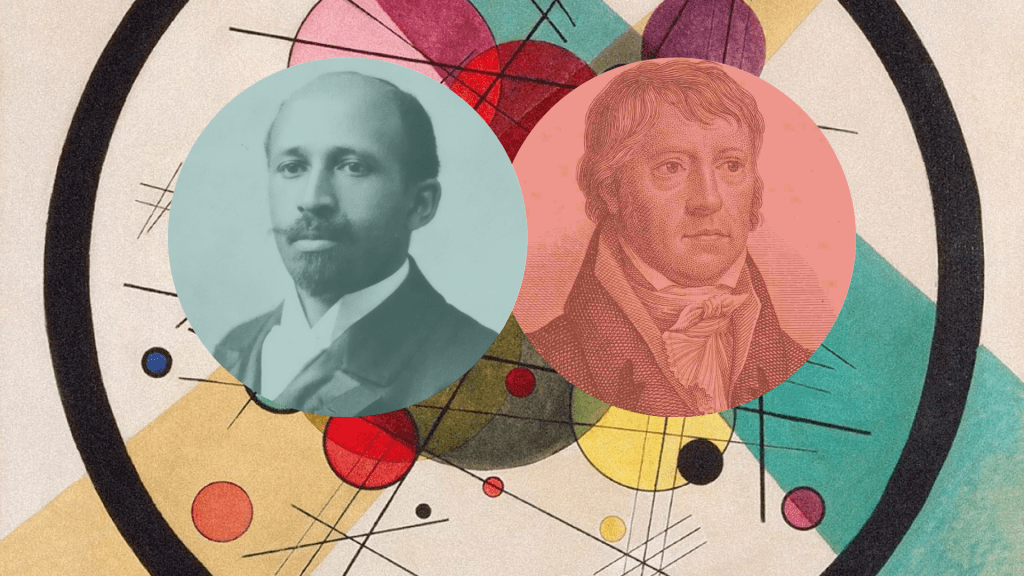
We are publishing a transcript of Dr. Anthony Monteiro’s opening remarks from the Saturday Free School’s April 22, 2023 session Continuing Hegel’s Science of Logic. The Free School meets every Saturday at 10:30 AM, and is streamed live on Facebook and YouTube.
Good morning to everybody — I’m like everybody else, I can’t wait for these hours together where we can engage in very serious intellectual and political work. So I guess what I’m expressing is my gratitude to all of y’all for making this possible. So I just wanted to say as we, once again — and we will get into the readings of this first part of the Science of Logic — I just wanted to make our case. Our case, that is the Free School’s case for reading philosophy and Hegel in particular.
I want to again state why we’re reading Hegel, by which I’m emphasizing why the Free School is reading Hegel, or better, why we’ve returned to Hegel because we had begun this over a year ago, and also how is our reading of Hegel different from what one would expect if she or he took a university course in a philosophy department and read Hegel, or what one could perhaps get in the inexhaustible lectures on Hegel on YouTube. (By the way, there are so many lectures on Hegel on YouTube that you would get completely confused if you did not know what’s going on and who the people are and what their ideologies are vis-a-vis Hegel. Or the many articles one might discover on the internet, or what one might read on Wikipedia, or from various and sundry encyclopedias of philosophy.)
To say how we’re different, we must say where and how we begin, not just with Hegel, but with philosophy, period. As we have said many times, philosophy is politics by other means. Which is to say it is ideology and hence is connected to the class struggle, the national liberation struggle, the struggle for racial and gender equality, and significantly, to the struggles for peace and a new democracy. Our reading is using Hegel’s words and his philosophy of history, connected to the epoch that produces philosophy and to the epoch that is transcending the epoch that produced philosophy.
The question then is, what is politics, and what is ideology? Briefly, politics is ultimately the struggle to achieve, maintain, consolidate, rearrange, and bring into being new politics and power. Politics is ultimately about power, and therefore about the state. The state is that set of institutions, structures, networks and people where ultimate decision making and strategic power rest. That is the state, and philosophy and ideology and politics cannot be understood without understanding their connections to the state, and to the arrangements of power. Anything other than that, I should say is obscurantist — that is, to obscure the real nature of power, the real nature of ideology, the real nature of struggle and class and national liberatory struggles.
However, political struggle is finally the struggle of ideas. Winning the ideological struggle is tantamount winning the struggle for power. There is no struggle for power that is not guided by ideas and ideology.
But then, what is ideology? In its most general sense, and here I am drawing upon Karl Marx and Friedrich Engels and their works on philosophy — ideology is a worldview, in its concrete manifestations, it is the worldview of significant class and political forces in society. Especially a class that holds onto power, must solidify its worldview or its ideology. In this respect, if you look at American society, that tiny part of the population that controls power either through corporate and economic means or through political means and the state, are not hesitant in putting forward their ideas, their worldviews, and in fact claiming that their worldview is the worldview of society itself. In other words, they attempt to give a moral grounding to their ideology by saying that their ideology represents the best of and for society, and in fact is the moral grounding of social solidarity and social stability. We can return to some of this if you wish to ask questions.
Without saying more, we approach Hegel in this way. We do philosophy because we in the Free School are deeply connected with and committed to ideas and how revolutionary ideas can be liberation forces, liberatory forces. Nothing is more powerful, one writer said, than an idea whose time has come. And so it is not an unimportant, leisurely occupation to engage in ideas, to understand ideas and their connections to social and political forces in society. In fact, it is the opposite — not to be engaged in ideas is literally to say that the best that people are capable of is a cycle of empty activity, without a connection to the ideological changes in society.
These relationships between dominant and liberatory ideas are what we call ideological relationships — the relationships of ideas in society. You know, when the Free School, as a lot of people know, we have taken positions on any number of ideas that are current in our society, and we do so because we care for people and we understand that wrong ideas will stifle the capacity of people to become agents of freedom and democracy.
I mean we saw this with identity politics, which took society and the people, you know, like it suddenly appeared and suddenly it was everywhere, and it was loud, and it was boisterous and it was canceling people, and we stood up against them. And obviously, what goes along with identity politics is cancel culture. And in standing up against those ideas, we had to take a stance against the class forces and the institutions like universities that promoted them.
Most philosophers, by which I mean most academic philosophers, connect Hegel to Kant and to Marx, and there’s nothing wrong with that obviously. These are widely explored areas of investigation in philosophy. For example if you went to the University of Chicago, which has a pretty good philosophy department especially in German classical philosophy, you would come out with a real deep academic understanding of the relationship of Kant and Hegel, a very technical understanding. Mentioning the University of Chicago, if you went there, if you go to YouTube, you would probably run into a philosopher named Robert Pippin, who is celebrated as a Hegel expert. But he finds Hegel lacking and in fact finds the 20th century German phenomenologist Martin Heidegger more important or having superseded Hegel. Some connect Hegel to Sartre and Nietzsche and to existentialism. Other philosophers like the British analytical philosophy of the early 20th century Bertrand Russell, and American pragmatists like William James and [Charles Sanders] Peirce and the neo-pragmatists such as the the Princeton philosopher Richard Rorty and Cornel West, by the way, dismiss Hegel as confused, as metaphysical, and as removed from the lifeworld of actual people.
We, on the other hand, approach Hegel in the ways that Marx and Lenin and indeed Du Bois did. We connect the Science of Logic — and this is what is novel and unique in our approach — we connect the Science of Logic to Du Bois’s Black Reconstruction. We therefore are not satisfied with abstraction and metaphysics which are a big part of Hegel’s Science of Logic (and I should say parenthetically not in the worst way by the way) but we approach Hegel from the concrete.
I want to explain that. Marx called this “ascending to the concrete.” That to take philosophy from the realm of abstraction, to apply it to concrete social relations, was not a descent to the concrete, but to ascend to the concrete. And I wish to underline that, and this is a great insight, a very transgressive move on Karl Marx’s part, that philosophy alone was not sufficient because of its overdetermination by the abstract.
And so let me just continue: our move, that is the Free School’s move from the abstract and abstract universal to the concrete, is manifested in our approach to Du Bois and Black Reconstruction in America. Our grasp of the essence of complexity and social complexity is our starting point, not with categories of knowledge.
So we begin with complex concrete realities. You know, it’s so interesting, this connection not made, between Hegel’s Science of Logic and Du Bois’s Black Reconstruction in America is probably one of the most promising moves in philosophy and social theorizing since Karl Marx applied Hegel’s dialectical categories to an understanding of capitalist social economic relationships.
In fact, it’s a well-rehearsed argument that the first chapter of Das Kapital, Marx’s magnum opus, is really showing the application of the dialectical categories and dialectical methods in Science of Logic, as they would be applied to economic categories. We could go back to that. However, at another time and probably not now, we might show the entanglements — that is, the connectedness — of Du Bois’s Souls of Black Folk and Baldwin’s essays in particular — the one “Letter from a Region in My Mind” and Hegel’s Phenomenology of Mind.
There are relations and connections here that have not been made, that could and should be made. But for now, our central concern is for Hegel’s Science of Logic and its relation to Black Reconstruction and Du Bois’s central category in Black Reconstruction; and this is not understood, Du Bois’s central category is the black proletariat, and the proletariat itself. And through the Bandung reading group, through the other reading groups we have, and through the Free School itself, we have discovered that to understand Du Bois’s Black Reconstruction in America, you must understand its central knowledge category and that is the black proletariat.
We have in the past and will continue to explore how Hegelian dialectics, dialectics meaning the logic of contradictions, if you don’t mind me once again repeating this — it is different than the logic of identity, of the logic of syllogisms associated with the work of Aristotle. In fact, most logics today, be they mathematical, be they computer logic, be they algorithms, are based upon Aristotelian logic which excludes the position of contradiction.
In Aristotle’s syllogisms, and by the way just a parentheses — this is not beyond the understanding and knowledge capability of ordinary people, so that’s why we’re doing it by the way. For Aristotle, a thing is itself, that is A is A; A is not B is the second law. And the third one which is an impossibility in Aristotle’s logic, which is the law of the excluded middle — a thing cannot be itself and its opposite at the same time. That is in fact where Hegelian logic begins. That everything exists as itself and its opposite at the same time because everything exists in a state of motion, state of movement, which thereby gives a hint to what might be the resolution of the conundrum of quantum physics and small particle physics which do not fit any laws or patterns of large bodies. I won’t get a lot into that, we’re going to try to set up a reading group on physics and theoretical physics and philosophy in an attempt to find a resolution to problems that people say are unresolvable, but that’s for another day.
Let me just go here, Hegel’s concept of being, of essence, of dialectics, might help to clarify, again, quantum and theoretical physical problems as well as string theory, not to mention the patterns of class and social struggle within the United States. Again we study Hegel’s logic in relationship to Du Bois’s Black Reconstruction. In so doing we elevate Hegelian categories of knowledge to the concrete and to the revolutionary process. Ours is not a metaphysical project, ours is a concrete project; but a concrete project, in order to understand the concrete, requires adequate categories of knowledge.
Hence, we can propose, that is we in the Saturday Free School, that the United States is capable of revolutionary change, and in fact a Fourth American Revolution. And we can confidently make the claim that anti-revolutionary arguments at this time in the United States, are philosophically empty arguments. If one understands what Hegel understood, that everything exists in a state of motion, that the principle law of dialectics is the law of negation as in the negation of a negation, the negation of which itself has previously negated an earlier moment in natural or human history — this concept of negation, this concept of movement, this concept of possibility emerging from the movement of things, the conflict of opposites, is central and it informs the way we go about our work.
To deepen our understanding of the category the black proletariat, its essence and concrete substance, we do philosophy. To better understand what Du Bois’s studies of the class struggle in the United States were getting at, we connect these studies to Hegelian logic. We take seriously Hegel’s claim that philosophy is the science of sciences, that it is a knowledge apparatus, a scaffolding if you will, that helps us understand society. However, as Marx, Lenin and even Sartre showed, Hegel did not quite show the connection between abstract knowledge categories and concrete social complexity.
So we do not start where Hegel started, i.e. with the notion, the abstract concept. We start with the concrete. We go from Du Bois and social historical complexity, to Hegel, and dialectically back to Du Bois. From Du Bois, to Hegel, back to Du Bois. Isn’t that an interesting dialectic.
This is to understand the movement of US history towards a Fourth American revolution and towards our ability to understand the concrete ideological and political struggles now occurring in our society and in the world. I had dinner the other evening with [Free School members] Caleb and Anna. They were working out their futures and their graduate school possibilities. I suggested, given their concerns with cognitive science and sociology and urban geography, they might consider reading Kant’s Critique of Pure Reason. They were very open to that and they asked if certain groups reading philosophy might be where they might start, and I suggested that they not. And I suggested they not for reasons that I’ve already given. To begin wrongly is to end up in the wrong place. So you end up, rather than being closer to the concrete, being closer to the metaphysical and the abstract.
All philosophy and all ideas must bend towards the future and the struggle to usher in the epoch of humanity. To achieve our country, to use Baldwin’s formulation, demands that we bend philosophy towards the future. To make America the ‘Last White Nation’ puts demands upon philosophy that philosophers themselves are incapable or unwilling to do, especially academic philosophers, who turn great philosophers into gods rather than into agents of knowledge and useful to greater human projects.
We are faced with the fierce urgency of now, to cite King. We must know the world so that it might be changed. However to fully know the world is to be part of changing the world. And that’s kind of how we go at this. Sometimes I refer to the knowledge process, the process of understanding categories of knowledge as, forgive this language, concrete metaphysics. Metaphysics, meaning of those categories that precede our immediate experience with the world. Those categories that make knowledge possible, that’s called often metaphysics, meta — before, higher than the physical. However, concrete metaphysics subverts abstraction and looks to the concrete world. So I just wanted to say that as we start again our reading today of the Science of Logic, which I feel is a really great project. I don’t know why more people don’t do it frankly, especially if they claim an allegiance to radical change in society.
 Avant-Garde: A Journal of Peace, Democracy, and Science
Leave a comment