
Read the Introduction, Part 1, Part 2, Part 3, and Part 4 of the interview series with Catherine Blunt.
Lucien and Jannie Blackwell bridge the current period of today with the period of the 1960s and 70s. Lucien Blackwell first took office in the 70s, and Jannie Blackwell was in office until recently. How are the Blackwells significant? What produced them? Why were they so trusted by the community?
This is the era of the 50s and 60s. We had the Civil Rights era, we had Martin Luther King. We had Cecil B. Moore and the great ministers. This is an era where the Black community from the 50s on said, we want to assert the fact that we are being discriminated against and held back in this city. And so the push was to be involved with the community and to press for the community opportunities and education, jobs, etc. that were not made available to the Black community, which certainly hurt the Black community tremendously.

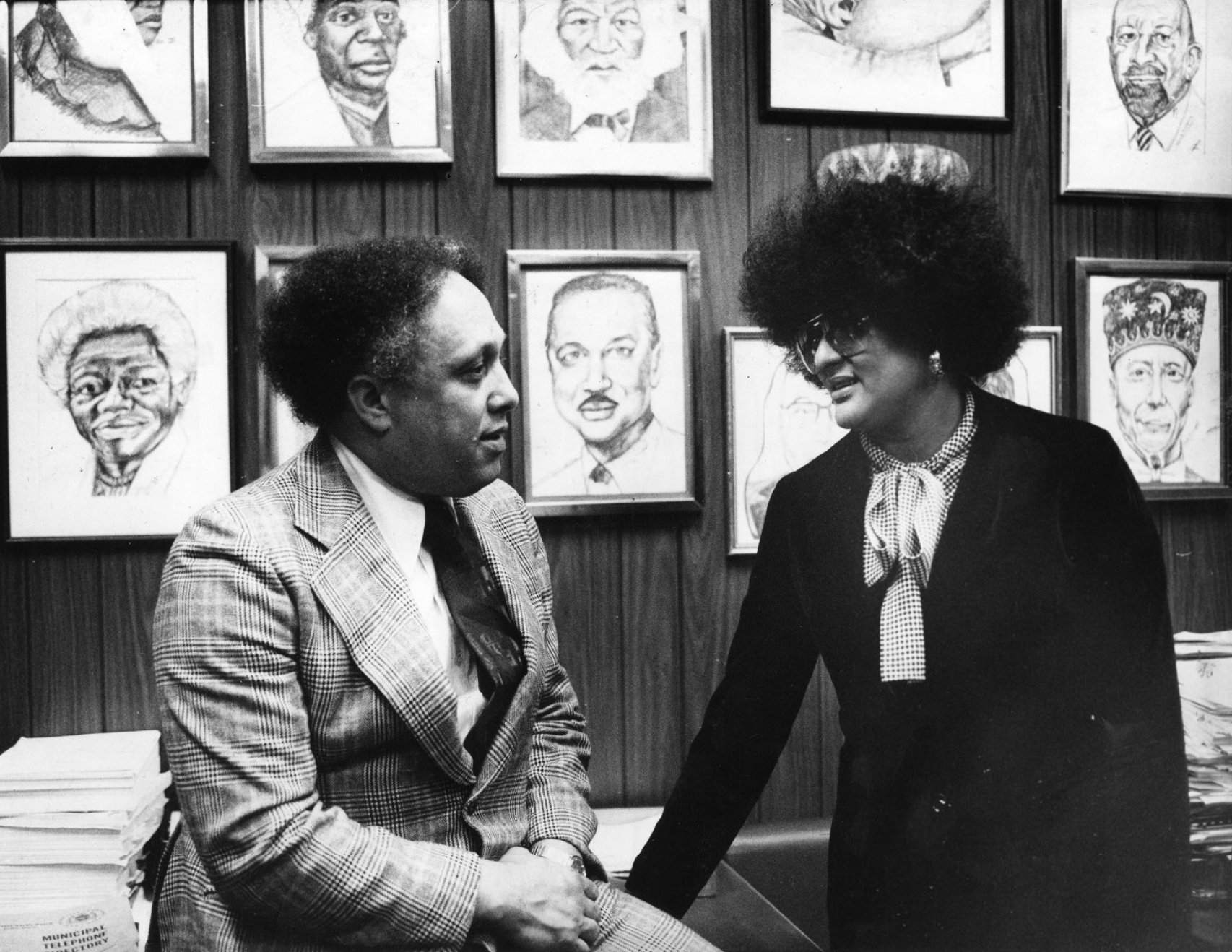


Images of Lucien (Lu) Blackwell and Jannie Blackwell at their 46th ward office and with supporters
(Courtesy of the Special Collections Research Center. Temple University Libraries. Philadelphia, PA)
Lu Blackwell worked on the waterfront and was very powerful on the waterfront. He ran for city council and won and was among the first African Americans on city council. He was very outspoken and argued against the institutional racism that is practiced on city council and in the city. He was involved with the peace movement as well. There was an organization called SANE (National Committee for a Sane Nuclear Policy) and people like Michael Jackson and Jane Fonda were involved. Lucien Blackwell attended and spoke at an event by SANE when he was running for mayor. He was the first Black candidate for mayor of the city and that was big. He was of the community and there was unity. At the time, the Democratic machine did not support Black candidates and so Black candidates had to go out in the community and rally their folk to come to the polls. Lou went about in his community and organized people around issues. Once he got elected, he did wonderful things for the community, which Jannie continued even after he died.
There is this farmers’ market, which is now Dock Street. In the late 80s, Lu gave that building for $1 to a community organization called Cedar Park Neighbors to be made into a farmers’ market. Through Cedar Park Neighbors, which owned the building and the business, the farmers’ market was created with the community. But Cedar Park Neighbors is a white-dominated organization masquerading as a community organization. So even white folk don’t like ‘em because they are excluded. Cedar Park Neighbors had their own agenda. And so Lucien stood against them and Jannie Blackwell stood against them. Lu and I took over Cedar Park Neighbors and we ran it in a democratic way after they purchased the building and they built everything. While I was President and Vice President of Cedar Park Neighbors and Lu was involved, we supported the community and tried to make it a community-based market.
The problem with Cedar Park Neighbors is there’s always a meeting before the meeting. You go to a board meeting and decisions have been already made. These people are mean and nasty. They will speak you out, tell you to shut up, and maybe curse you out and be drunk at the same time. One of the reasons why these folk, east of 52nd Street, do not like Jannie Blackwell is because she does not support them. She doesn’t support their behavior. There was a big fight around the market and ultimately it was sold.
People get tired. It’s like generation after generation of them. I’m telling you, they clone and everybody else gets tired. Black folk are fighting every day all the time, so they don’t want to fight these crazy white people. It got to a point where, even where you have people who are trying to do the right thing, you have folks who don’t want to do the right thing. A split occurred in our group, and people were not willing to really get in, continue being engaged in that fight. I lost my election and I walked away and had other things to do. Jannie, who had become City Councilperson at the time, would not support that. Rightly so, she supported the Black community, and good white folks wherever they may be.
Jannie’s a nice lady. She’s not mean at all. Even when they’re nasty and mean to her, she still smiles and does things for them. That’s the kind of person she is. Even to this day, she’s loved in the community because she has done a lot for the community. Those that get upset at Jannie see the Blackwell name and talk about a “Blackwell dynasty”. First, that’s racism. Second, those people have a whole other agenda for what they want to see happen in West Philly, which will put money in their own pockets. This is a level and layer above the average West Philadelphia citizen. Then we have the West Philadelphia youth who may have come from Drexel or Penn or wherever they came from with not a clue and end up getting involved in Reclaim – that group on 51st and Spruce.
The Blackwells represent the pushback and the fight against the racist policies and practices of the city for the Black community and the needs of the Black community. They are a continuation from the 50s. It started with the great Civil Rights leaders and Cecil B. Moore.
This segues into jobs.
I link jobs and education because we have to start looking for solutions. Of the ten largest cities, Philadelphia has the highest population of poverty. We have schools where 100% of the children are from economically disadvantaged neighborhoods.
A Black guy who was investigating becoming a police officer asked, “Why is the need for police officers so high? Have they been going into the community to get folks to apply?” He was told, “Yes, but the people can’t read.” The guy says, “Well, maybe they shouldn’t be police officers.” But my thing is, ”Why can’t they read?”
How are you graduating people that can’t read or write? I always knew education was important. For the last four years, I have felt that the city needs to build its own workforce in dealing with this poverty and job crisis within the black and brown communities and poor communities. The way they build this is by linking the jobs to the high schools. Everybody in high school is not going to go to college. If they are going to go to college, the city should give them a leg up – make sure that community college for two years is affordable and make sure there is a link between Community College of Philadelphia and Temple. There used to be a link, but that link has now vanished. The City can pay for anybody who wants to be a teacher to go to school for four years – they work in the communities for five years, their debt is wiped. We have a police force that is in need of police officers from minority communities. You link up. The police force has something called the Explorers Cadet Program. But even before that, we have to talk about revamping the mindset of the police. Completely revamping, in terms of making it a police force that has a mindset that it does not support property. It supports the people. That it does community policing. Walk into the community, performing liaisons with the community.
There are already structures in place such as the Community Advisory Board. But guess who’s on it? Hand-picked fools. They have a whole stash of hand-picked people that they circulate in various commissions. I was put on a commission by Jannie Blackwell, which is the only way that somebody like me would be on a commission. I was on a commission for pre-kindergarten. She put me on there and I was a community voice. They didn’t like the fact that I was a community voice. I would not let the back office, all those tired folk in City Hall, do all the work. I insisted on community meetings, which we had. I insisted on putting the community voice in the reports, which we did. Then I insisted on having a vote because they didn’t want to take a vote for the final report. And I insisted we record who voted which way because I thought that when you have a commission, you should not allow them to obscure how they voted. I voted against the piece. I worked hard on it, but I voted against it because I did not agree with the premise. This started under Mayor Nutter and ended under Mayor Kenney. Now Kenney appoints the School Board and of course, when I applied to the school board, I was not going to be appointed. And I understand stuff like that. That’s why people like Jannie Blackwell become important. If it wasn’t for her, I wouldn’t have been on the commission for pre-kindergarten. Some other people would not have been on it. We would not have exposed some of what we exposed regarding notions of pre-K. They would not have been able to be pushed further than where they intended. So when you remove people like her, you control the voice of the community.
If we can get the apprenticeships for the students who want to go into various fields, then we can provide opportunities for our youth so that they can graduate and ultimately end up with well paying meaningful jobs that will sustain them and their families. We can get the unions to go along with this. That’s how you get out of poverty – you provide opportunities for people.
The big push is for entrepreneurialism, but you cannot entrepreneur yourself out of this. There is no such thing. The money folk will not lend money to sustain black businesses. And that’s only minor. It’s not what China did, it’s not what Cuba did – they have to be the models. When we talk about poverty and addressing poverty, it’s not about workforce development, whatever it is the city’s talking about. It’s about actually providing jobs, and they can do that. They’ve done it before, and they can do it again – start providing meaningful jobs, which allows people to make enough money so that they can afford to buy a house, which provides enough benefits where now they don’t have to work a second job and they can spend time at the school that their children go to. It’s sort of the middle class way of living, but you spread that over to everybody. Education is important for jobs, and jobs have to be made.
Nutter began and Kenney continued to import a workforce, particularly women, especially women. Go down City Hall now, a lot of young women. The other thing is they promoted young people, 40 and under, into positions of power, which they should not be in because they don’t have the experience. Are they mature enough? It’s like the city is bowing down to the millennials at the expense of the city itself. Everybody has to be trained. They have to be in that environment. But the environment is unhealthy too, because there’s so much corruption now in most corporations and businesses. It’s about money. This is like capitalism at its worst and it impacts just about everything. When you try to look at it from above, you see the massive destruction that is being caused and that it will continue to cause. You wonder, “Wow, well, how do we deal with this?” You really can’t get depressed by it. You can’t think that there’s not a way out. This is a tough time for you guys. But you have to remain hopeful, and you have to do your work on your level, because it’s got to be ground up. It comes from the ground, not from the top. We want some of that, but we’re only going to get a little bit from Biden. We’re not gonna get a whole lot. With electoral politics, we’re only going to get so much from that. We need to use that to educate people, which is what Reclaim claimed it was doing, but it was not.
With my work with the 46th Ward RCO, we look at what candidates we want to run, why we want them to run and what’s going to be the black vote. The platform becomes very, very important, because the platform is to highlight the issues that the community wants addressed to try to galvanize the community. Without the community, we’re lost. We can’t just fight it ourselves. We’re just a small group.
Where do you see groups like Philly 3.0 and Reclaim, or these new “progressive” politicians like Jamie Gauthier and Rick Krajewski? Where do they fit into the picture? How would you compare the notions of what progress means to these so-called “progressives” to those of past movements that you have been involved in?
I had a conversation with somebody about how we make progress, how we measure it, and what we are looking for. I started with Juneteenth, a holiday we did not ask for, that I will never celebrate. I will never celebrate a lie. Those people in Texas can continue to barbecue all they want, but Juneteenth was a ploy by Biden and by this Mayor. ”We won’t give you reparations. We will give you a damn holiday, and you go out and celebrate. Get drunk and do some fireworks.” I see that as a way of controlling the Black voice, same way as with Black Lives Matter. Controlling the Black narrative, controlling the Black voice. That’s what Reclaim does. Reclaim claims to represent the community, but it doesn’t. It has never asked the community what the community wants. It is not of the community and it is not in the community. It is an overlay.
Jamie Gauthier’s father was from Southwest Philly. Maybe she grew up there, but she is not of there. Even her father, Leon Williams, has an interesting history. Back in the day, usually on talk radio, he would generally take positions that did not resonate in and with the Black community. He never engaged in the struggles that Lucien Blackwell or Cecil B. Moore did. But her father knows the people of Southwest Philadelphia District Services, she doesn’t. Gauthier went to Penn and became an urban planner. As such, she was trained to promote gentrification of West Philadelphia communities. She had two jobs prior to her becoming the City Council representative for the 3rd District. Her first job was with a nonprofit. Later she worked for the Fairmount Park Conservancy. She had little work experience in and with the Black community.
When she ran for her City Council seat, she stayed east of 52nd St in predominantly white neighborhoods, not west of 52nd St in neighborhoods that are predominantly Black. When you look at how Jannie Blackwell lost, you don’t know what role the people west of 52nd played because voters were not informed, causing the turnout to be low. We keep that in the back of our minds while we continue to organize against gentrification and the loss of Black home ownership. Gauthier was supported by 3.0 and 3.0 spent almost a half a million on her campaign. It was a very quiet campaign and with little being done west of 52nd street. It was assumed that people would turn out to vote for Blackwell, but they didn’t know she was running and they did not participate in the election. East of 52nd street was being organized against Blackwell and for Gauthier, particularly by the 27th Ward, which includes the University of Pennsylvania, a bastion of gentrification in and around the West Philadelphia neighborhood. This is where Penn students played a role. They carried Gauthier. Even in my ward, people said, “Oh, Jannie’s too old. Oh, she’s in with the developers.” It escaped people’s minds that 3.0 represents billionaire developers in and outside the city seeking to gentrify Black, Latino poor areas of the city. Then you have other organizations: 5th Square, Bicycle Coalition, and Transit Forward. These are staffed by millennial graduates of Penn, Temple, and other universities promoting the gentrification of urban areas, especially those close to universities seeking to expand their power base and influence.
With Reclaim, you have Rick Krajewski, who replaced Jim Roebuck as the Representative for the 188th District in West Philly. Rick, who graduated from Penn, is from New York and is biracial. It is interesting that when he ran for office, he only used ‘Rick’ and not his last name to obscure his mixed parentage. He too was supported by the 27th Ward, mostly white folk. The Black folk west of 52nd St again did not turn out for Jim Roebuck who thought the Democratic machine would carry him. For the most part, the Democratic machine is broken and not as reliable as it has been in the past. The other piece is that younger people now are using electronics and technology. They email-canvas rather than face-to-face canvas. Older candidates and politicians don’t do that. They’re not into all of that. But they weren’t going face-to-face either because of COVID. For about ten years after graduating from Penn, Rick volunteered for nonprofits and was allegedly supported financially by Reclaim, who consider themselves progressive. But we have positions like the people’s agenda, see, and this is where Helen Gym fits in. Helen has a whole host of organizations that she is a part of and has worked to build. That is why she is the highest vote-getter among the seven City Councilmembers. She’s well organized. She’s worked on issues regarding public education. But her message has declined over a period of time because at some point, people, and even Helen, begin to think about their election and getting elected as their priority. She really doesn’t have anything to worry about but she wants to become Mayor. So I think she toned down her positions and is doing a lot of photo-ops instead. Her days of commitment were when she was building the structure that she now has: a well mixed group, especially a lot of African Americans and white folks. The problem is, what are the community-related issues she’s championing.

I was asked by Our City Our Schools to run for the school board and I said, “I’ll do it. And I will go to their meetings.” I would raise issues such as the 10-year tax abatement and getting funding for the schools. I would say, “Don’t we need a forensic audit of the school district’s budget? How do we spend this money?” Right now, we’re throwing good money after bad money. How is it that the city is getting 46% of the property tax? Isn’t the city robbing the school? Those are the things that I wanted to talk about, because they were critical. They were fundamental, they were foundational issues. But they wanted to do 10-year tax abatements. It’s not that I’m opposed to doing the ten year tax abatement, but that’s only one issue. And then they want to do pilots, and pay Penn to do some tests for a million dollars. But does that mean? They weren’t prepared to talk about those issues that expose the mismanagement of money in the city. Before I could even go to the final interview, I had to fill out this questionnaire. The millennials are so busy trying to make sure that everybody is represented that they are insulting people. The reason why this is happening is because the millennials are not clear. Don’t ask me my age, that’s none of your business. We have fought ageism, which is another problem. Millennials got a real serious problem with ageism. And this whole thing about sexual orientation. They’re more comfortable with that than with Black folk. It’s easier to talk about LGBTQ and trans and about building a bathroom for transgender people than it is to talk about building low income and moderate income housing for Black folk. They’re trying to use gender so as to supplant the issue of white supremacy and racism. All that becomes very, very clear. You see it in the Black Lives Matter. You see it in MeToo. You see it in many ways, in many places, and people like Krajewski, they’re comfortable with that.
The strippers had a second fundraiser at Malcolm X Park. Have you ever heard of something like this? You’re gonna have sex workers come to a park where there are children and they’re gonna put up their poles, pole dance and have people throw money at them. Gauthier said everybody has a right to work. Now nobody’s opposing sex workers working. But you don’t work. You notice they didn’t come east of 52nd St. Okay, what is it? Why is she so comfortable with it being over there? Have you heard anything from Rick Krajewski or Reclaim? Have you heard anything from the so-called progressive about that? You know them by what they do. The fact that they’re not involved in the fight against gentrification tells you they are apologists. They become apologists for the capitalists and what I call the polite white supremacists. That’s who they are. It’s about making money. Money is more important than people. Money is more important than humanity.
These “progressive” forces are not progressive. You can see it when you look at the landscape of West Philly. They are absent in the struggle. 3.0 is outright capitalist. 5th Square is outright capitalist. Bicycle Coalition wants to change West Philly into a European city. They want to bring Europe into West Philadelphia. Make Philadelphia into a European city, right? With the bicycles all over. Kenney was paying $155 million for the Schuylkill Trail. But would he provide housing for the homeless? I’m not talking about shelters either. Will he provide low-income housing? People are on waiting lists for low-income housing. Would he use that money to repair some of the schools? Who’s gonna use that? Black folk gonna use that trail? No. Now they want electric bicycles. I mean, that’s cute. But as opposed to what? We have people with dire needs, but this is a city that has gone broke. This is a city that is filthy dirty. That has dumping all over the place. That has all kinds of developments going all over the place. That does not seem to have a plan. They like confusion. Anarchy comes out of that and that means that people can do whatever they want to do. That’s what’s happening now. This is unbelievable.
5th Square is related to 3.0. The Bicycle Coalition and the Transit Coalition want to replace the trolleys and put high speed trolleys. Where the money will come from, I have no idea. Biden buys into this whole notion of density and affordability. They don’t even know what they’re talking about. They have not come to any communities because they don’t work on the ground. They don’t really speak to the community. You have to go through so many layers before you can get to the community. They don’t know the truth. Groups like 3.0 are seen as legitimate. Reclaim is trying to be legitimate. I don’t even know if white folk in the community understand that Reclaim does not represent Black folk. It’s a very dangerous role they play. They’re like the veneer. They have to be held accountable because they’ve made a choice and their choice is not to be of and with the community. They know what they’re doing. I don’t excuse them at all. I don’t excuse Gauthier at all. She knows what she’s doing. Rick knows what he’s doing. Now maybe, they just don’t see us because they live on a different level. But I don’t see how they can. The mindset is certainly not left. It’s not real. It’s not authentic.
One of the issues that you’re touching on is something that we see a lot today of the so-called “progressive left”, which is the dishonesty and how they claim to present a certain agenda and to represent the people but really they represent another agenda. Then also, you talk about the confusion and anarchy and how in that environment, it’s very easy for people to take advantage of whatever they want to. Even on a broader national level. We saw [in 2020] the Black Lives Matter, George Floyd protests, and the slogans of “defund the police” and “abolish the police”. How did you see the effect of those kinds of slogans and protests in Philly?
Slogans like “defund the police” played into the hands of [Carlos] Vega who was running for District Attorney at the time but was unsuccessful. This narrative is very dangerous and damaging because it is portrayed as coming from the Black community but it is not. It plays into the hands of the FOP [Fraternal Order of Police] that has demonstrated a history of bias against Black people. Again, it’s so-called progressives setting up a narrative that does not represent the people they claim they represent. It’s dangerous because the forces out there, legitimate and non-legitimate forces, take these slogans as gospel and it casts the Black community in a bad light. It makes the police think, “Oh, they want to defund us so why should we protect them.” What I have noticed since all of that, is that there are fewer police patrols in the area. I mean, I hardly see any. They’ll stop and go to the breakfast place, but they don’t patrol, which is really advantageous for criminal behavior. Crime occurs especially when you don’t have a police presence that engages the community in safety measures that build police-community relationships. We’re not talking about a police presence that is bullying people, but a police patrol that becomes part of the community. When that happens, it produces a natural deterrent as well as a sense of safety within the community. It is believed the FOP told its members that “defund the police” was the sentiment expressed by the Black community, which caused a response like “Oh, we don’t want to risk our lives”. I can’t speak for other neighborhoods, but I do know in West Philly, in the areas where I am, I hardly ever see the police. Then you have all of the shootings. Crime is allowed to just occur. Guns were allowed to come into the city. So it’s like law enforcement steps back, which is another assault on the Black community. They can find where these guns come from but seem not committed to doing so. At one of those Black Lives Matter demonstrations, a white woman firebombed a police car and they found her through some emblem on her t-shirt or something. If you want to talk about guns, then you have to bring in various national law enforcement agencies to trace and stop illegal gun trafficking now proliferating Black neighborhoods.

The fact is that the narrative goes to communities that don’t know the Black community, that are being recruited by white supremacists, and that are being influenced by the white supremacists and their ideology and their narrative. They mistakenly believe in law and order but don’t understand what that means. They believe in protecting property. They have as much to lose as Black folk. They have nothing. Some of them are worse off than Black folk right? Appalachia and those places. It’s very dangerous because it’s divisive. It’s extremely divisive. We need to be forging relationships with these various communities based on similar concerns. It can be done. It can be done. And so those voices drive a wedge. We’re separated physically but we have to find opportunities for us to have these dialogues. These narratives put out by these folks paint a negative picture about us without us having the opportunity to say, “No, that’s not who we are. And that’s not what we are.” The media doesn’t say the Black community does not support the police. Because they know clearly, that’s not something that the Black community is about.
Fortunately, the Black community showed up for and elected Krasner instead of Vega. It is that support for criminal justice reform in the Black community that hopefully will create fairer conditions within the criminal justice community for Black people and other people of color.
What do you think are the possibilities for building unity among the Black working class, Black community, poor whites, and immigrants?
We were doing something called the RCO [registered community organization] Roundtable in West Philly, where various RCOs meet and talk. It’s through the Roundtable that we hoped to and did meet with Gauthier around saving residential areas by correct-zoning them to single family. It would have completed the down-zoning remapping done by Jannie Blackwell in 2019. Gauthier’s ultimate response was to introduce overlay legislation that enabled gentrification rather than downzone areas we had identified.
We also wanted to involve RCOs across the city, but the problem is that not all RCOs represent the people and their communities. There are some who do and so there is a pushback throughout the city against gentrification, from Society Hill to Germantown, etc. However, we have to be careful not to be taken over by millennial organizations which support gentrification like an RCO in Fishtown that is now run by millennial-gentrifiers in an area that was white working class.
We really have to think about how to find the venue. I think that there’s certainly a strong possibility with the immigrant community. There is a West Philadelphia RCO that engages the Asian community in its efforts to confront gentrification. We have to somehow find a way to do that while at the same time, remaining in the struggle to protect our communities against gentrification and displacement. We’re a small group, so we have to expand and find ways to outreach to other communities. Right now, I think a lot of our groups are kind of insulated. Because even the African groups in West Philly are the same way. Somehow we’ve got to penetrate, to reach out. I know that maybe through Jannie Blackwell, we can get to the African groups. But in terms of Asian groups… we have to think about outreaching perhaps through elected officials like Councilman David Oh and maybe Helen Gym.
In terms of the white community, they’ll come. Even though I don’t believe in electoral politics, I do run as a Judge of Elections in the 46th Ward. I do have to go door-to-door to communicate with my neighbors. I don’t have a problem with that. In the course of that, I will become acquainted with people that I believe are like-minded, that have similar thoughts. Those are the people that I will engage with, most notably when it comes to time to organize. It’s a work in progress. It’s difficult.
We wanted to talk to you because we, as part of the younger generation, have so much to learn from people from your generation. And there’s just so much that gets in the way that is distracting younger people. Something that I’ve really learned from talking with you is how these issues which are so local and so involved with people’s lives on the ground level connect to these global problems and issues. You’ve been to places like Palestine. You’ve done so much work in terms of solidarity with South Africa and Namibia. Looking back on that experience – of being part of multiple, interconnected movements – what does true solidarity and true unity mean to you?


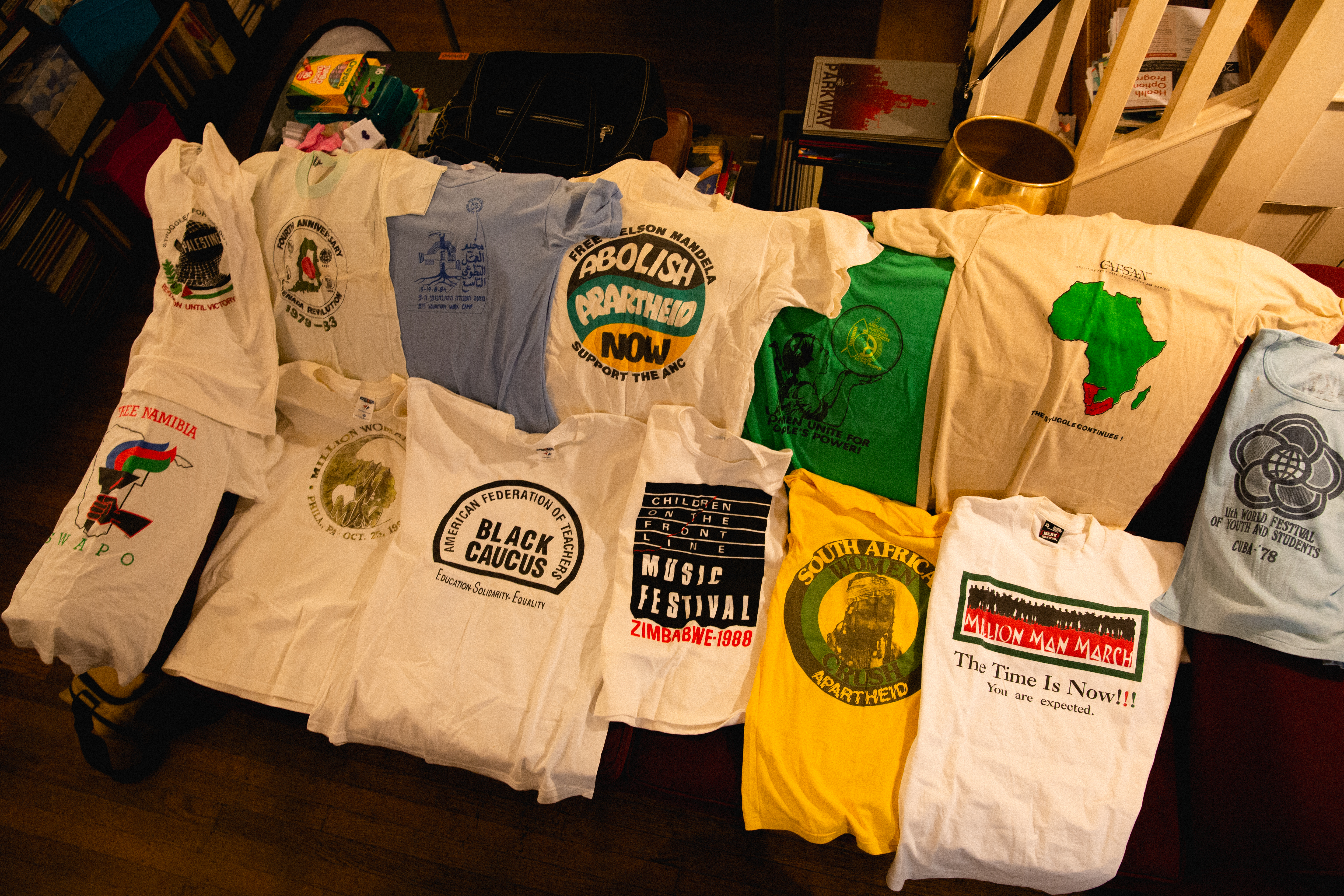
Photos of Catherine in her home with political memorabilia, including t-shirts from various movements, historical events, and causes (Photos by Michelle Lyu)
Since re-engaging with the Saturday Free School, I became acquainted with the Beloved Community, the World House and the Single Garment of Destiny [of Martin Luther King Jr]. And I have an affinity for these concepts because I believe that’s where we have to go. When I was in Cuba, I saw it there. When I was in Palestine, I saw it there. When we did the anti-apartheid work, I saw it in the spirit of the work that we did. This sense of camaraderie, of being comrades, of being a collective. Even some of the work that I do now, I see it. Because you make these connections with people in the community. They are genuine connections, and you have an impact. And they have an impact. And it’s so authentic, and so genuine. You know it, you feel it, you see it. And it makes you hopeful about humanity, stripped of all the garbage we deal with everyday. I learned a lot from all of that work. I did. I learned what it means to be a comrade. I learned what it means to be focused. I learned what it means to be organized. I learned what principles of unity are. Why you have to have order. Why you have to have structure. Why you have to be focused. I also learned about why you have to withhold judgment initially. You just don’t write people off. It takes work, it takes effort. And I also learned that during the struggle, you do experience that beloved community and it’s wonderful. So you kind of have an idea. It gives you an idea of what it is that you want, in terms of people that you deal with, in terms of the world in which you want to live in and the community in which you want to live. You see the possibilities. And I think that young people need to see that possibility. Because you live in a time that is darker than I did – I think this may be the darkest period in human history.
At least in America.
At least in America – from an American perspective. There are also good things happening. And see, that’s the other piece. Being like Du Bois, who visited Russia, and being able to go to these other places and see where this human development is occurring, this development of humanity is occurring is important too. I think that the Saturday Free School also provides that kind of unity, kind of grounding, kind of support – social, emotional, intellectual – that one needs. When you look at what solidarity means, you see it in what you do in the Saturday Free School. I see it through the work I do. But I also recognize that some of the work that I do is at an infantile level and it’s not going to have strong bonds. One of the things we have to do is to build those strong bonds. Those strong bonds are very, very important for solidarity. It’s very easy once you break down the barriers. We break down the barriers because then people talk with us and they see us. They learn that we are genuine. And if we are consistent with them, they bond with us and even when things go off, you don’t break them off. You still try to bring them back into what we think would be a good union, a good solidarity. Sometimes people have to go off, but we don’t leave them out there, we still keep touch with them until we bring them back.
You experience solidarity now – the solidarity that you have among the group. And this is the solidarity that we want to have in the community. I have it somewhat even within my block. I’ll tell you one story. One of my white neighbors on the three story end of the block, where the houses don’t go for half a million dollars, said to me one day – “Maybe we need to separate and form our own block.” He didn’t want to be with them anymore. And I laughed, and thought yes – because they were of a different class, a different mindset. He did not feel any solidarity with them. He felt solidarity with what I call “the wrong side of the railroad tracks”. We’re the side of the block that has a lot going on. It’s certainly a lot more diverse, economically and socially. Solidarity is important. You guys are taking the right steps. You’re experiencing it – you really are. And coming to meet with you, anytime I’m with you guys, is an instant sense of solidarity because of who we are, what we believe in, our vision for humanity, and our experiences together. Pushing it beyond that is tough.


 Avant-Garde: A Journal of Peace, Democracy, and Science
Leave a comment