

Read the Introduction, Part 1, and Part 2 of the interview series with Catherine Blunt.
What kind of role did figures like Cecil B. Moore and Father Paul Washington play in the movement and the people’s consciousness in Philly? It seems like those were two very important and pivotal figures, at least in Philadelphia.
Yes, Cecil B. Moore was prominent. There were other folk, but he was prominent because he was outspoken and he challenged the system like no one else had done before. And so it was not just about integrating Girard College, but it was also about providing jobs for people and having black folk have access to jobs. When I was coming up, downtown was segregated, basically. And black people could not work downtown, except as elevator operators. They certainly weren’t cashiers. And we didn’t really go downtown except on maybe Easter and some of the holidays. Downtown was exclusively for white people. We went and shopped but that was it. But the jobs were not just in downtown but in government, etc. Cecil B. Moore fought that fight to provide decent jobs for black people in Philadelphia. And that’s why he was so significant. People always talk about Girard College, but that was just one of the things that he did. What was more important was the symbol he became for us in the struggle for justice and equality. And that side of him, they don’t talk about at all.

(Courtesy of the Special Collections Research Center. Temple University Libraries. Philadelphia, PA)
So you know, you fast forward to Father Paul Washington and the Church of the Advocate. First of all, Father Paul Washington was … it wasn’t so much that he said anything, it was about what he did, that he opened the church for us to come and have our meetings there. And he supported our movements, and he saw the city as his parish, and not just the immediate community. And his impact was to facilitate. And he did. He did that very well. That’s the long history of the Church of the Advocate — it has to do with him and not so much the building itself. His association with the black leadership, his association with the various groups that were coming together for social justice and against racism, etc. So again, it’s not so much what he said, but what he did that made him important.
There were others. David P. Richardson — have you heard of him?
No, we haven’t.
David P. Richardson was a state legislator elected from the Germantown area. He grew up around the same time that I did, and he was a big man. He must have been 6’5”, and he always wore African garb, so he wore his ethnicity. And he was very powerful and important in organizing people around the issue of Black Power and black politics. He worked with the black politicians to form a black caucus of elected officials and to get policy passed on the city level and state level. There were several meetings in Philly on Black Power, which I think he convened one of them. So I worked with him around anti-apartheid stuff, so he was part of the anti-apartheid movement as well as linking the struggles at home and abroad. But he was important.

(Courtesy of the Special Collections Research Center. Temple University Libraries. Philadelphia, PA)
Then there were the ministers — Reverend Gray Sr. at Bright Hope Baptist Church. And the ministers were instrumental in bringing King to the city, and they worked with King around some of the issues. But their part in the Philadelphia story is not always told. Everybody involved in the Philadelphia story is not always identified, and their stories are not always told or heard.
How did people in Philadelphia view King and the Southern Civil Rights movement? That’s part of what is not told in how you understand Northern cities and the South.
King, being a Baptist minister, of course connected with the Baptist ministers of Philadelphia. And Tony [Monteiro] will tell you. We were young and we didn’t understand what King was about. So somebody like Gray, Reverend Weeks, and all of them, brought him into the congregation. This was at a time when black people went to church. The black middle class and black people in general went to church. So their embracing King had a significant impact on the black community. So we may have been young and we may not have understood exactly who King was because Malcolm seemed to be more fiery, but we had to acknowledge and give him his props — particularly after the March on Washington with all those people coming and this thing about the bad check and what he and the Southern Christian Leadership Council were doing in the South. And this was after Emmett Till, so we were very much aware of how racist the South was. It was these ministers and their congregations that provided the overwhelming support in the North for King, particularly in Philadelphia. So they embraced King. King went to those congregations and spoke to those congregations in the same way he was doing in the South. And there was, I think, a following of King.
Younger people — we weren’t clear. We didn’t understand his importance, but let me tell you, the average black person over twenty understood and embraced him and his message against the racism in this country. We understood, as young people, the need to do that. But we just didn’t understand the how, and we probably thought a more fiery approach like Malcolm was going to be it. History showed us something else. As we look back now, we can see. So King’s impact on the city was significant. It may not have been apparent to the young people because at the same time we had Stokely Carmichael or whatever he calls himself, coming out. Black Power and the whole Black Power movement sort of diminished what King was establishing. But what King had established led to the whole concept of Black Power and the need for Black Power, particularly as it was clear that the system was not going to give us anything that we deserved.
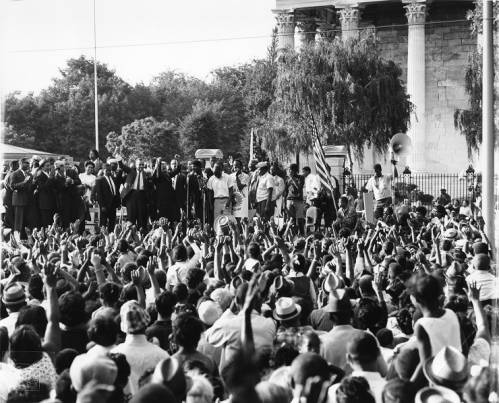

(Courtesy of the Special Collections Research Center. Temple University Libraries. Philadelphia, PA)
I know that King spoke to a school. There’s Barratt School and he spoke to those students. And also there’s a placard at 40th and Lancaster where he spoke, and that was not far from one of the churches. I can’t remember that church, which is on 42nd Street near Haverford. So yeah, it was significant.
Could you say more about what you mean about how King established the groundwork for Black Power to emerge?
When you view stuff going on — we could still see stuff going on the TV, and we could see pictures of Emmett Till’s body, we could see the marches, the bus rides, etc. — you look for a response. What is going to be the response to this? Certainly black people didn’t have any power and that’s what became evident as King and the Civil Rights movement and the bus rides occurred, and even the March on Washington. It became clear that black people did not have the power to change our circumstances. Then the notion of Black Power became something that loomed large for us because if you have no power to change your circumstances, that means that you are relying on somebody else’s power to liberate you. Black power came particularly from the young, as something the young realized we didn’t have and we needed and with Malcolm saying, “any means necessary.” We felt that the older generations were taking it too easy and taking it too slow for us to get anywhere. That was, for us, the next logical step: Black Power. So Stokely and his group SNCC [Student Nonviolent Coordinating Committee] came out and said Black Power. The younger people identified with that.
The way that Black Power is represented, whether it’s in classrooms or documentaries, the connection between that and what King represented is not clear. Was Black Power something that meant different things to different groups?
Well it did, because I mean, on the one level, it meant identifying with your groups. The cultural nationalist aspect came into play as well. Those folks started having meetings and trying to organize around how we gain power and having a convention here in Philadelphia. I think it was called the Black Power convention, if I’m not mistaken. How do we gain control. So basically, this was more of a younger people thing — not necessarily the older people who stayed with King and didn’t necessarily go with Stokely.
With the cultural nationalists, their thing was we needed to re-identify with Africa. But, I guess for many, it was a show of defiance. Number one, we define ourselves, we are no longer Negroes, we are black, and then we are African American. And for some, well it was like we are going to give up our last name because they were our slave names, and we are going to be an X, or we are going to assume African names or Arabic names. It manifested itself in many different ways. But I think it was an attempt to define who we were and what we were about. But the black sense of power was elusive. It’s one thing to say Black Power. So we got more black people elected — I don’t know if that meant anything. I don’t think so, to some extent. And they talk about economic power as well. Forming black business, black co-ops. I will tell you, in Philly, there was a lot of stuff that went on.
Have you ever heard of the Odunde celebration on South St?
You had mentioned earlier, so we looked it up.
I think Odunde was formed around the same time. There was a lot. Philly was really thriving. A lot of black people owned their homes. A lot of people didn’t. Youth were going to school. We weren’t going to just traditional black schools like Cheyney (Tony went to Lincoln). But we were at Penn, we were at Temple. We were with international students at Penn, Temple, Swarthmore. It was a period of awakening, redefining ourselves, and understanding that we had power to do that and even think about entrepreneurialism to some degree. To think about cultural alliances and form Odunde and other cultural expressions. The Arthur Hall Dance Troupe to rekindle and get acquainted with our culture in Africa, etc. It was not a definitive notion. We talk about Black Power, but it was a combination of things we did that led to some actualization of who we were in Philly. But it didn’t necessarily lead to any sustaining real power.
When we look at the state of the black community in Philly now, it looks like those times did not occur. Because we lost significant people. We lost Dave Richardson. Black Power became black politics. People moved away from the movement. That’s it. If you ask how Black Power is realized today in Philly, I don’t know what we would say. We have some people elected, but I don’t know what that means. Their being elected has not significantly and positively impacted the state of things in the black community. It was elusive. Black Power was elusive.
I’ve always assumed that King and Stokely Carmichael are antagonistic. One stands for nonviolence and one stands for violence, or any means necessary. But what you are saying, for this elusive term “Black Power” in this period of the 60s and 70s, there was searching among the people to reclaim what power means. King is one expression of that through the church and spirituality and moral power, whereas for other young people there is a certain search for power via a more flamboyant flair that other new figures, like Stokely Carmichael, were representing. It’s not that King and Cecil B Moore and other influential figures were opposed or antagonistic, but they were all representing a certain search to reclaim a sense of dignity and power.
King was about humanist, civil rights, and ethical moral approaches to dealing with problems. Now Stokely was, yes, a lot more flamboyant. I think that when we think about Black Power, the Black Panthers is an outgrowth of that, where you control your own community. You provide for your own community via healthcare, breakfast programs, etc. When you look at the end result, the Black Panthers were targeted, and they were killed. Whatever they added to the climate was certainly and clearly washed away by the assault of the state against them. What is left? What do you see of the Black Panthers to remember? It’s the memory that the state attempted to distort. I think MOVE was an expression of distorting what the Black Panthers stood for. Nonetheless, the Black Panthers provided a way to organize and a reality about organizing within the community and the things that needed to be done to move the community forward to insulate itself and protect itself.

(Courtesy of the Special Collections Research Center. Temple University Libraries. Philadelphia, PA)
I think that’s probably the clearest view of Black Power that I would subscribe to. Not the flamboyancy of the Stokely Carmichael, but the more systemic approach that the Panthers talked about, and the vision of Martin Luther King. People did not necessarily perceive that as power or Black Power, but he and the Civil Rights movement demonstrated that power. It made changes. Because Lyndon Johnson enacted the Civil Rights legislation, the Voting Rights legislation, and the Great Society. That was an outgrowth of the Civil Rights movement directly. In that regard, the young people who engaged in the Civil Rights movement, the bus movement, the boycotts, etc., and their leaders had achieved a sense of power, if power means influence and the ability to definitely address a situation. They did achieve that. When we look at Martin Luther King, and when we look at Stokely and the Black Power movement — one was a movement of changing the status quo and influencing legislation that would impact significantly and positively the situation of black folk; the other one, which Stokely led to, if we do a continuum, led to the Black Panthers. Organizing within and without the community and bringing services to the community that we need.
And when we look at the deep poverty in Philly, we’re at that stage right now. But we don’t have anybody capturing this moment. I believe that’s because there’s a lack of clarity to understand that this is the moment for us. The other piece is organizing for that. Because the avenues of organizing have changed. But then also when you look at the black community, the black community is less cohesive and more divided than it was before. And less clear. We have become disconnected from our own history and struggle, unfortunately. The churches — we’re not in the churches anymore, which were a vehicle for King. And when Stokely visited, he went to the Church of the Advocate — that’s where he had a rally. We have the Church of the Advocate left, hopefully. But all the other churches, the ministers, they’re not there anymore. None of that is there. And the Black Panthers and what they attempted to do, which was good work — I haven’t seen Black youth who are interested in doing something like that. A lot of the black youth, particularly those who’ve gone to college, they’re into entrepreneurialism. Which does not solve the problem. And when we talk about continuing with the middle class, black folk, and some of the activists, they think it’s a matter of getting black businesses. And somehow these black businesses are going to solve the problem.
What in your view were the broad political or cultural changes in the landscape of Philly and the U.S. from the 1960s to the 1980s?
In the 60s and 70s, Philly and, I would say, the United States, were more open societies than they were in the 80s. The 60s and 70s for Philly was also about a cultural revolution. Black people shifted from “Negro” to “Black” and then “African American”. You know, naming yourself is important and that was part of our self-determination. To decide how we were going to be called and how we were going to be viewed. And also, to decide, culturally and historically, that we were from Africa and to learn to appreciate Africa and the culture of Africa. So, that was important for us. That was important for our own self-identification just as other peoples around the globe were fighting to determine who they were and how they were going to be. So the climate was open and there was more free expression, more organizing, more movement, in the United States, in Philly.
Now rural United States — they were beset with a whole bunch of problems because industries were beginning to be closed down. They were losing jobs, and if you were working in the coal mines, you had lung disease. The steel mill was closing down. And so, for rural America, it wasn’t the same. They were becoming more isolated, and they were not privy to the news or to the movements that were taking place in the major cities. And they were left out and they were neglected. Aside from King and what he was doing, the South, especially the white South, did not engage in the anti-war movement.
There was this notion that King should only be about civil rights and not human rights. And so after his March on Washington and his “I Have a Dream” speech, it was felt that this was where King should have ended. Have his dream, not his legacy, not his later speeches on the Three Evils of Society, etc. Which, you know, I just stumbled across ‘cause it was never publicized [back] then. Or, you know, we kinda knew about his speech on apartheid, but that was not made public as part of the King legacy. We knew he got the Nobel Prize, but again, these were never part of the King legacy that was promoted.
Only his dream was promoted, and we were supposed to be satisfied with his dream. Nothing about the Poor People’s Campaign and the tent city he was creating in Washington. So his whole shift to include — ‘cause it wasn’t away from civil rights — a broader view of the human condition and his naming of the three evils: racism, capitalism — because that’s what he talked about, but then they’ll make it more polite and say economic oppression — and militarism. He realized those three things and I think that for those of us who went along with his journey ultimately appreciated what he was saying more so than what Malcolm X, who was also someone we looked up to, was saying or Minister Farrakhan as well was saying.
So King took us on that journey, and we actually embraced more fully internationalism — he made that more legitimate. But again, there was a divide. And because King spoke about those things, it meant that the federal government, [J. Edgar] Hoover and the rest of them, and even President Johnson, made him a pariah. Named him a pariah and made him a pariah. And those who used to support him — the unions, the trade unions, and some of the ministers and some of the Civil Rights folks — backed away from him. King became unpopular among the more contented and middle class elements of the black community and the so-called liberal community who only saw the struggle as it related to the United States. They got more comfortable and left the masses of both black and white folks behind. At this point, you know, King’s tent city was about poor people. It was a Poor People’s Campaign. The Reverend Dr. William Barber took up that people’s campaign and is continuing it.

(Courtesy of the Special Collections Research Center. Temple University Libraries. Philadelphia, PA)
So again, the fabric of society was elastic and it could stretch to embrace all of us, those of us who wanted to engage in the linkage of international politics with local politics.
It seems like you’re describing the shift broadly within American society’s view of King as a result of the state turning their back on him as he begins to expand on his movement for civil rights and to talk about the Vietnam War. How were you able to draw out some of these lesser known principles of King like peace and internationalism? Was that being talked about in the churches or was that just within your circles?
So it wasn’t in the churches. This is after the March on Washington. You know, people don’t talk about Lyndon Johnson much. But he gave us the Civil Rights bill, the Voting Rights bill, the Great Society, etc. And during the Great Society, a lot of black folk were able to go to college. It became affordable. And, jobs became available, housing became available, under Johnson. And we got our first Black Supreme Court Justice under Johnson. Now, Texas lost because of what Johnson did. Johnson was a Democrat, and Texas turned Republican after him. It turned completely Republican. Texas was a strong Democratic state, but it turned Republican because the white political establishment rebelled against the kind of things that Johnson did. He does have a place in this story even though he increased troops in Vietnam. He was against King becoming more focused on international issues. But in terms of certain domestic situations, he did what the Kennedys could not do. The Kennedys talked about social justice and political justice, etc. But Johnson delivered on that. So we have to give him some credit for that.
The separation from King was engineered by the state. It was also because King took us to a certain place in terms of understanding civil rights. [After King’s assassination] it became apparent that it was not the masses, it was the leadership that was not prepared to take the masses to the next level that King took. I think that that was, from my perspective, the problem. And so, the education that was done in the churches around civil rights did not include the international concerns, the international concerns about human rights. King linked that to the local struggles in the United States. And I think it’s just like, what people understood about Black people in the United States was always controlled by, and as much as possible, the state — until people like Du Bois and Robeson went abroad. But they would handpick the people to go abroad, and they would control the narrative, so to speak. And so the same thing happened with King as happened with Robeson — and Winnie Mandela, for a matter of fact, if you watched the movie Winnie. And I do believe that movie when they said that the state and England organized against her, alright, that did happen. So yeah, there was organizing against King and the trajectory that he was pushing the movement towards. Which was anti-colonial, anti-imperial, and anti-capitalist focused.
So at some point there came attempts to appease, through drugs and jobs, the Black community because we are that community that does not trust this country and the state. And it’s known. And so, drugs, you know heroin and crack cocaine and whatever else is out there, were pushed into our communities. And Philly, now on guns, alright. When they talk about the murders in Philly — about, was it about 460 now? — the number of shootings in Philly, over a thousand — I forget how much, how many exactly. So this is something that started maybe a couple of years ago. You know, we didn’t have the rate of crime, particularly violent crime and murders years ago, that we have now.
So again, that’s another control of the community. To shape us to want to go back to draconian methods to deal with crime and shootings. It’s sort of like, we want the police, they want to make us want the police, to ignore the constitutional rights of citizens who are charged with crime. They want the police to be violent, they want them to shoot Black men especially. And all of these guns in the community are brought in by who? No one seems to know. That’s interesting. And they’re in the hands of young people from 15 to their 20s. Shootings, killing kids. Drugs are sold. There are no jobs. A lot of it is related to drugs and territory, gangs that we didn’t have for a long period. So this is all a part of the control mechanism used against and in the Black community. And of course, you know, where are the Black youth who are in college? What are they doing? I don’t see them at the Saturday Free School. I don’t see them anywhere. But they are working in and with these NGOs and just as confused as ever. So again, that is to dilute the strength of the Black community; gentrification is another tool to do that as well.
So, King was targeted and not just for death — he was shot. He was targeted so as to stop his message and to stop the movement from moving from local and national, to international.
From our perspective, one of the things that we see is that because young people are getting all of our information from sources on social media and online, you see that people want to learn from the past, but they are not actually engaging with the real history. And so you see a lot of young activists in Philadelphia today look to groups like MOVE. Like, “This is what a real radical looks like.” That’s one of the things that we were curious about — RAM and MOVE…
Don’t even get me started on RAM [The Revolutionary Action Movement]. (Laughs)
But this is what’s so important. This history is not really told in a truthful way, and to have someone like you talk about it…
And that disconnect between the generations has to do with technology. And the overwhelming use of technology. The older generations are on technology to some degree but not to the degree as the younger generation. Now the older people are still in the church. The younger people are not in the church, which is interesting. But for the younger people, they do not understand MOVE’s history in the city. They don’t understand the role that MOVE played in the destruction of the community. Or that MOVE is a misrepresentation of what organizing in the black community has been, and certainly it does not exemplify what the Panthers did. MOVE is an aberration, and RAM was a joke.
RAM tried to recruit me and my friends, so I knew Max Stanford, and his name is something else now, he’s got some kind of Arabic name. Tony worked with him. They weren’t even serious, but they were dangerous because they called themselves revolutionaries and all they did was get people arrested and locked up. Because they didn’t understand the nature of struggle. They romanticized revolution. They talked about revolution, but they could not even imagine, they could not even fathom what they were dealing with in terms of revolution in this country. In this country. But RAM became a dangerous group, and people affiliated with RAM, some of them went to jail. Now I don’t know if young people even know about RAM, but I know they know about MOVE, and somehow they identify with MOVE. I don’t even know how they can connect with MOVE and not anything else. I don’t understand that. But I think that the cultural nationalists connect with MOVE. And that may be how young people are being drawn into this whole acknowledgment of MOVE as more of significant force in Philly than it ever was. But this is serious, you’re right about spaces. Where are the spaces, the places where we can come together, the young and the old, to congregate and talk about history, to pass down that generational knowledge? Because the youth certainly do not have it, they don’t have it at all.

(Courtesy of the Special Collections Research Center. Temple University Libraries. Philadelphia, PA)
You mentioned MOVE, how young people connect with them so strongly. That’s something I noticed among college activists in Philadelphia, they’ll mention MOVE in different events and in their Disorientation guides. I was wondering if you could talk more about MOVE’s history in West Philadelphia and how it misrepresented the Black Struggle.
First of all, the most offensive thing is to call themselves “Africa”. To assume the name of Africa and then to live the way they lived. That was perhaps the most offensive thing for me and for other people. Secondly, how they raised — or didn’t raise — their children and how they carried themselves. Let’s get to Osage, okay? They had harassed those people on their block for a long time. They put a bunker on top of the house, on the roof of the house. They had some sort of sound system going 24/7. They talked about shooting in the streets, and so people were afraid to leave their houses. They refused to clean up anything and everything. They were the most insensitive people to the black community, to call themselves revolutionary and be black. They disrespected the black community, they disrespected the black churches. Alright? And whatever their aim was, it was oblivious to all of us what they stood for.
When we were doing anti-apartheid work, MOVE wasn’t doing anything. They were standing outside of churches and harassing churchgoers going to church. Being loud and obnoxious at other gatherings. Basically, there is nothing about MOVE that anybody should be pleased with or recommend. Because they stood for nothing, basically. Now, they should not have been killed, but I will say that the community asked for the police to get involved. It wasn’t that the police showed up without cause. MOVE just did not respect those neighbors even when they were, I think, on 43rd Street. They weren’t as bad because that was a larger block and a more integrated neighborhood. But on Osage, that was Black and they did not care at all. And another piece was their role with Mumia Abu Jamal. We had, when Mumia was arrested, a coalition of various forces — white, black, progressive, etc. — in support of Mumia. Apparently, he had a girlfriend who was a MOVE member which allowed MOVE to come in. So they started coming to the meetings and Mumia was only talking through them.
How were you able to identify the principles you believed in during this period of state interventions and groups like RAM and MOVE?
So, Baldwin said, “I know you,” and Du Bois said, “I am bone of your bone.” So, you know, when you live in what they call the belly of the beast, you kind of understand something. You have like a second sight, and you have a healthy skepticism — or you develop one, or it’s passed down from generation to generation to generation. Unfortunately, we’re losing that though. So it was not difficult for me to discern half-truths, untruths, misinformation, and disinformation. Even within the Black Liberation movements, there were some aberrations.
RAM and MOVE were aberrations. And probably a post-COINTELPRO product. So, you know, there are certain principles that you accept, and above all is the principle of loving humanity. And when you love humanity and you want to promote humanity, there are certain things that you don’t do. And you don’t set people up to go out here and engage in frivolous activities that will lead them to be killed or put in jail. You don’t call for people to pick up arms and to shoot folk unless it is related to some broader liberation movement with an agenda. You don’t tell people to stop work because you’re only working for the whitey. So there’s a whole host of things that you don’t do.
These principles become embedded in who you are, what you are, and how you operate. And as a result of that, I’m very clear on what I will and will not do. And I’m very vocal about what I will or will not do. And those of us, like Tony and our friend Brenda who has passed, she was like that as well. So those of us who are like that, you know, we’re just very clear, it’s sort of like a second sense almost. You can sense after a while, after seeing what you’ve seen and after experiencing what you’ve experienced, that something is kind of off or not right. And you become observant, you back off and say, “Well, let me — let me just watch this.” And then you watch it from the keen eye of your principledness, your sense of morality and ethics. And that helps you to stay upright and to weave through a lot of the deceptive practices and activities that people and so-called movements are engaging in now. And so for me, the Black Lives Matter so-called movement is not a movement. It is not something that I would engage in because it doesn’t seem to have any principles up front that is moving the organization and engaging them in struggle in and with and for the community, you know, that kind of thing.
So I think that I was able to, through the skepticism and through my experience and through my belief in humanity, I was able to move forward and sidestep a lot of the negative activity. And it allows me to see gentrification and what the impact that will have and is having on the black community. And that too is a part of the state and an assault on the black community because black people tend to be, because of our experiences, the natural enemy of white supremacists and white supremacy. I think the indigenous people are as well.
 Avant-Garde: A Journal of Peace, Democracy, and Science
Leave a comment