
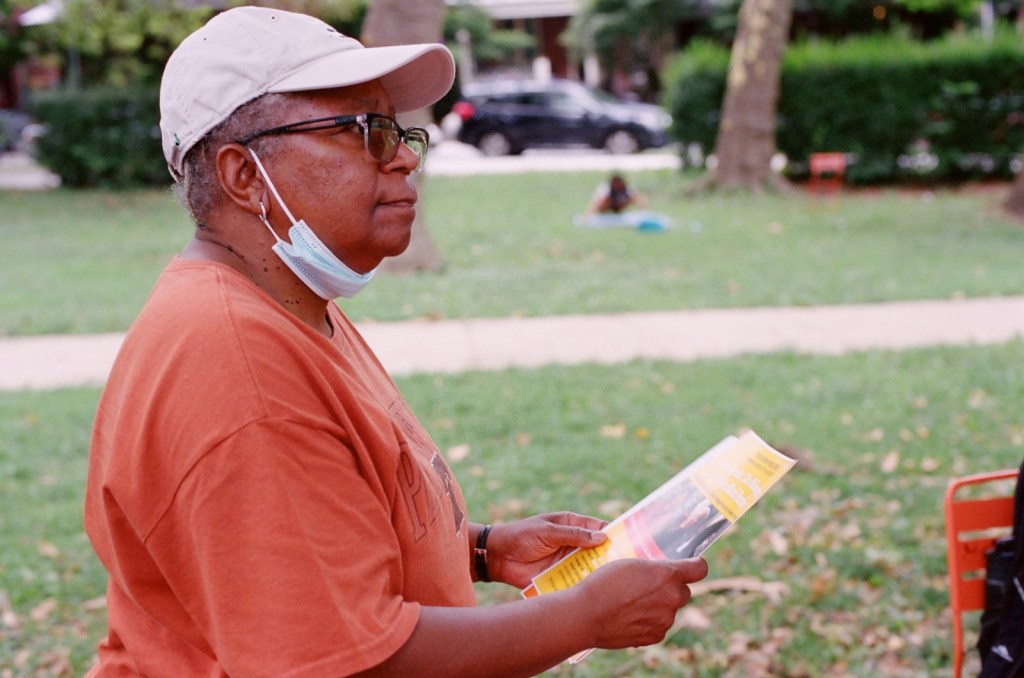
In 2020, we interviewed Catherine Blunt, a longtime educator and activist in Philadelphia. She is a native of the city and has witnessed its decades of transformation, from the 1950s up to the present day. Throughout her life, Catherine has participated in numerous political movements, including the Black freedom movement, the world peace movement, the anti-apartheid movement, and the struggle against gentrification. Our interview with Catherine sought to learn more about her experiences, and to understand the principles that guide her ongoing political and community work in Philadelphia, including with the Saturday Free School for Philosophy & Black Liberation.
Catherine’s insights are important for several reasons. Catherine is part of a generation produced by the aspirations of the Black working class in Philadelphia, a group that has propelled the political, economic, and spiritual evolution of the city for more than a century. She grew up in an environment where church ministers like Reverend William Gray II and Father Paul Washington, and civic leaders like Cecil B. Moore, were visible figures known for their commitment to struggling against discrimination and for dignity and jobs. As a teenager, it was natural to hear in the news and at the dinner table about anti-colonial struggles taking place in Africa, Asia, and Latin America; it was natural for a young person to become involved in the struggle for freedom and peace at home and abroad.
On the other hand, Catherine describes how this progressive current in Philadelphia, and in America more broadly, has come under attack by the U.S. state and ruling class. This attack has taken different forms: the assassination of leaders like Martin Luther King Jr, the sabotage and manipulation of political movements by the state, the flooding of guns and drugs into the Black community, the steady eradication of Black homeownership, the hollowing out of the Black church, the disruption of generational knowledge through social media, the misleadership and misdirection of “progressive” organizations and politicians, and the propaganda told about previous periods of history like the Civil Rights movement. It is no surprise, then, that Catherine’s recollections of her upbringing and formation contrast starkly with the lifeworld that inundates young people today.
Today’s youth are placed at a distinct disadvantage if they wish to know the history of a city like Philadelphia, whether they are born here or newcomers to the city. The ruling class distorts our view of the past by suppressing the example of revolutionary traditions and leaders, thus limiting the possibility of discovering our own revolutionary potential for the present and future. If young people do become interested in politics, we are told that groups like the MOVE organization, which agitated against ordinary people, represent the most radical expression of politics in Philadelphia, or that increased apartment density and European-style urbanism are the progressive path to solving the housing crisis. These messages come from universities, nonprofits, dark money groups, and other powerful institutions; they do not come from people like Catherine who have been at the heart of decades-long struggles to carve out a better future for children and working people.
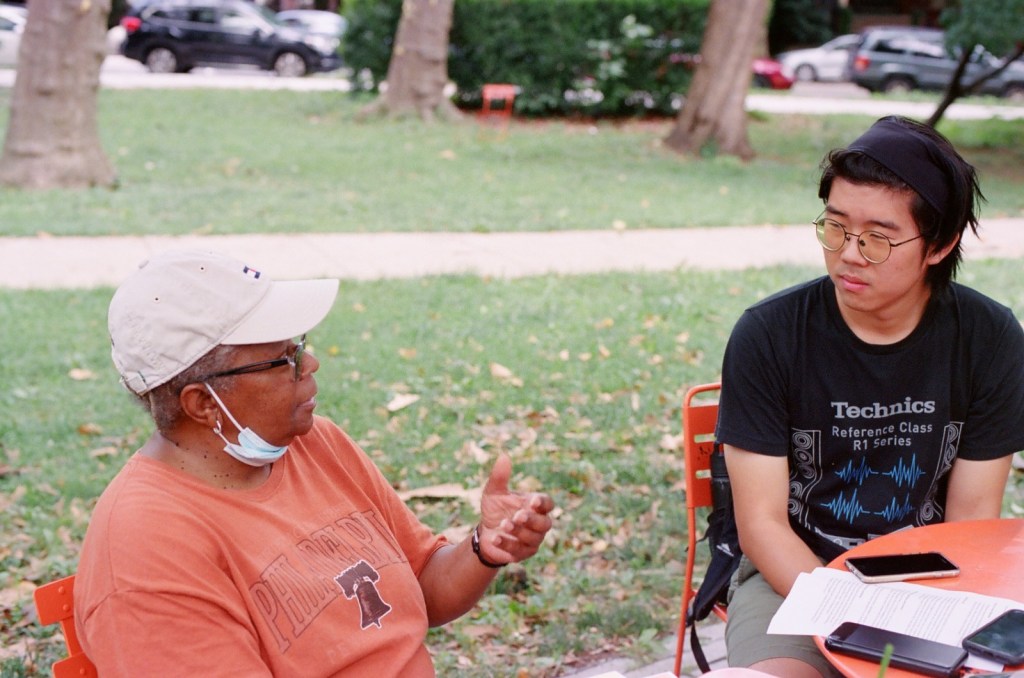

We present these interviews with the hope that they can open a window into a different understanding of the city and our nation’s recent history. This understanding can help us navigate the confusing, isolating ideological landscape of our times and encourage a new perspective on the contemporary possibilities and avenues of struggle today.
Part 1 of the interview series covers Catherine’s upbringing in North Philadelphia as part of the city’s Black working class, and how this community fostered an organic, moral aspiration to struggle for equality and knowledge of the world. Read here.
Part 2 covers Catherine’s exposure to and participation in the world peace, anti-colonial, and anti-apartheid movements, together with the Free School’s Anthony Monteiro; it also highlights the deep importance and influence of Martin Luther King’s global vision and political philosophy on her activism. Read here.
Part 3 covers Catherine’s assessment of the Black Freedom Struggle in Philadelphia, including the impact of the southern Civil Rights Movement in the North, the role of figures like Cecil B. Moore and Father Paul Washington, the multiple meanings of Black Power, and a critique of groups like RAM (Revolutionary Action Movement) and MOVE. Read here.
Part 4 covers the assault on Philadelphia’s Black and poor communities in the decades after the Black Freedom Movement, from the decline of the Black church to the drug crisis of the 1980s and 90s; it also covers the mechanisms of gentrification and why the fight for homeownership remains vital today. Read here.
Part 5 covers Philadelphia’s Jannie and Lucien Blackwell, and the disruption of their legacy through the promotion of false progressives in the contemporary political landscape such as Jamie Gauthier and Rick Krajewski; it ends with a reflection on the meaning of solidarity and the work that remains to be done in cities like Philadelphia. Read here.
Interviews conducted and edited by Jeremiah Kim, Dohyun Byun, Caleb Chen, and Alice Li.
 Avant-Garde: A Journal of Peace, Democracy, and Science
Leave a comment