
By Brandon Do.
Presentation given on March 12, 2022 at Korea, Vietnam, and Afro-America: Our Shared Struggle for Peace & Democracy, organized by the VietLaoKhmer and Bandung reading groups.
Part I. Why the Refugee Identity?
In 1975, the revolutionary forces of Vietnam, with the support of the Vietnamese people and the progressive peoples of the world, defeated the U.S.-backed Saigon regime. Following the humiliating defeat of the United States, thousands of Vietnamese fled the country, landing in refugee camps throughout Asia and North America. This moment in history marked the beginning of the Vietnamese American, whose worldview significantly differed with the worldview of the people from which they came.
Young Vietnamese Americans are instilled with the belief that we became a righteous and dignified people only once our families made their journey toward North America. American propaganda on the Vietnam War and the stigma of being the descendants of refugees has dictated our trajectory in Western civilization. Although the refugee experience is not all there is to our history, the refugee identity remains a driving force behind the standard by which Vietnamese Americans live their lives.
In order to maintain their safety and social status, Vietnamese Americans are pressured to remain silent about the war crimes that the United States committed against the people of Vietnam. On the other hand, they are encouraged to use false claims to criticize the Socialist Republic of Vietnam and the forces that liberated Vietnam from imperialism. The majority of Vietnamese Americans consent to the position that the American war in Vietnam was necessary to free the Vietnamese people from “communism”. This consent, however, was manufactured by the U.S. government, who for generations waged ideological warfare against the Vietnamese people. The U.S. government set their sights on turning Vietnamese Americans against the progressive forces of America and the world. By turning them against the legacy of the anti-colonial struggle in particular, the U.S. ruling class robbed Vietnamese Americans of the moral conscience and courageous spirit exemplified in the Vietnamese people’s resistance against Western domination. In doing so, the imperialists produced a people who reinforced the lie that America’s genocidal wars against Asian and African nations are being waged to save darker people from their own moral corruption.
Today, we are faced with the questions: What is the purpose of imposing the “refugee” identity onto Vietnamese Americans? How does this identity make us see ourselves and our role in society? We must address these questions to understand who we are, how we got here, and where we have the potential to go if we are willing to make the right choices.
Part II. Vietnamese Refugee Camps Post-Liberation of South Vietnam, 1975
A defining factor of the Vietnamese refugee experience post-1975, was that the power to determine the destiny of the refugees lay not within the hands of the Vietnamese, but in the hands of American camp officials who strictly limited and controlled their freedom to express their culture, political viewpoints, and customs.
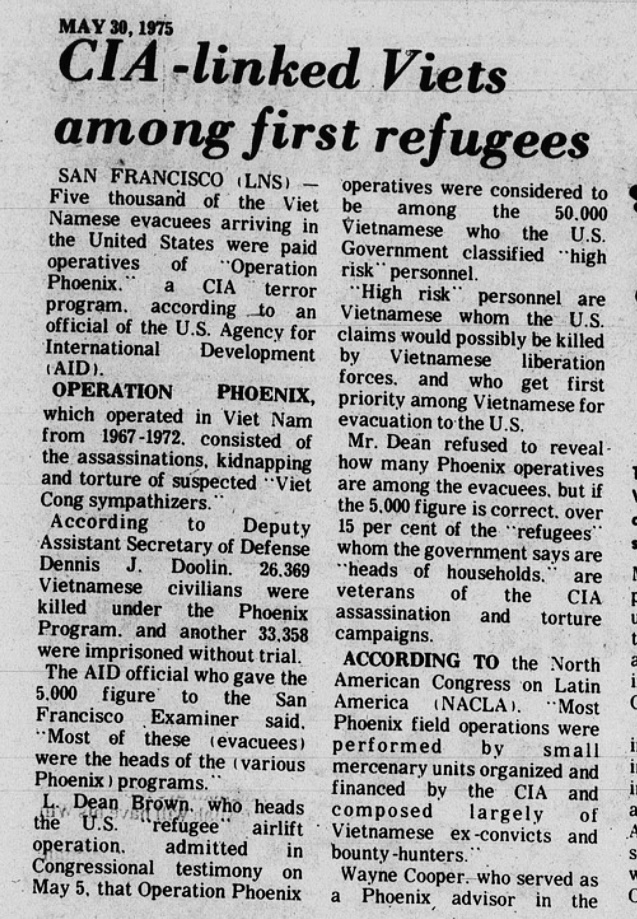
In a refugee camp in Fort Indiantown Gap, Pennsylvania, the Vietnamese were robbed of their personal agency. They were banned from speaking the Vietnamese language in specific areas. Teachers were sent to indoctrinate them into a white middle class worldview. They condescendingly lectured the Vietnamese on the “correct” way to carry themselves – to pledge allegiance to the flag of the United States despite what the U.S. military had just inflicted onto their people, and to fear the establishment. Many refugees languished for months and even years in these camps. These conditions created a destructive self-fulfilling prophecy and as a consequence, many refugees fell into drug addiction, domestic abuse, and alcoholism.
The written observations of scholars who visited these camps in 1975 foreshadowed the present condition of Vietnamese Americans. They wrote, “The Vietnamese role [in the refugee camps] was passive: things were done to them; they did very little. And, like much of the camp life that followed, they stood in interminable lines waiting for something to happen; This mental state [of helplessness] resembles that of a billiard ball which, devoid of inner self-propelling force, allows its path and movement to be governed by outside forces beyond its control.”
Part III. U.S. Propaganda – Turning the Vietnamese Against Their Own Interests Pre-1975
The imperialists began indoctrinating Vietnamese people decades prior to the post-war refugee crisis that we most commonly hear about today. The United States Information Agency (USIA) specialized in waging psychological warfare to destroy the liberation movements of Asia and Africa. Founded in 1953, with the backing of the U.S. State department, they had a headquarters in South Vietnam and aimed to manipulate the masses of Vietnamese against each other. To strengthen and expand imperialist domination over the country of Vietnam, they wanted to make the Vietnamese population believe that the United States’ way of governing was the best model of freedom and democracy. Ultimately, they aimed to turn the whole of Vietnam into a base of imperialism by which they could organize against the liberation movements rising in Asia.
The USIA spread disinformation through newspapers, magazines, films, and more. They opened institutions such as libraries, radio stations, and movie theaters. They employed Vietnamese talent to be the face of their operation through a front called the Vietnamese Information Service to hide their role in propagandizing the people.
In 1954, a million Vietnamese Catholics fled from Ho Chi Minh’s North Vietnam to the U.S.-occupied South Vietnam. This happened shortly after Ho Chi Minh’s army defeated the French in the Battle of Dien Bien Phu and the partitioning of Vietnam into North and South. The mass exodus in 1954 was a CIA-manufactured crisis through what U.S. intelligence called, “Operation Passage to Freedom”. It was a scheme to destroy the anti-western unity that Ho Chi Minh and the Vietnamese people built by telling Vietnamese Catholics the egregious lie that South Vietnam was safer for Catholics than North Vietnam.
In the midst of this 1954 refugee crisis, the USIA published a pamphlet about the refugees titled, “Flight to Freedom: A story of Courage, Sacrifice, and Faith in the Free World”. This pamphlet praised the refugees victimized by U.S. propaganda, while vilifying Ho Chi Minh’s Viet Minh army who were the ones standing up to the U.S. imperialists. The pamphlet praised the refugees for leaving the North and running toward the “safety” of South Vietnam, portraying the South as a paradise for refugees, and the North as a place of pervasive malnourishment, forced labor, and political repression. This notion that the refugees fleeing North Vietnam were embarking on a quote-on-quote “Flight Toward Freedom”, strengthened the argument that U.S. military presence in Vietnam was necessary for the greater good of Vietnamese people. Aware that most Vietnamese were illiterate, the USIA also used film as a means to spread their lies. They hired drivers to transport movie projectors in trucks to organize film screenings in villages and even rice paddies for the peasants to absorb this deadly propaganda.
They painted a portrait of President Ngo Dinh Diem, the South Vietnamese puppet leader, as someone who worked in the interests of Vietnamese people. In actuality, President Diem brutalized Vietnamese peasants of all religions and ethnic groups who dared to challenge America’s presence in Vietnam. He facilitated mass executions, torture programs, and concentration camps. The majority of South Vietnam hated Diem because it was clear that he was a part of the U.S. strategy that used Asians to kill other Asians.
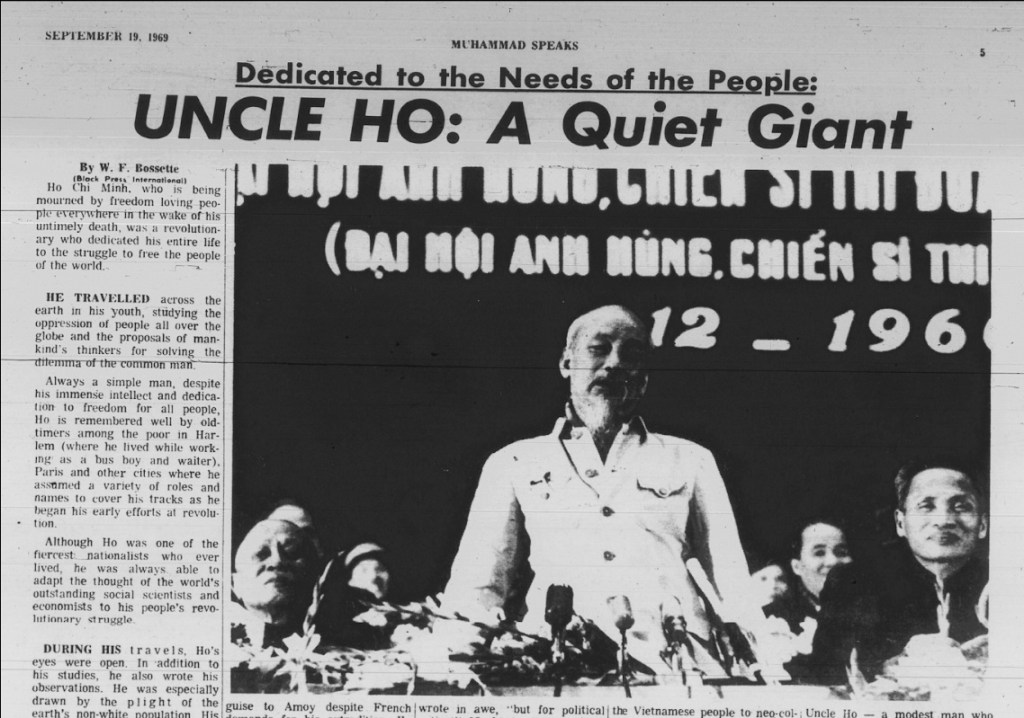
Most people in the South supported Ho Chi Minh, their beloved leader in the fight against the French and American oppressors. But the films portrayed Diem as a kind figure with roots in the Vietnamese people. On the other hand, they portrayed Ho Chi Minh as an outsider, not a home-grown revolutionary like he was in actuality, but as a pawn of the Soviet Union and China. Ho Chi Minh was made out to be a foreigner who appeared to be invading Vietnam and stealing the country from the Vietnamese people. This emotional manipulation embedded within the Vietnamese a sense of despair and a longing for their homeland that they “lost” to the communists.
With an annual budget of $132 million by 1959, it is estimated that the Motion Pictures programs of the USIA reached a total of over 9 million people in 1960. It was said by a USIA officer, Douglas Pike, that at the time it was “the biggest motion picture operation in the world”.
The USIA’s psychological warfare served as a tool of military recruitment for the United States who needed brown and yellow people to fight their war. Their propaganda distorted who the real enemy of the Vietnamese people was and created the atmosphere for brothers to kill their own brothers. This continued into the 1970s when the American policy of Vietnamization armed puppet troops to carry out the strategy of suppressing the Vietnamese anti-US resistance. It’s like what Malcolm X said, “If you’re not careful, the newspapers will have you hating the people who are being oppressed, and loving the people who are doing the oppressing”.
Part IV. The U.S. Ruling Class Uses the Refugee Identity for the Continuation of White Supremacy
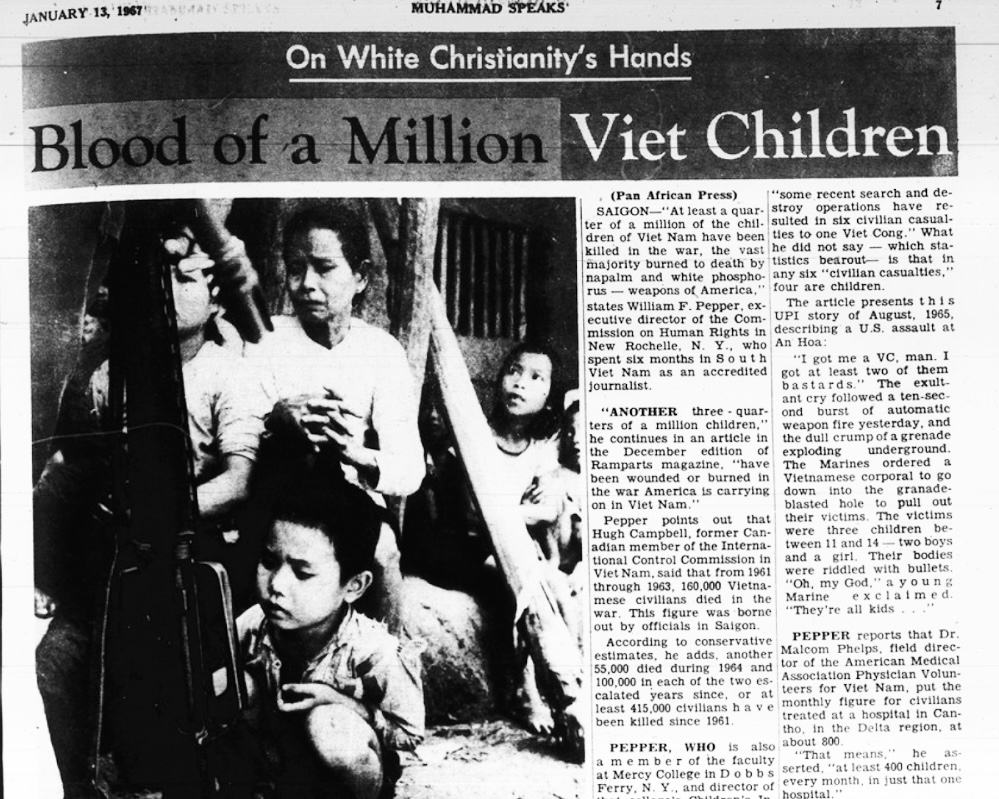
Growing up, Vietnamese Americans often hear that our families fled Vietnam because the communists executed whoever supported the South Vietnamese government. The Australian journalist, Wilfred Burchett, proved these accusations wrong. He interviewed the American POWs held captive by the North Vietnamese, who testified that they received fair and adequate treatment for survival. He interviewed Vietnamese peasants who witnessed soldiers from the South Vietnamese Army dressing up in the black uniforms of the National Liberation Army before massacring villages of people to make it look like it was the communists who did it. The Muhammad Speaks newspaper also reported that the majority of people in Vietnam correctly identified the myth of the bloodthirsty revolutionary as a baseless accusation being perpetrated by U.S. intelligence.
The American regime attempted to restore its image as a friendly humanitarian government after murdering over 3 million of the people of Vietnam, Laos, and Cambodia. They did this by facilitating the transfer of refugees to North America.
In Operation Babylift, which took place as the puppet-regime was nearing its defeat, U.S. soldiers were pictured in the American media as gentle protectors rescuing Vietnamese orphans from the “dangerous” Vietnam and transporting them to the “safe and peaceful” land of North America. This PR campaign constructed the Vietnamese refugee as the emblematic victim of communism as a means to solidify the image of a morally superior America in contrast to the corrupt and authoritarian government of what was to become the Socialist Republic of Vietnam. It was to show the world that the U.S. war in Vietnam was necessary in order to save the Vietnamese children from their own people.

Gerald Ford, the U.S. president in 1975, signed the Indochina Migration and Refugee Act less than a month after Vietnam’s liberation. This designated over $400 million toward the transportation, resettlement, and processing of Southeast Asian refugees. Victor Palmeri, the coordinator of Refugee Affairs, said in 1980, “We must consider how our participation in refugee resettlement efforts can further our broader foreign policy objective.” Henry Kissinger, the architect of the bombing of Vietnam, Laos, and Cambodia, stressed that media coverage of the transfer of refugees should emphasize the “basic humanitarian nature” of the U.S. government.
Their calculated transfer of refugees served as justification for the embargo they imposed on Vietnam which prevented other nations from sending help to what was then one of the poorest countries in the world. They accused the Vietnamese communists of inhumane actions in order to cover up the atrocities that they themselves were committing against the Vietnamese people. We often hear about the hardworking refugee – the brave people who escaped their corrupt countries in order to find a better life in America. But it is this constructed image of the resilient and traumatized Vietnamese refugee victim that was created to reinforce the image of the morally corrupt and brutal Vietnamese freedom fighter.
What the refugee-making process also did was separate Vietnamese Americans from the international anti-imperialist struggle by turning them against it. It embedded within the refugees a contempt for the heroes who sacrificed their lives to defeat the powerful United States. They did this by assigning virtue to the voice of the Vietnamese imperialist collaborator while vilifying the Vietnamese revolutionary. Therefore, the refugee has been conditioned to see those who stand up to the U.S. government as an enemy and a threat to his own personal security.
This refugee-making process sought to create a force of pro-imperialist foot soldiers within the American population to destroy the bridge between Black and Asian people. There is no disputing the great Black and Vietnamese solidarity that was forged during the Vietnamese struggle against the U.S. military. Black U.S. soldiers and Black people in America made the most significant contribution toward ending the war out of all Americans. But, since war was established by U.S. propaganda as a humanitarian endeavor, Asian Americans have been manipulated to believe that those who rise up against U.S. imperialist wars are morally corrupt and inhumane – whether they be in Asia or America. And since the refugees were conditioned to see America as their source of safety, they were consequently conditioned by the U.S. ruling class to see Black Americans, the demographic within the American population most critical of U.S. imperialism, as a threat to their safety. Today’s demonization of Black and Asian figures who stood against the war in Vietnam – figures such as Muhammad Ali, Martin Luther King Jr., the Honorable Elijah Muhammad, Ho Chi Minh, and Vo Nguyen Giap – functions to remove Black and Asian people from the very foundation that unites them against their common enemy: the U.S. ruling class and the warmakers of the West.

The influx of Asian refugees were used to suppress the Black Freedom Movement’s critique of U.S. imperialism. The refugees were trained to become the new face of U.S. empire who can attest to the superiority of American democracy. The U.S. government separated Vietnamese Americans from the international community by instilling within them a blind obedience to the status quo of the U.S. empire. Vietnamese refugees were psychologically broken and separated from their revolutionary heritage. Thus, they were robbed of their moral conscience and used as pawns for the continuation of U.S. wars throughout the darker world in the years ahead.
I am not trying to put down refugees or the children of refugees. I am asking, why should the refugee identity be the model for who we can strive to become? I ask this because I have come to the realization that many of us have never left those refugee camps. Remember how we were described: Passive. Helpless. Devoid of inner self-propelling force. Governed by forces outside of our control. We must ask ourselves, who benefits from us being in this condition?
Part V. Begin Building a New Future by Standing Up For the Truth!
The rulers of this government have robbed you of your proud revolutionary history, which means that they’ve robbed you of your backbone. They’ve taught you to look down on where you come from and the people you come from. You have been reduced to an object of their sick desire to keep you in a permanently neutral and disempowered position. We have a generation of youth who lack character, who are wandering through life aimlessly, who abuse drugs and alcohol because their fear of facing reality is greater than their belief that they can change reality. They’ve prevented you from becoming what you’re meant to be by making you into what they want you to be. They’ve killed your spirit by miseducating you.
Our fight against the war agenda of this country is part and parcel with the struggle to save our youth. We have the choice to no longer take part in maintaining our oppressor and to put an end to their poisoning of our minds with the spirit of cynicism and defeat. True compassion is more than just feeling pity for refugees. True compassion recognizes that an edifice which produces refugees needs to be transformed.
The world is moving in a new direction. The European powers who long ago divided Africa and Asia, and in their wars used a darker people to conquer another darker people, did not see the day that their empire would come to an end. But the sun is setting on the white man’s world. As Martin Luther King Jr. said, “The shirtless and barefoot people are rising up”. It is time we determine who our true enemies are on our own terms and then ask ourselves the question: what side are we on?
Many famous Vietnamese American scholars are telling the lie that the Vietnamese revolutionaries were brutal in their very nature. This is the position of war apologists who work in the interests of the empire. There is no moral equivalence between the defenders of national sovereignty and a murderous imperialist regime trying to conquer a proud and ancient people. It was not Ho Chi Minh who invented Agent Orange. It was not Ho Chi Minh who invented napalm. It was not Ho Chi Minh who turned South Vietnam into a giant whorehouse. Men and women living under conditions of genocide have the right to struggle against the forces that aim to annihilate them. Ho Chi Minh embodies the very best of who we are: our courageous fighting spirit in the struggle for peace and justice, and our love for all of the oppressed peoples of the world. By condemning Ho Chi Minh, these scholars also condemn the Vietnamese people and a great figure who belongs to humanity.
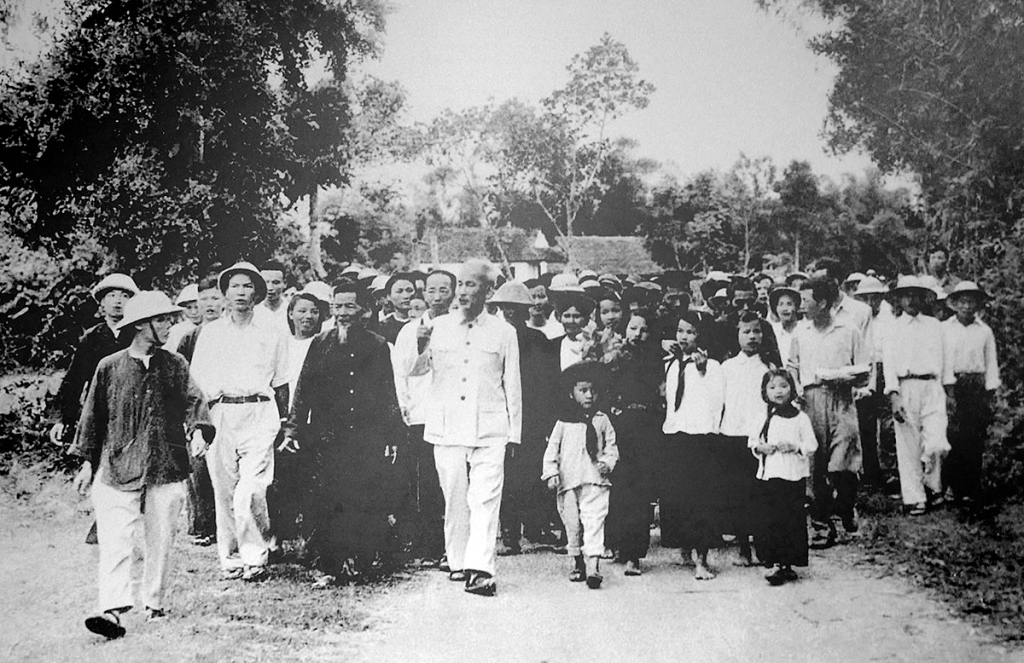
The refugee identity is the opposite of what our brave ancestors fought for. We did not passively accept the cruel conditions of the U.S. military, nor were we victims of “communist authoritarianism”. Vilifying our anti-colonial struggle imposes the limitations of the white world into the mind of a young person and prevents him from rising up to become a changer of his circumstance. Our revolutionary history frees our creative potential and informs us on the future we are capable of bringing into existence. So for the sake of future generations, we must not compromise the truth.
We, the children of a lost people, can reclaim our righteous role on this earth, only if we break free from the falsehood that has held us captive. Only if we embrace the history of our brave freedom fighters, rather than the lies told by those who succumbed to the cruelty of the world.
There are people throughout Africa, Asia, and Latin America who admire the Vietnamese people and remember our heroic struggle. We have brothers and sisters in every continent. We can release ourselves from the fear that imprisons us if we are defined not by a shared victimhood, but a shared duty to uplift our fellow humanity. Our true heritage gives us the foundation to begin our transformation into a free people, and become a force for positive change in this society and the world.
References:
- “Hiding Behind the Humanitarian Label”: Refugees, Repatriates, and the Rebuilding of America’s Benevolent Image After the Vietnam War
- UNITED STATES: THE REFUGEE ACT OF 1980 AND ITS IMPLEMENTATION
- Vietnam: Inside the Story of Guerilla War, Wilfred Burchett
- Toward a Critical Refugee Study, Yen Le Espiritu
- Prisoners of International Politics: Vietnamese Refugees Coping with Transit Life
- Selling America, Ignoring Vietnam: The United States Information Agency in South Vietnam, 1954-1960
- Beyond Vietnam — A Time to Break Silence, Martin Luther King Jr.
- The Muhammad Speaks Newspaper Archives
 Avant-Garde: A Journal of Peace, Democracy, and Science
Leave a comment