
By Emile Paulmier.
Presentation given November 6th, 2021 at the symposium “Strategy for Freedom: The Life and Vision of Henry Winston,” organized by the Saturday Free School
The ruling narrative in America today is that the essence of democracy is individual freedom from any social responsibilities. Civil rights means the ability to put one’s own identity and self-interest above a broader concern for humanity as a whole. This removes civil rights from its relationship to peace, and democracy from the question of poverty. To see our common future, this rupture needs to be understood no matter how uncomfortable that conversation might be.
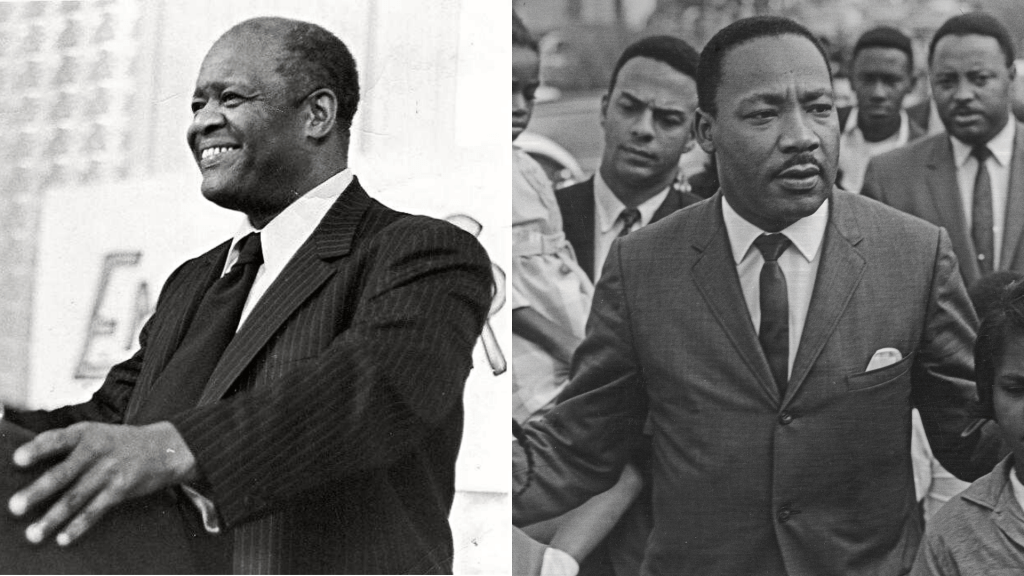
In a society divided by ruling institutions and their self-defined solutions, unity requires non-conformity to ruling interpretations. Unity demands that we seek out the truth from wherever it might bear fruit. Unity requires us to delve into that painful shared history which we are assured is of no value. For there have always been those willing to risk the depths of despair to shine a light towards the future; thinkers who were not limited to the ruling voices of their time and moved to a higher calling in the uplift of their people. To be true to that great striving for unity, we look to the great democratic legacies of Henry Winston, Martin Luther King Jr., and the movements they embodied. We must study their work to rekindle that flame of struggle by which our humanity depends.
We think of Martin Luther King Jr. as well-known. Many of us realize the sanitized version of King is not the full picture – but still, we make the error of treating King as naive or tragically misguided. His true legacy has been co-opted by corporate interests and confused by today’s radical self-righteous youth.
Henry Winston, on the other hand, is a name none of us are taught in school. Although his body of work mirrors King and his struggle was a prelude to the civil rights period, his life has been removed from our collective consciousness. Winston’s connection to the Communist Party made him intolerable to the dogmatic views of U.S. ruling institutions. The essence of his ideas was rooted in elevating the consciousness of the masses towards their rightful desire for peace.

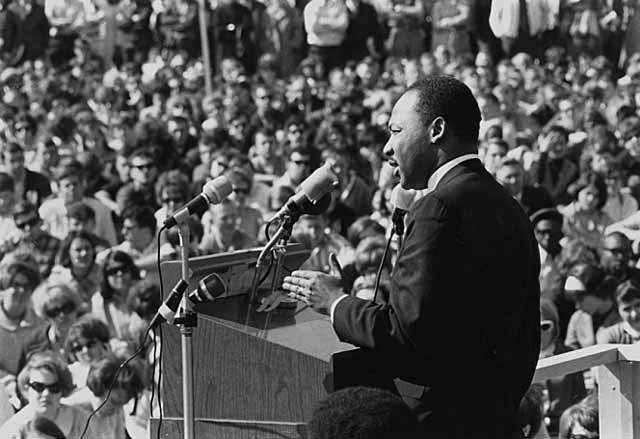
This vision bound these two luminaries together with the lot of the voiceless in society. It put them in the crosshairs of class forces committed to holding working people back to the pre-civil rights era of struggle. Through the use of academia and mass media, this elite class has shown a determined interest in separating us from their Ideas.
In the face of a society driven blind from war, King reminded us of our moral responsibility to speak up when injustice demanded silence. He illuminated how the ills endured by this society are a direct consequence of our government’s insatiable drive to war. This interconnection between war, racism, and poverty in our society provides us with a deeper understanding of our current crisis.
King also stressed the need for moral clarity in order to develop a principled unity among the people. When he was confronted with the notion that he remained focused solely on civil rights, King rejected such divisions in struggle and emphasized the importance of a commitment to all humanity. In his famous speech “Beyond Vietnam: A Time to Break Silence”, King said:
“We are called to speak for the weak, for the voiceless, for the victims of our nation and for those it calls ‘enemy,’ for no document from human hands can make these humans any less our brothers.”
Winston saw these ideas as crucial for raising the consciousness of the people. He believed that democracy was the most effective means by which the people of this nation could advance towards socialism. He saw democracy not only in procedural terms but in its relationship to a higher life for the people it serves. Confronted with the question of applying Soviet theory to the West, Winston said:
“We drink from the fountain of knowledge from whatever source, and use it for social advance. This is the case in natural sciences. Why shouldn’t it be the case in social science? So I think in debate people should deal with substance, and not form.”
Winston saw the work of social progress as a scientific endeavor that was best understood through the social theories of Marxist-Leninism. His books focused on the many ways in which working people and their revolutionary movements, like the Black Freedom Struggle, are distorted. He clarified how these movements are blunted and used as tools to help a monopoly class maintain its rule. In misinterpreting these struggles, Winston believed we are led to aggravate the very issues we seek to solve. Winston stressed the inseparable role that race and class played in understanding our social woes. It is through this lens that we must revisit our nation’s legacy of struggle.
We are told the Civil Rights movement had more to do with diversity for individuals than universal social demands. The fight was simply about inclusion for people of color into an overall just and civil society. The fact that this society always skewed who was considered human by their enforced economic position was not considered relevant. This narrow view of civil rights loses sight of the ultimate aims of the Black Freedom Struggle. Shortly before his death, King said:
“I fear, I am integrating my people into a burning house.”
To this idea, he stressed we become firemen and said:
“Until we commit ourselves to ensuring that the underclass is given justice and opportunity, we will continue to perpetuate the anger and violence that tears at the soul of this nation.”
King saw integration as a necessary means to progress towards the real goal of social, political and economic equality.
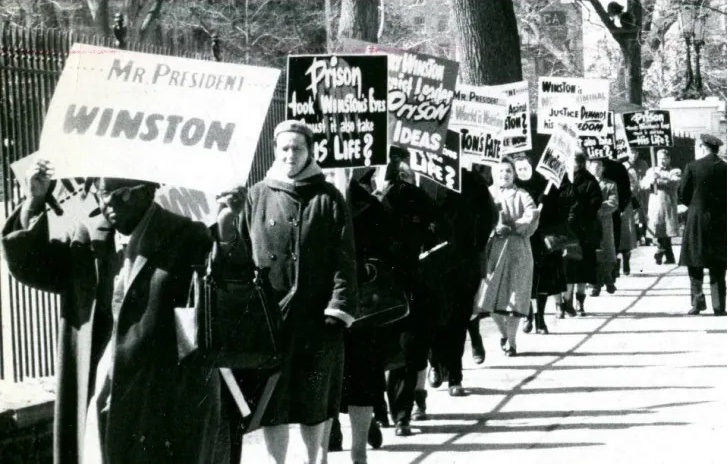
All of the struggles in which Henry Winston participated have been removed of their ideological content as well. From the struggle to organize the unemployed, to the fight for integration and a living wage, to even the war against fascism. We are assured these developments are completely unrelated to the communist movements of that time. The trial in which Winston and ten other leaders of the Communist Party were wrongly convicted is hardly discussed to this day – despite the fact that this country recently had a parallel show trial in which the former president was accused of being an agent of a foreign government. This slander of treason was used against Winston in the Smith Act Trials and has been used to endanger and destroy the lives of thousands of American citizens throughout the United States.
These distorted versions of history lead us to false and ultimately selfish solutions. The current academic notion of how to fight racism is to successfully pass liberal reform through the Democratic Party – to support “anti-racist” policies. This view of racism separates it from what Winston would call its class origins. He saw racism as a social phenomenon based on historic developments in class struggle – a fight, Winston stressed, that must never be denied. In Strategy for A Black Agenda, Winston writes:
“To carry out this legacy in the United States calls for challenging the ‘quasi-intellectuals and pseudo-revolutionaries;’ who would have us abandon the struggle by denying the class basis of racism. Fighting racism, expecting liberation, is inconceivable without a strategy directed against the class source of racism.”
Today, Western mass media suggests another solution to racism: buy black merchandise, watch black Marvel films, and support more black-owned private businesses. This severs racism from its relationship as a link between war and poverty. These prescribed antidotes have led us down the path of declaring changes in the names and language of problems as progressive. These solutions in name only are what Henry Winston referred to as “tokenist reformism”. He stressed that these supposed solutions cloak and distort the real conflict: a fight which has a class force invested in maintaining that inequality. As a result, we are led to believe that racism is a personal question with individualist answers.
These answers come from a value system that is not of our own communities’ teachings. They are what Winston called “the values of division” and they are extremely effective in doing precisely that. Instead of seeing hard-working white men and women as our natural allies, we are told their struggle isn’t real and their minds are backward. Worse yet they have been given the blame for all our societal woes. Does this remind us of another time in history? It’s not the intelligence community who is at fault. Nor Wall Street nor Google nor the weapons firms, who profit most from bombs dropped on the darker peoples of the world. No – it’s your uncle who voted for Trump or your schools’ janitor who doesn’t understand your pronouns. They are condemned in our academies as the bearers of white privilege and scorned for their supposed monolithic history of settler colonialism. We are to believe somehow that white people have never been victims of this society nor have ever fought alongside blacks for equality. It’s as if the examples of Lucretia Mott, Elias Hicks, Francis Pastorius, and John Brown never existed. Martin Luther King Jr. himself said there are twice as many poor whites as blacks. As such, he didn’t see any legitimate reason to separate the march against poverty between them. Instead, King called on us to develop an overriding loyalty to mankind as a whole. To develop a broad movement of an anti-war, anti-poverty and anti-monopoly coalition.
In the current insular and isolated time we live in, this universality to movements is lacking. Instead of finding a principled center from which to drive the common demands of all people, we find ourselves manipulated into accepting extremely narrow positions. In divided corners like these, we argue positions so far from our ideals and our reality, we forget that there is a war taking place or peace to be had.
The need for a sincere and critical analysis of our moment has never been more evident. The unending climb in violent crime and unemployment has no end in sight. The expanding number of prisons, tent cities and open-air drug markets are fast becoming the only real growth in America for poor and working people. The obscene inequality which structures this mess has led our leaders to plan for a nuclear conflict in Asia with our environment on the edge of becoming uninhabitable. This is the threat Winston was referring to when he called fascism “the genocidal consequences of anti-communism”. It’s what King warned of when he said:
“A nation that continues year after year to spend more money on military defense than on programs of social uplift is approaching spiritual death.”
Without hope, humanity will lose the will to fight. Without ideas that can truly unite us, we don’t stand a fighting chance.
To the youth wandering from one crumbling school building to the next, and each and every generation of children who dream of meaning – what will we tell them? What can we offer them if not something to believe in? For their humanity, as well as our own, our awareness must rise high above our own individual pleasures. Above the pain we have masked with entertainment and self-entitlement. We must follow those who marched for our humanity, hand in hand.
Any awareness of Martin Luther King’s name means very little without the consciousness to realize and actuate his ideas.
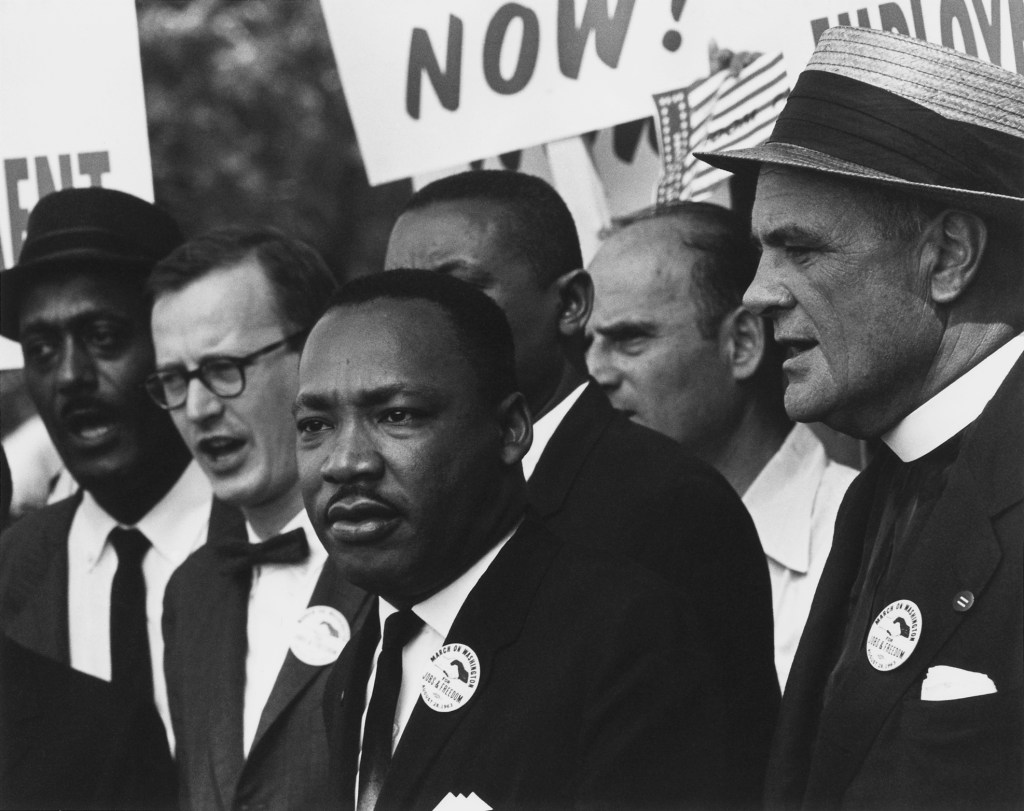
In today’s America, democracy, civil rights and peace are defined in the abstract. These words glow out of the mouth of our nation’s loudspeakers like banners of pride and accomplishment. The truth of those ideals, however, has yet to be realized by the broad masses of society. For these truths to reach their human potential, we must listen to the hoarse voice of the poor and humble among us in order to understand our world. For Winston this is the weight of our task: To unify on the essence of principles rooted in struggle, and not acquiesce to the comforting, cliche forms we are given.
Like a beacon beaming out from the fog, King’s ideological clarity is vital to our survival.
His blueprint for unity is just as priceless today as ever before. He places the power to change the course of history firmly in human hands. He speaks from a faith in humanity cultivated from a committed struggle among common people; a people who gave their lives and marched for an end to poverty, war and oppression of any kind. He speaks of a revolution of values which he has witnessed and experienced firsthand, from the transformation of these poorest and most humble among us into new human beings. It is by this fundamental connection to the plight of black and white working people that true leadership is born. It is precisely from this love of people that the principle of peace resides.
If we are truly interested in progressing as society and as a people, we must embrace the struggle for peace. If ideas like civil rights, democracy and freedom mean anything at all, they mean we must affirm the dignity of all human life. In doing so, we must be willing to sacrifice the things that bring us comfort from our government’s insatiable subjugation of others. The material pleasures we enjoy are not as important as the life we lead. The sovereignty of any country is just as negotiable as our own. As Americans, we must firmly reject this culture which holds such casual disregard for the human casualties of war. As King and Winston demonstrated, we are citizens of the world. As such, it is our responsibility to dedicate ourselves towards this fight.
 Avant-Garde: A Journal of Peace, Democracy, and Science
Leave a comment