

By Jeremiah Kim.
At a time when domestic repression is increasing and threats of war with China are escalating, the American people today need principled examples of how to move forward toward freedom and peace. The great artist and freedom fighter Paul Robeson provides one such example. In stark contrast to the smug anti-Americanism of today’s woke left, Robeson stood firm as a proud American patriot against the creeping McCarthyism and barbaric warmongering of the United States’ ruling class during the Cold War. His ceaseless crusade for peace in a time of war, which culminated in his testimony before Congress’s House Un-American Activities Committee (HUAC) in 1956, provides a beacon of clarity for Americans seeking a framework to respond to a New Cold War coupled with a New Domestic War on Terror.
Though his legacy has been erased from American memory, Robeson was one of the most famous Americans in the world for much of the early 20th century – an internationally beloved singer, athlete, and actor who traveled widely throughout Africa, Asia, Western Europe, Eastern Europe, and the Pacific. Wherever he went, he sang the folk songs of the people whom he was visiting — driven by his conception that all folk culture emerged from and reinforced a universal reservoir of humanity’s strivings. Like his contemporary W.E.B. Du Bois, Robeson sought to build bridges of friendship and peace with the peoples of the world. And like Du Bois, Robeson was seen as a threat to the interests of reactionary forces within the U.S. that quickly consolidated power in the post-World War II era. It is important to remember that after WWII, the vast majority of the American people desired peace and cooperation with the Soviet Union. The U.S. government, which was by that time fully in the grip of organized Big Business, set about destroying this postwar friendship between the two countries, convinced of the idea that “armed conflict with Russia was necessary to world domination of American industry.” To serve this crusade, McCarthyism burst onto the scene in the late 1940s and quickly perverted every sphere of American public and private life. America became a police state ruled by war, and as James Baldwin would later write, the American liberal in particular became a creature defined by his irresponsibility, cowardice, and sterility amid this great struggle between humanity and an ascendant global American empire.

As a result, both Du Bois and Robeson were blacklisted by the government and banned from attending historic events such as the 1955 Afro-Asian Conference in Bandung, as well as the 1956 Congress of Black Writers and Artists in Paris. Robeson was thus officially brought before HUAC over the question of his application for a passport to travel outside the U.S. However, the hearing quickly turned into a rapid-fire, all-out inquisition seeking to uncover Robeson’s participation in a vast, secret Communist conspiracy. Members of Congress pressed Robeson on why he had not signed a “non-Communist affidavit”. They asked him if he was a member of the Communist Party. They rattled off names of suspected and known affiliates, goading him to expose them as fellow Communists. They asked if he admired Joseph Stalin, and tried to implicate him as an agent of the Soviet Union by hurling phrases at him from past speeches he had given in support of peace.
In the face of all this, Robeson did not cower or back down. For questions that clearly violated his rights as an American citizen, he invoked the Fifth Amendment. But more importantly, he responded to the whole inane logic of the hearing by outlining the real reasons why he had been summoned:
“The reason that I am here today, from the mouth of the State Department itself, is: I should not be allowed to travel because I have struggled for years for the independence of the colonial peoples of Africa… That is the kind of independence like Sukarno got in Indonesia… The other reason that I am here today, again from the State Department and from the court record of the court of appeals, is that when I am abroad I speak out against the injustices against the Negro people of this land. I sent a message to the Bandung Conference and so forth. That is why I am here… I am not being tried for whether I am a Communist, I am being tried for fighting for the rights of my people, who are still second-class citizens in this United States of America… My mother was a Quaker, and my ancestors baked bread for George Washington’s troops when they crossed the Delaware, and my own father was a slave. I stand here struggling for the rights of my people to be full citizens in this country. And they are not. They are not in Mississippi. And they are not in Montgomery, Alabama. And they are not in Washington. They are nowhere, and that is why I am here today. You want to shut up every Negro who has the courage to stand up and fight for the rights of his people, for the rights of workers, and I have been on many a picket line for the steelworkers too. And that is why I am here today.”
Placed under such extreme pressure by the state, Robeson did not shy away from proclaiming his rights and responsibilities as an American citizen; instead, he embraced them. In doing so, he turned the tables on his own government, insisting that the State Department and Congress were in fact persecuting him for fighting to preserve the best in the American tradition. This notion — that there is something positive in America’s national identity that is worth preserving — would be instantly dismissed by many present-day leftists as a racist, settler colonialist concept. Indeed Paul Robeson’s view of America is under attack on a wider level across American society. The settler-colonial thesis of American history, which first gained traction in academic circles several decades ago, has recently been propagated in the mainstream by the ruling elite through intellectuals such as Gerald Horne. Horne’s 2014 book The Counterrevolution of 1776 served as the ideological foundation for the 1619 Project by Nikole Hannah-Jones and The New York Times, which has been praised by the likes of Kamala Harris. The crux of Horne’s thesis is that the American Revolution was fought by the Founding Fathers and white settlers in order to preserve slavery. All white people must therefore be viewed first and foremost as racist settlers, from Jeff Bezos to the white Amazon temp worker plunged precariously between joblessness and servitude. Consequently, Horne argues that there is no hope in trying to fight for principled unity between the black worker and the white worker — a cause once championed by the old Left as well as the Civil Rights Movement and Martin Luther King Jr’s Poor People’s Campaign. Such a cynical view of America’s past and future is now increasingly popular among professional-managerial class liberals, major corporations, and elite institutions. True to form, Horne has taken the stance of admonishing his fellow leftists to catch up to the ruling class in embracing settler colonialism.
In this light, it cannot be overstated that Robeson saw no opposition between the American tradition, going back to the Revolutionary War of 1776, and the anti-colonial movements of the 20th century. On the contrary, he believed that this American tradition could serve as a basis for the American people to find kinship, understanding, and genuine solidarity with the Bandung spirit of independence sweeping across Asia and Africa. His fight for principled unity between black and white labor existed within the same fabric of his efforts to support the anti-colonial struggle and peace movement. As he wrote in his message to Bandung:
“The demand of Africa and Asia for independence from alien domination and exploitation finds warm support among democratic-minded peoples everywhere. Although the calling of the Bandung Conference evoked bitter words of displeasure from high circles in Washington, the common people of America have not forgotten that our own country was founded in a revolution of colonies against a foreign tyranny — a revolution proclaiming that all nations have a right to independence under a government of their own choice. To the Negro people of the United States and the Caribbean Islands it was good news… Typical of the Negro people’s sentiments are these words from one of our leading weekly newspapers: ‘Negro Americans should be interested in the proceedings at Bandung. We have fought this kind of fight for more than 300 years and have a vested interest in the outcome.’”
As he saluted the revolutionary struggles being waged by the peoples of Asia and Africa, Robeson was also calling upon the American people to remember their roots in waging a war for independence from British rule. Robeson knew that the American experiment began with contradictions — foremost among them the system of slavery and the division of the Color Line. This did not prevent him from seeing the American Revolution as part of a larger revolutionary tradition that was continued, not negated, by the Russian Revolution and the anti-colonial revolutions of the darker nations.
This way of thinking was anathema to the American ruling class, which sought to constrain and twist the nation’s sense of identity into a narrow chauvinism fearful of the Soviet experiment and other experiments in people’s democracy. Propagandists in the media and government projected Freedom and Democracy as pale slogans aimed at suppressing humanity’s struggle to free itself from an epoch of poverty, war, and subjugation to the West. And yet, despite this atmosphere, Robeson flatly rejected the ruling class’s ironclad ideology of anti-communism. He did so because he looked at the Soviet Union from the position of the Black Freedom Struggle, which he saw as intertwined with the struggle for world peace and the struggle for people’s democratic rule over the monopolists in Wall Street and the warmakers in Washington. On this question, Robeson represented the broader black community, which has historically stood as a bastion against anti-communism. Much effort has been made to suppress the fact that ordinary people — not just those within the Black Freedom Movement — were not and are not invested in the ruling class’s hysterical anti-communism. This can be explained by Henry Winston’s formulation that anti-communism is, in its essence, the same as racism. For his part, Robeson assessed the Soviet Union as a free black man who knew he was simultaneously the son of a slave, a product of American society, and an artist beholden to the masses of people of his country and the world.
Examining the exchanges in his HUAC testimony, it becomes clear just how vast a gulf separated Robeson from his inquisitors. As Robeson himself said, the real question at hand in the hearing — and in the whole era of McCarthyism — was not about Communism vs. non-Communism, but about being with humanity or against humanity. The tragedy of America’s obsessive anti-communism was that it created a barrier between the American people and the rest of the world. And so whereas Robeson spoke with the confidence and clear-headedness of someone who was firmly grounded in humanity, the members of Congress spoke with a dogmatic neuroticism that revealed how completely divorced they had become from any kind of human reality:
Mr. ARENS (reading from an article by Robeson): “If the American warmongers fancy that they could win America’s millions of Negroes for a war against those countries (i.e., the Soviet Union and the peoples‘ democracies) then they ought to understand that this will never be the case. Why should the Negroes ever fight against the only nations of the world where racial discrimination is prohibited, and where the people can live freely? Never! I can assure you, they will never fight against either the Soviet Union or the peoples’ democracies.”
Did you make that statement?
Mr. ROBESON: I do not remember that. But what is perfectly clear today is that nine hundred million other colored people have told you that they will not. Four hundred million in India, and millions everywhere, have told you, precisely, that the colored people are not going to die for anybody: they are going to die for their independence. We are dealing not with fifteen million colored people, we are dealing with hundreds of millions.
Mr. KEARNEY: The witness has answered the question and he does not have to make a speech…
Mr. ROBESON: In Russia I felt for the first time like a full human being. No color prejudice like in Mississippi, no color prejudice like in Washington. It was the first time I felt like a human being. Where I did not feel the pressure of color as I feel [it] in this Committee today.
Mr. SCHERER: Why do you not stay in Russia?
Mr. ROBESON: Because my father was a slave, and my people died to build this country, and I am going to stay here, and have a part of it just like you. And no Fascist-minded people will drive me from it. Is that clear? I am for peace with the Soviet Union, and I am for peace with China, and I am not for peace or friendship with the Fascist Franco, and I am not for peace with Fascist Nazi Germans. I am for peace with decent people.
Mr. SCHERER: You are here because you are promoting the Communist cause.
Mr. ROBESON: I am here because I am opposing the neo-Fascist cause which I see arising in these committees. You are like the Alien [and] Sedition Act, and Jefferson could be sitting here, and Frederick Douglass could be sitting here, and Eugene Debs could be here.”
Robeson challenged the American people to recognize that their own ruling elite had become, for the rest of the world, what the tyrannical British monarchs were to America in 1776. He identified the U.S. ruling class with the fascists of Europe — basing his assessment on the total takeover of the state by the most predatory, repressive, war-hungry elements of monopoly capitalism, as distinguished from the hysterical “anti-fascism” that currently grips liberals and leftists in the present-day. Furthermore, Robeson unequivocally stated that he planned to continue his fight on American soil, the land of his forefathers. To struggle for peace and a democratic future in America was his birthright, which no person or government could strip away.
All of this led Robeson to declare his final searing indictment of his inquisitors, which reverberates to this day: “You gentlemen belong with the Alien and Sedition Acts, and you are the non-patriots, and you are the un-Americans, and you ought to be ashamed of yourselves.”
At that moment and for all his life, Paul Robeson stood for what he called the “true America”. This true America was composed of the men and women whose labor had built the country — the Afro-American descendants of slaves and the white workers of America’s fields and factories — as well as people of all backgrounds who desired peace as the precondition to achieving societal progress. “This America,” he wrote in 1951, “wants a chance for its children to grow up without fear. It wants them to grow up in a land which knows no poverty, slums and Jim Crow oppression; a land which recognizes a world in change, a world of different ways of life; a land which refuses to sacrifice its precious youth to the folly and greed of the few but powerful inheritors of the robber-baron, gangster imperialist tradition of American life. Such an America will gladly and courageously assume its grave responsibility to impose the peace upon our own home-bred would-be destroyers.”
After the HUAC hearing, the U.S. government continued its efforts to destroy Robeson. The American press unanimously condemned him as a Communist traitor, and Robeson’s films and recordings were removed from public distribution. Though his passport was eventually restored several years later, American and British intelligence agencies surveilled and harassed Robeson wherever he traveled. Since his death in 1976, generations of Americans have grown up without ever hearing the name Paul Robeson or learning about his towering contributions to humanity. Robeson’s erasure is one terrible consequence of a period of America’s history in which the federal government essentially waged all-out ideological warfare against its own citizenry while it rampaged its obscene war drive around the world.
The global predicament facing Americans in our New Cold War moment bears significant parallels to the time of Robeson’s HUAC testimony. The past few years have seen a growing consolidation between the national security state, political establishment, and corporate media with the military-industrial complex, Big Tech, and the most rapacious elements of Wall Street on the question of containing the rise of China. Even those who may be otherwise opposed to America’s endless wars have become convinced that China is an existential threat that must be crushed. Ceaseless propaganda has made China a shapeshifting mirror reflecting many Americans’ worst fears. For conservatives, China foreshadows the trajectory of America’s own atmosphere of repression under the Biden administration; for liberals, China is where America would be headed under a ‘strongman’ figure like Trump. The stage has been set for a century of perpetual conflict with China under the banner of “democracy versus autocracy”; peace and detente are forever off the table. Echoing the anti-Soviet hysteria of Robeson’s time, the merest mention of China in America today causes all human reason to evaporate in a haze of ominous headlines, childish mantras, and ideological truisms that say very little in substance about our supposed adversary or even our own situation.
Crucially, this all-encompassing McCarthyite mentality is so damaging because it prevents Americans from discerning important differences between the old Cold War and the new one. Whereas the old Cold War took place between two separate blocs, today China and America are interwoven in the same global economic system; beyond the looming danger of wholesale nuclear catastrophe, then, any form of manufactured conflict between the two nations poses a serious threat to the development of all peoples. Moreover, the United States no longer occupies the same position of economic/political/military dominance as it did post-World War II. From the U.S. military’s humiliating defeat in Afghanistan, to the global shockwaves sent out by January 6, to the growing trend of de-dollarization, the core pillars that once upheld the U.S.-led world order are collapsing. The crisis of the Western order must bring Americans to contend with the fact that China has risen as a distinct civilization, with a historical evolution — including the current period of governance by the Communist Party of China — that spans thousands of years. Americans are presented with an opportunity to learn why one-fifth of the human race has chosen a particular leadership and path of socialist development that differs from Western prescribed models of modernization. In that vein, Americans must recognize that China today represents one part of a vast ocean of humanity striding toward a new era of peaceful coexistence and global democracy. America’s elites are determined to arrest this historical process and keep humanity frozen in a bygone era — thus also caging the masses of Americans in a prison of clouded thought and stagnated potential.
It is unmistakable that in this New Cold War moment the American people are again under vicious attack. Like before, the true threat comes not from an external enemy such as China or Russia, but from their own ruling class. The domestic side of this attack takes many forms: the withdrawal of decent, stable jobs by remorseless corporations; the calculated neglect which seeds poverty, violence, and deaths of despair in both cities and rural areas; the gleeful gambling on human life by financial and military leaders without a shred of accountability; the full-saturation, gaslighting propaganda of corporate media and elite universities; the degrading, isolating impact of popular culture on the nation’s youth; the unabashed rule of tech monopolies over all spheres of public life; the desecration of basic human values by a constant onslaught of woke language and standards; and the bullying tactics and increasing repression by the state against any expressions of genuine dissent.
Rather than take up the fight alongside their own people in the search for truth and clarity on these issues, the woke left in America has espoused a self-righteous slogan of anti-Americanism. This slogan is justified with the argument that American patriotism always, automatically feeds into U.S. imperialism — a claim that is clearly disproven in practice by Robeson and others of his generation. The actual function of this woke anti-Americanism, then, is to demonize working-class Americans who love their country as backward bigots. Even more disturbingly, many on the left have stepped into the role of serving as the attack dogs for the state’s campaign to target Trump supporters as domestic terrorists — a campaign that revives many of the features of the original McCarthyism. Such a politics from the current left betrays the legacy of past revolutionaries like Robeson and only serves the interests of imperialism.
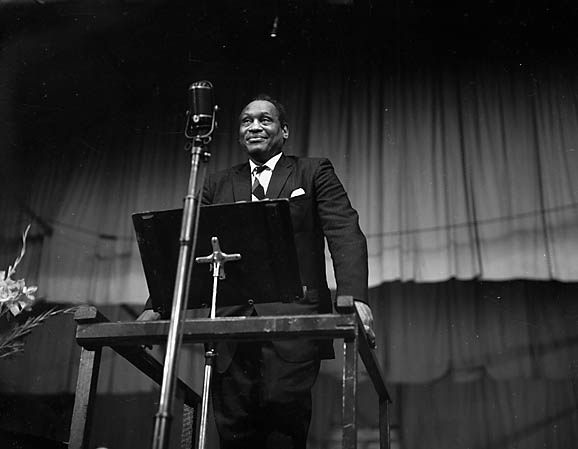
At a moment when the whole architecture of U.S. empire is in crisis, when the ruling elite is vulnerable and therefore especially neurotic and vindictive, the question becomes: Will Americans have the courage to follow the example of Robeson? To do so would require Americans to move to save America from the death spiral of a collapsing imperialist order and rebuild their nation on principles of peace, dignity, and human brotherhood. Robeson’s legacy also challenges Americans to pierce through the veil of ruling class propaganda and form their own independent opinions of China. Ultimately, the life story of Paul Robeson must be retold because it presents the American people with the choice to retrieve their revolutionary heritage and stand up to their own home-bred would-be destroyers.
By attempting to bury Paul Robeson under the slanderous lies and brute intimidation of McCarthyism, the ruling class sought to bury the true America. But the spirit of Paul Robeson can never be fully extinguished, because it is a spirit distilled from the masses of people who make up this nation and hold its future in their hands.
 Avant-Garde: A Journal of Peace, Democracy, and Science
Leave a comment