
by Dr. Ziauddin Ahmed.
Today when I look back 50 years ago, in the broader picture, I can see the effect of colonial mentality on our native rulers, imposed by prolonged British misrule in our subcontinent, which utterly disregarded race and religion.
India was invaded by many groups and ethnicities over thousands of years but all of them came and to stay as Indians except the British. In 1700, when most part of the country was ruled by Muslim Mughals, India had a 24.4% world GDP share, higher than entire Europe’s 23.3%. However after the British ruled for 200 year the global GDP share of India fell to only 5.9%. They looted and plundered not only economic growth but also social fabrics in many circumstances. British’s conspiracy deeply dived the Hindu and the Muslims in India long before it was geographically divided between Pakistan and India in 1947.
Pakistani ruling class and its military had inherited the same mentality with the twist of a domestic colonialism during their service to British India.
It’s still a vivid memory of me waking up suddenly on the morning of 26th March 1971 and finding that I had no other choice except taking up arms to fight against the murdering Pakistani army until I die or liberate the country. I was 18 years old, a first year medical student and son of a well off family with no economic worries or political affiliations.
Urdu speaking West Pakistan’s elite group and military misrule of 23 years undermined not only the democracy but also exploited then East Pakistan’s Bengali speaking population so much that the dream for a united Pakistan with equal rights and mutual respect was completely shattered. Under the leadership and wisdom of a great Bengali leader, Sheikh Mujibur Rahman, the Awami League party won a landslide victory in the last election in 1970. The Pakistani military rulers along with their civilian partner and conspirator Mr Bhutto, instead of handing over power to the elected body, started a genocide in East Pakistan at the midnight of March 25th, 1971.
I fled from home on 7th day towards remote village to the organize any armed resistance. My destination was unknown with certainty. Luckily, I found a fragment of the rebel Bengali military and joined them and started the fight. Students and farmers created the people’s army with help of the Indian and Bengali armies. The resistance by the freedom fighters, called Muktibahini, became increasingly intense against the well trained Pakistani army who already had broken moral laws with atrocities, and were facing hate and resistance from all the Bengali population in East Pakistan. The army had no national agenda except killing and suppressing the population on the orders of their superiors, and could not sustain the pressure from the people.


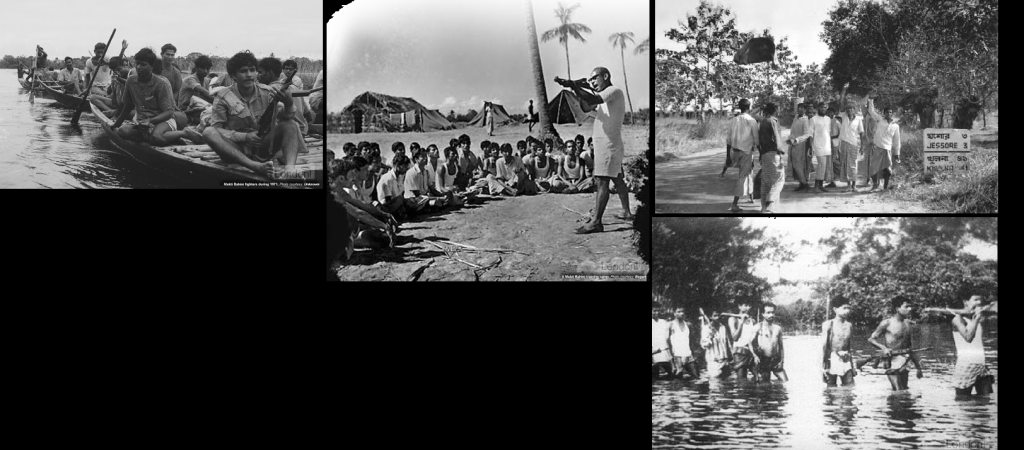
Pictures of the muktibahini
In the battle field, during the middle of the war I found out my father was killed by the Pakistani army inside his hospital. He was head of the surgery in Sylhet Medical College and stayed with his wounded patients with another young doctor, a male nurse, and ambulance driver when every doctor had left the war zone in town. I still remember the shock I felt not knowing what had happened to the rest of my family.
After 9 months of intense war in each village and hate from each civilian the plundering army lost their footing. The Indian army joined the war together which took only 13 days to defeat the already broken 95,000 Pakistani army.
They didn’t realize people can fight back against such atrocity despite no military training or weapons. The freedom fighters were a mixture of rebel Bengali Pakistani army men, students, farmers, villagers all come together to defend the ravaging destruction of their homes, villages, cities, raping their women and killing innocent civilians to create havoc in the Bengali population regardless of religion, age and gender. Dismayingly, they had killed three million Bengali innocent unarmed civilians, intellectuals, minorities, women and children and raped about half a million women. The only crime the people had committed was to democratically win an election for their basic rights.
Bangladesh is the biggest testimony to the enduring truth that religion can’t peacefully unify a nation.
The whole world was horrified but world politics and cult of alliance prevented direct support from most powerful governments. Only India and Russia came forward with their strong support to our struggle. Though the Peace loving public from all over the world supported the war for freedom. Many Pakistani political leaders, intellectuals and media opposed such atrocities but the military brutally suppressed them.
When I came to US in 1980, I was happy to know the citizens of USA supported the freedom war despite president Nixon and Henry Kissinger’s policy to aid the murdering Pakistani army. Many senators, congressmen and press spoke against the US’s role in supporting the Pakistani Army. I met a Quaker group in Philadelphia who risked their own lives to blockade a Pakistani ship with small canoes and Kayaks in Philadelphia and Baltimore to prevent arms shipments to Pakistan. I heard how the Longshoreman Association refused to load arms on to Pakistani ships. I heard of a great African American man Richard Askew who was the president of Philadelphia Longshoremen Association who refused to load not only arms but anything on to Pakistani ships. The civilians through non violent movement for the first time in the US history changed the foreign policy of their own government.
Every time I have pain and pride when I look back at the history of which I became a small part. Now more than ever in my new country, the USA, I hope to see the resurgence of the same spirit of humanity and also see the need to ignite the Bandung spirit of Asian and African alliance against the cult of white supremacy and other discrepancies to create a much better world for our children.

 Avant-Garde: A Journal of Peace, Democracy, and Science
Leave a comment