
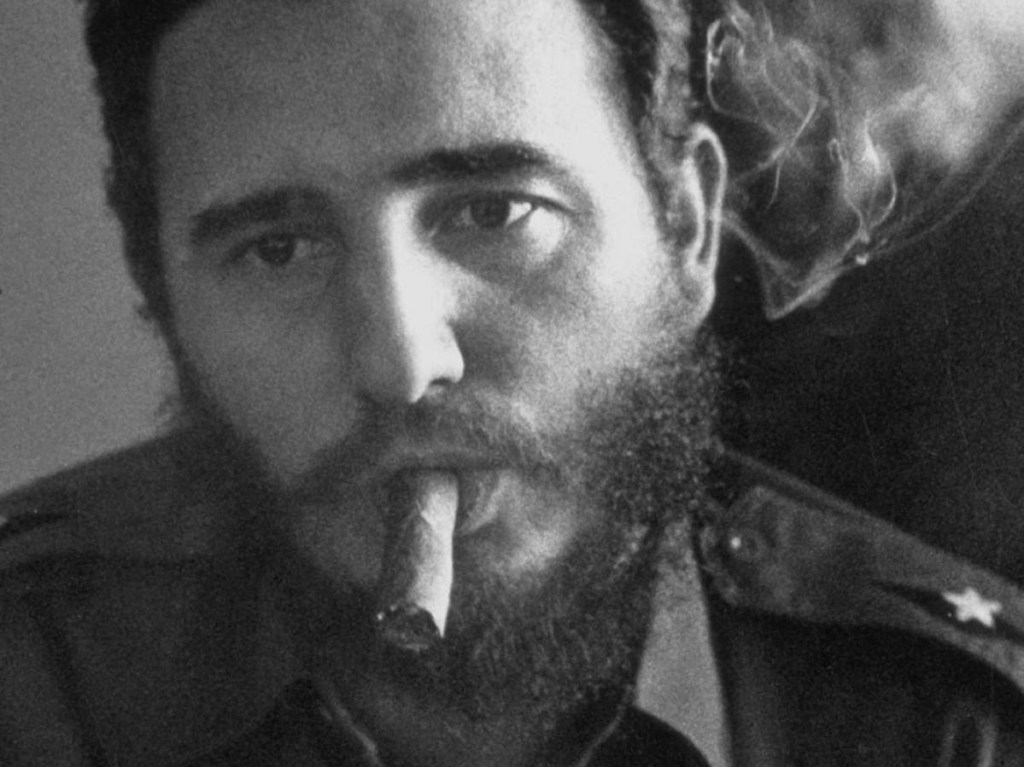
Today, we remember Fidel Castro Ruz, leader of the Cuban revolution, and a beloved friend of the darker nations, on his birth anniversary. We remember him for his leadership of the Cuban people, as they built a new society where all had enough to eat, dignified employment, education for their mind, and health for their bodies. He led the Cuban people to set a new milestone in the struggle for human unity and solidarity as they fought alongside their African brothers for the freedom of Africa. We remember Fidel as a man who was guided by an all encompassing love for the people, and as an ordinary man who made extra-ordinary commitments. Below we are sharing a speech he gave at the main lecture hall in the Central University of Venezuela, on 3 February, 1999. Here he speaks about the battle of ideas that is crucial to any struggle for freedom. We hope that those struggling for a better world today can learn from his emphasis on ideological struggle. This is a very long dialogue with students, characteristic of Fidel. We have selected some important parts.
Speech given by Dr. Fidel Castro Ruz, President of the Republic of Cuba, at the main lecture hall in the Central University of Venezuela, on 3 February, 1999.
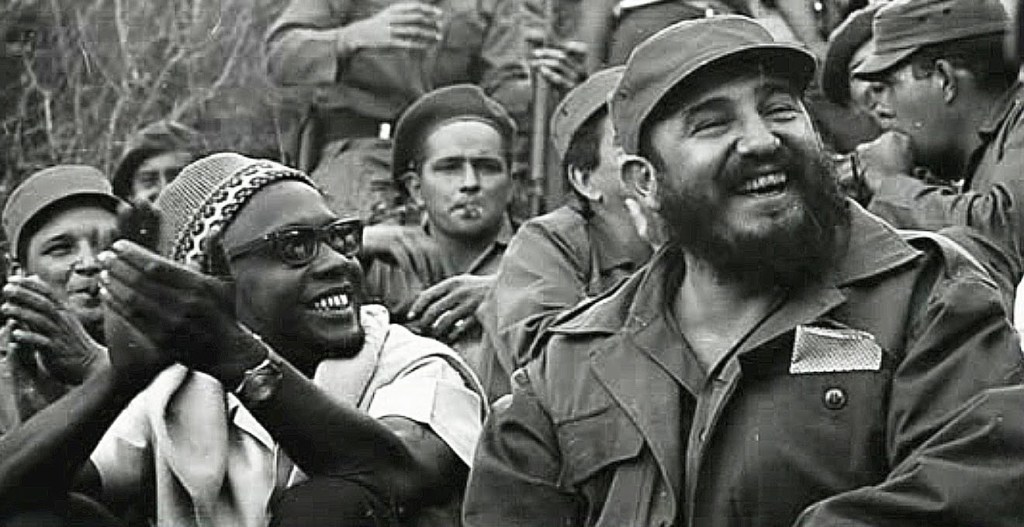
I do not have a written speech, unfortunately (LAUGHTER), but I brought some notes that I thought would be useful for the sake of precision. Still, I have realized that a booklet is missing, one that I had read, underlined, noted with great care and then… left at my hotel. (LAUGHTER AND APPLAUSE) I have sent for it, and I hope they find it because this copy here is not underlined.
At least I should address this audience formally, shouldn’t I? (LAUGHTER) I am not going to make a long list of the many excellent friends we have here. (SOMEONE IN THE AUDIENCE SAYS: “WE CANNOT HEAR!”) Listen, I do not have that much voice (LAUGHTER AND APPLAUSE) and if I start shouting… I thought there were better microphones here. (LAUGHTER)
How many of you cannot hear over there? Please, raise your hands. (HANDS RAISED) If someone does not fix this, we can invite you to sit around here or some place where you can hear. (APPLAUSE)
I am going to try to get closer to this small microphone, right? But allow me to begin properly.

Dear friends, (APPLAUSE)
I was going to say that today, February 3, 1999, it is 40 years and 10 days to this day that I first visited this university and we met in this same place. Of course, you understand that I am moved — without the melodrama you find in certain soap operas at the moment — (LAUGHTER) as it would have been unimaginable then that one day, so many years later, I would return to this place.
(…)
I told my fellow countrymen — in paying tribute to the people who had achieved that first great triumph 40 years before — that in spite of an enormous educational backwardness, they had been able to undertake and defend an extraordinary revolutionary feat. Something else: probably their political culture was lower than their educational level.
Those were times of brutal anti-communism, the final years of McCarthyism, when by all possible means our powerful and imperial neighbor had tried to sow in the minds of our noble people all possible lies and prejudices. Oftentimes, I would meet a common citizen and ask him a number of questions: whether he believed we should undertake a land reform; whether it would be fair for families to own the homes for which at times they paid big landlords almost half their salaries. Also if he believed that it was right that all those banks where the people’s money was deposited should be owned by the people in order to finance with those resources the development of the country instead of being owned by private institutions. Whether those big factories — most of them foreign-owned — should belong to, and produce for, the people… things like that. I could ask ten, fifteen similar questions and he would agree absolutely: “Yes, it would be great.”
In essence, if all those big stores and all those profitable business that only enriched their privileged owners belonged to the people and were used to enrich the people, would you agree? “Yes, yes, he would answer immediately. He agreed completely with each of these simple proposals. So, then I asked him: “Would you agree with socialism? (APPLAUSE) Answer: “Socialism? No, no, no, not with socialism.” Let alone communism… There was so much prejudice that this was an even more scaring word.
Revolutionary legislation was what contributed the most to creating a socialist consciousness in our people. Then, it was that very people — illiterate or semi-illiterate at the beginning — who had to start by teaching many of its children to read and write. The same people that out of love for liberty and yearning for justice had overthrown the tyranny and carried out, and heroically defended, the most profound social revolution in this Hemisphere.
In 1961, only two years after the triumph, with the support of young students working as teachers about 1 million people learned how to read and write. They went to the countryside, to the mountains, the remotest places and there they taught people that were even 80 years old how to read and write. Later on, there were follow-up courses and the necessary steps were taken in a constant effort to attain what we have today. A revolution can only be born from culture and ideas.
No people become revolutionary by force. Those who sow ideas have no need to suppress the people ever. Weapons in the hands of that same people are used to fight those abroad who try to take away their achievements.
Forgive me for touching on this issue because I did not come here to preach socialism or communism and I do not want to be misinterpreted. Nor did I come here to propose radical legislation or anything of the sort. I was simply reflecting on our experience that showed us the importance of ideas, the importance of believing in man, the importance of trusting the people. This is extremely important when mankind is facing such complicated and difficult times.
Naturally, on January 1st this year in Santiago de Cuba it was fitting to acknowledge, in a very special way, that that Revolution which had managed to survive 40 years and mark this anniversary without folding its banners, without surrendering, was mainly the work of the people gathered there, young people and mature men and women. They had received their education under the Revolution and were capable of that feat, thus writing pages of noble and well-earned glory for our nation and our brothers and sisters in the Americas.
We could say that thanks to the efforts of three generations of Cubans, vis-a-vis the mightiest power, the biggest empire ever in Man’s history, this sort of miracle came true: that a small country would undergo such an ordeal and achieve victory.
Our even greater recognition went to those countrymen who in the past 10 years — the latest 8 years, to be precise — had been willing to withstand the double blockade resulting from the collapse of the socialist camp and the demise of the USSR which left our neighbor as the sole superpower in a unipolar world, unrivaled in the political, economic, military, technological and cultural fields. I do not mean the value of their culture but rather the tremendous power they exercise to impose their culture on the rest of the world. (APPLAUSE)
However, it was unable to defeat a united people, a people armed with just ideas, a people endowed with a great political consciousness because that is most important for us. We have resisted everything and are ready to continue resisting for as long as need be (APPLAUSE) thanks to the seeds planted throughout those decades, thanks to the ideas and the consciousness developed during that time.
It has been our best weapon and it shall remain so, even in nuclear times. Now that I mention it, we even had experiences related to that type of weapons because at a given moment, who knows how many bombs and how many nuclear missiles were aimed at our small island during the well-known Missile Crisis in October 1962. Even in times of smart weapons — which sometimes make mistakes and strike 100 or 200 km away from their targets (LAUGHTER) but which have a certain degree of precision — man’s intelligence will always be greater than any of these sophisticated weapons. (APPLAUSE AND EXCLAMATIONS)
The type of fight becomes a matter of concepts. The defense doctrine of our nation, which feels stronger today as it has perfected these concepts, is based on the conclusion that at the end — the end of our invaders — it would be a body combat, a man-to-man and a woman-to-invader combat, whether man or woman. (PROLONGED APPLAUSE)
We have had to wage, and will have to continue waging, a more difficult battle against that extremely powerful empire: a ceaseless ideological battle that they stepped up with all their resources after the collapse of the socialist camp when, fully confident in our ideas, we decided to continue forward. More than that, to continue forward alone; and when I say alone I am thinking of state entities, without ever forgetting the immense and invincible support and solidarity of the peoples which we always had and which makes us feel under a greater obligation to struggle. (APPLAUSE)
We have accomplished honorable internationalist missions. Over 500,000 Cubans have taken part in such hard and difficult missions. The children of that people which could not read or write developed such a high consciousness that they shed their sweat, and even their blood, for other peoples; in short, for any people in the world. (APPLAUSE)
When the special period began we said: “Now, our first internationalist duty is to defend this bulwark”. We meant what Martí had described in the last words he wrote the day before his death, when he said that the main objective of his struggle had to go undeclared in order to be accomplished. Martí, who was not only a true believer in his ideas but also a wholehearted follower of Bolívar’s, (APPLAUSE) had set himself an objective. According to his own words, it was “to timely prevent with the independence of Cuba that the United States should expand itself over the Antilles and fall, with this additional might, on our lands in the Americas. Everything I have done up so far, and everything I will do, is for this purpose.” (APPLAUSE)
It was his political will and he expressed his life’s aspiration: to prevent the fall of that first trench which the northern neighbors had so many times tried to occupy. That trench is still there, and will continue to be there, with a people willing to fight to death to prevent the fall of that trench of the Americas. (APPLAUSE) The people there is capable of defending even the last trench, and whoever defends the last trench and prevents anyone from taking it begins, at that very moment, to attain victory. (APPLAUSE)
Comrades, if you allow me to call you that. That is what we are at this moment and I also believe that here, at this moment, we are defending a trench. (APPLAUSE) And trenches of ideas — forgive me for quoting Martí again — are worth, as he said, more than trenches of stones. (APPLAUSE)
We must discuss ideas here, and so I go back to what I was saying. Many things have happened in these 40 years but the most transcendental is that the world has changed. This world of today in which I am talking to you — to those who had not been born then, and many were far from being born at the time — does not resemble the world of those days.
I tried to find a newspaper where there might be a note on that rally at the university. Fortunately, we do have the complete text of the speech delivered at Plaza del Silencio. The revolutionary fever we had come down with from the mountains only a few days before accompanied us when speaking of revolutionary processes in Latin America and focusing on the liberation of the Dominican people from Trujillo’s clutches. I believe that issue took most of the time — or a good part of the time of that meeting — with a tremendous enthusiasm shared by all.
Today, that would not be an issue. Today, there is not one particular people to liberate. Today, there is not one particular people to save. Today, a whole world, all of mankind needs to be liberated and saved. (APPLAUSE) And it is not our task, it is your task. (APPLAUSE)
There was not a unipolar world at that time, a single, hegemonistic superpower. Today, the world and all mankind are under the domination of an enormous superpower. Nonetheless, we are convinced that we will win the battle (APPLAUSE) without panglossian optimism — I believe that is a word writers sometimes use (LAUGHTER). I believe so because you can be sure that if you drop this notebook (SHOWING IT) it will fall in a second, that if this table were not here, this notebook would be on the floor. And the table on which this mighty superpower ruling a unipolar world is objectively standing, is disappearing. (APPLAUSE)
These are objective reasons, and I am sure mankind will provide all the indispensable subjective ones. For this, neither nuclear weapons nor big wars are necessary but ideas. (APPLAUSE) This I say on behalf of that small country we mentioned before, which has struggled staunchly and unhesitatingly for 40 years. (APPLAUSE)
You were saying, calling — to my embarrassment — the name by which I am known, I mean “Fidel,” because I do not have any other title actually. I understand that protocol demands the use of “His Excellency the President” and so on and so forth. (APPLAUSE AND CALLS OF FIDEL! FIDEL!) When I heard you chanting: “Fidel! Fidel! What is it with Fidel that Americans cannot put him down?” I had an idea. So I turned to my neighbor on the right, I mean on the right in terms of geography, (LAUGHTER AND EXCLAMATIONS) there are some people making signs I do not understand, but I say that all of us are in the same combat unit. (APPLAUSE) So, I told him: “Well, actually what they should be asking is: What is it with the Americans that cannot put him down?” (LAUGHTER AND APPLAUSE) And, that instead of saying “him” when asking: “What is it with the Americans that cannot put him down?” They could say: “What is with the Americans that cannot put Cuba down?” It would be more accurate. (APPLAUSE) I realize words are used to symbolize ideas. That is the way I have always understood it. I never take credit, nor can I take credit, for that myself. (EXCLAMATIONS OF “LONG LIVE FIDEL!”)
Yes, we all hope to live long, all of us! (APPLAUSE) In the ideas that we believe and in the conviction that those following in our steps will carry them forward. However, your task — it should be said — will be more difficult than ours.
I was saying that we are living in a very different world. This is the first thing we need to understand; then, I was explaining certain political characteristics. Furthermore, the world is globalized, really globalized, a world dominated by the ideology, the standards and the principles of neo-liberal globalization.

(…)
We have withstood that warfare and like in all battles — whether military, political or ideological — there are casualties. There are those who may be confused, some really are, softened or weakened by a combination of economic difficulties, material hardships, the parading of luxury in consumer societies and the nicely sweetened but rotten ideas about the fabulous advantages of their economic system, based on the mean notion that man is an animal moved only by a carrot or when beaten with a whip. We might say that their whole ideological strategy is based on this.
There are casualties, but also, like in all battles and struggles, other people gain experience, fighters become veterans, multiply their qualities and help preserve and increase the morale and strength needed to continue fighting.
We are winning the battle of ideas. (APPLAUSE) Still, the battlefield is not limited to our small island, although the small island has to fight. Today, the world is the battlefield; it is everywhere, in all continents, in all institutions, in every forum. This is the good side of the globalized struggle. (LAUGHTER AND APPLAUSE) We must defend the small island while fighting throughout the huge world they dominate or try to dominate. In many fields they dominate it almost exclusively but not in all fields, nor in the same way, nor in absolutely every country.
They have discovered very intelligent weapons but we, the revolutionaries, have discovered an even more powerful weapon, more powerful: man thinks and feels. (APPLAUSE) We have learned that around the world, in the countless internationalist missions we have discharged in one field or another throughout the world. Suffice it to mention a single figure: 26,000 Cuban doctors have taken part in them.
The country that was left with only 3,000 out of the 6,000 doctors it had at the triumph of the Revolution, many of them unemployed but always wanting to migrate to obtain such and such income and salaries. The Revolution has been able to multiply those 3000 who stayed by training more and more doctors from those who began studying first or second grade in the schools immediately established throughout the country after the Revolution. These people have such a spirit of sacrifice and solidarity that 26,000 of them have accomplished internationalist missions (APPLAUSE) just as other hundreds of thousands Cubans have worked as professionals, teachers, constructors and combatants. Yes, combatants, and we take pride in saying this (APPLAUSE) because fighting against the fascist and racist soldiers of apartheid and contributing to the victory of African peoples to whom that system was the greatest insult is, and will forever be, a reason to feel proud. (APPLAUSE)
But in this ignored — highly ignored — effort, we have learned a lot from peoples. We have come to know those peoples and their extraordinary qualities. Among other things we have learned, not only through abstract notions but also in ordinary everyday life, that all men may not be equal in their features but all men are equal in their talents, feelings and other virtues. This proves that, in terms of moral, social, intellectual and human abilities, all men are genetically equal. (APPLAUSE)
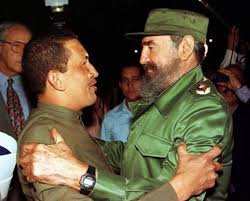
(…)
Fate would have it that Venezuela should be the country to fight the most for the independence of this hemisphere. (APPLAUSE) It began here and you had a legendary precursor like Miranda, who even lead a French army in campaign waging famous battles which, at a point in time, during the French Revolution, prevented an invasion of French territory. He had also fought in the United States for that country’s independence. I have a wide collection of books about Miranda’s great life, although I have not been able to read them all. The Venezuelans, therefore, had Miranda, the forefather of Latin America’s independence, and later Bolívar, the Liberator, who was always for me the greatest among the greatest men in history. (From the audience they shout: “FIDEL TOO!”)
Please, put me in the forty-thousandth place. I always remember one of Martí’s phrases deeply engraved in my mind: “All the glory in the world can fit into a kernel of corn.” Many great people in history were concerned about glory and that is no reason to criticize them. Perhaps it was the concept of time, the sense of history, the future, the importance and survival of events in their lives what they took for glory. This is natural and understandable. Bolívar liked to speak about glory and he spoke very strongly about glory. He cannot be criticized; a great aura of glory will forever be attached to his name.
Martí’s concept, which I entirely share, associates glory to personal vanity and self-exaltation. The role of the individual in important historic events has been very much debated and even admitted. What I especially like about Martí’s phrase is the idea of man’s insignificance as compared to the enormous significance and transcendence of humanity and the immeasurable reach of universe, the reality that we are really like a small speck of dust floating in space. However, that reality does not diminish man’s greatness a single bit. On the contrary, it is enhanced when, like in Bolívar’s case, he carried in his mind a whole universe full of just ideas and noble sentiments. That is why I admire Bolívar so much. That is why I consider his work so immense. He does not belong to the stock of men who conquered territories and nations, or founded empires that gave fame to others; he created nations, freed territories and tore empires. He was also a brilliant soldier, a distinguished thinker and prophet.
Today, we are trying to do what he wanted to do and remains to be done. We are trying to unite our peoples so that tomorrow, following the same train of unitary thought, the only one which corresponds with our specie and our age, human beings will be able to know and live in a united, brotherly, just and free world. That is what he wanted to do with the white, black, native and mixed peoples of our America.
Here we are in this land for which we feel special admiration, respect and love. When I came 40 years ago, I expressed it with deep gratitude because nowhere else was I better received, with so much affection and enthusiasm. The only thing I could be ashamed of is that I was actually in kindergarten when that first meeting in this prestigious university was held. (LAUGHTER AND APPLAUSE)
(…)
There is no way of escaping it, and there is no alternative. So I am not trying to flatter you with my words. I rather remind you of your duty, the duty of the nation, of the people, of all those who were born after that visit, of the youngest, of the more mature, who really have a great responsibility ahead of you. I think opportunities have often been lost, but you would not be forgiven if you lose this one. (APPLAUSE)
The person speaking to you here has had the privilege and the opportunity of accumulating some political experience, of having lived through a revolutionary process in a country where, as I have already said, people did not even want to hear about socialism. And when I say people, I mean the vast majority. That same majority supported the Revolution, supported the leaders, supported the Rebel Army but there were ghosts they were afraid of. What Pavlov did with his famous dogs, it is the same thing the United States did with many of us and who knows with how many millions of Latin Americans: create conditioned reflexes in us.
We have had to fight a lot against scarcity and poverty. We have had to learn to do a lot with little. We had good and bad moments, the former especially when we were able to establish trade agreements with the socialist block and the Soviet Union and demanded fairer prices for our export products. Because we observed how the prices of what they exported rose while those of our products, in the course of a five-year trade agreement, remained the same. Then, at the end of the five-year period, we had less purchasing power. We proposed a sliding clause: when the prices of the products that they exported to us rose, the prices of the products that we exported to them also automatically rose. We resorted to diplomacy, to the doctrine and the eloquence that revolutionaries in a country that had to overcome so many obstacles must have.
Actually, the Soviets felt great sympathy for Cuba and great admiration for our Revolution. It was very surprising for them to see that after so many years a tiny country, right next to the United States, would rebel against that mighty superpower. They had never contemplated such possibility and they would have never advised it to anyone. Luckily we never asked anybody for advise, (LAUGHTER) although we had already read almost a whole library of the works of Marx, Engels, Lenin and other theoreticians. We were convinced Marxists and socialists.
With that fever and that blind passion that characterizes young people, and sometimes old people too, (APPLAUSE) I assumed the basic principles that I learned from those books and they helped me understand the society where I lived. Until then it was for me an intricate entanglement for which I could not find any convincing explanation. I must say that the famous Communist Manifesto, which Marx and Engels took so long to write — you can tell that its main author worked conscientiously, a phrase he liked to use, and must have revised it more times than Balzac revised each page of any of his novels — impressed me tremendously because for the first time in my life I realized a few truths that I had never seen before.
Before that, I was a sort of utopian communist. I began to draw my own conclusions and ended up being a utopian communist while studying from an enormous book with some 900 mimeographed pages, the first political economy course they taught us in Law School. It was a political economy inspired in the ideas of capitalism but which mentioned and analyzed very briefly the different schools and criteria. Later, in the second course, I paid much attention to the subject and meditated on the basis of rational viewpoints, so I ended up being a utopian communist. I call it that because my doctrine had no scientific or historic basis whatsoever. It was based on the good wishes of a student recently graduated from a Jesuits’ school. And I am very grateful because they taught me some things that have helped me in life, above all, to have strength, a certain sense of honor and definite ethical principles that these Spanish Jesuits although very distant from any of the ideas I uphold today instilled in their pupils.
I came out of that school an athlete, an explorer and a mountain climber. I entered the University of Havana ignorant about politics, without a revolutionary private tutor who would have been so useful to me at that stage of my life.
That is how I came to have my own ideas, which I preserve and maintain with growing loyalty and fervor. Maybe it is because I now have a little more experience and knowledge, and maybe also because I have had the opportunity of meditating about new problems that did not even exist during Marx’s time.
For example, the word environment was probably never pronounced by anyone in all of Karl Marx’s life, except Malthus who said that the population grew in geometric progression and that there would not be enough food for so many people. He thus became a sort of forerunner of today’s ecologists, although he maintained ideas concerning the economy and salaries we cannot but disagree with. (LAUGHTER)
So I am wearing the same coat I wore when I came to this university 40 years ago, (APPLAUSE) the same one I wore when I attacked the Moncada garrison, when we disembarked from Granma (APPLAUSE). I would venture to say, despite the many pages of adventure that anyone can find in my revolutionary life, that I always tried to be wise and sensible, although perhaps I have been wiser than sensible.
In our conception and development of the Cuban Revolution, we acted as Martí said when, on the eve of his death in combat, he addressed the great anti-imperialist objective of his struggle: “It had to be in silence and sort of indirectly since the achievement of certain goals demands concealment for, if proclaimed for what they really are, obstacles so formidable would rise as to prevent their attainment.”
I was discreet, but not as much as I should have been because I would explain Marx’s ideas and the class society to everyone I met. So, in the people’s movement whose slogan in its fight against corruption was “Dignity against Money” which I had joined as soon as I arrived at the university, they were beginning to take me for a communist. Towards the end of my university studies, I was no longer a utopian communist but rather an atypical communist who was acting freely. I based myself in a realistic analysis of our country’s situation.
Those were the times of McCarthyism and Cuba’s Marxist Party, the People’s Socialist Party was almost completely isolated. However, within the movement I had joined, which had now become the Cuban People’s Party, a large mass, in my opinion, had a class instinct but lacked a class consciousness: peasants, workers, professionals, middle-class people, good, honest, potentially revolutionary people. Its founder and leader, a man of great charisma, had dramatically taken his own life a few months before the 1952 coup d’état. The younger ranks of that party later became an important part of our movement.
I was a member of that political organization which, as it usually happened, was already falling into the hands of rich people, and I knew by heart what was going to happen after the then inevitable electoral triumph. But I had come up with some ideas, also on my own — just imagine the things a utopian can think up — about what had to be done in Cuba and how to do it, despite the United States. Those masses had to be led along a revolutionary path. Maybe that was the merit of the tactic we pursued. Of course, we were reading Marx’s, Engels’s and Lenin’s books.
When we attacked the Moncada garrison we left one of Lenin’s books behind, and the first thing the propaganda of Batista’s regime said during the trial was that it was a conspiracy of corrupt members of the recently overthrown government, bankrolled with their money, and communist too. No one knows how both categories could be reconciled.
In the trial, I assumed my own defense. It was not that I thought myself a good lawyer but I thought that I was the person who could best defend myself at that moment. I put on a gown and took my place with the lawyers. It was a political and not a penal trial. I did not intend to be acquitted but to disseminate ideas. I began to cross-examine all those killers who had murdered dozens upon dozens of our comrades and were there as witnesses; I turned the trial against them. (APPLAUSE) So the next day they took me out of there, they put me away and declared me ill. (LAUGHTER)
That was the last thing they did although they really wanted to do away with me once and for all; but, well, I knew very well why they checked themselves. I knew and I know the psychology of all of those people. It was due to the mood and the situation with the people, the rejection and huge indignation caused by all the murders they had committed. I also had a bit of luck. But the fact is that at the beginning, while they were questioning me, this book of Lenin appears. Someone takes it out and says: “You people had a book of Lenin.”
We were explaining who we were: Martí followers, that was the truth, that we had nothing to do with that corrupt government that they had ousted from power, that our objectives were such and such. However, we did not say a word about Marxism-Leninism, neither did we have to. We said what we had to say but since the subject of the book came up at the trial, I felt really irritated and said: “Yes, that book by Lenin is ours, we read Lenin’s books and other socialist books, and whoever does not read them is an ignorant.” That is what I told the judges and the rest of the people there. (APPLAUSE) That was insufferable. We were not going to say: “Listen, that little book was planted there by somebody…” (LAUGHTER)
Our program had been presented when I defended myself at the trial, therefore, those who did not know how we thought was because they did not want to know. Perhaps they tried to ignore that speech known as “History Will Absolve Me” with which I defended myself all alone over there. Because, as I have explained, I was expelled, they declared me ill, they tried all the others and sent me to a hospital to try me, in a small ward. They did not exactly hospitalize me but put me in an isolated prison cell. In the hospital, they turned a small ward into a courtroom with the judges and a few other people crammed into it, most of them from the military. They tried me there, and I had the pleasure of saying there all that I thought, everything, quite defiantly.
I wonder why they were not able to deduce what our political thought was, for it was all there. It contained you might say the foundation of a socialist government program although we were convinced the time was not ripe, that the right time and stages would come. That was when we spoke about the land reform among many other things of a social and economic nature. We said that all the profits obtained by all those gentlemen with so much money — that is, the surplus value but without using such terminology — (LAUGHTER) should be used for the development of the country, and I hinted that it was the government’s responsibility to look after the development of the country and that surplus money.
I even spoke about the golden calf. I recalled the Bible once again and singled out “those who worshipped the golden calf,” in a clear reference to those who expected everything from capitalism. Those were elements enough for them to deduce our way of thinking.
Later, I have meditated that it is likely that many of those who could be affected by a true revolution did not believe us at all, because in the 57 years of Yankee neocolonialism, many a progressive or revolutionary program had been proclaimed. The ruling classes never believed our program to be possible or permissible by the United States. They did not pay much attention to it. They heeded it and even found it funny. At the end of the day, all the programs used to be abandoned and people would become corrupt. So they probably said: “Yes, the illusions of these romantic young men are very pretty, very nice, but, why worry about that?”
They did not like Batista. They admired the frontal fight against his abusive and corrupt regime and they possibly underestimated the thoughts contained in that declaration, which were the basis of what we later did and of what we think today. The difference is that many years of experience have further enriched our knowledge and perceptions about all those problems. So, as I have said, that is the way I have thought since then.
We have undergone the tough experience of a long revolutionary period, especially during the last ten years, confronting extremely powerful forces under very difficult circumstances. Well, I will tell you the truth: we achieved what seemed impossible. I would venture to say that near miracles were performed. Of course, the laws were passed exactly as they had been promised always with United States angry and arrogant opposition. It had had great influence in our country, so it made itself felt and the process became increasingly radicalized with each blow and aggression we suffered.
Thus began the long struggle we have waged until today. The forces in our country polarized. Fortunately, the vast majority was in favor of the Revolution and a minority, around 10% or less, was against it. So there has always been a great consensus and a great support for all that process until today. One knows what to worry about, because we made a great effort to overcome the prejudices that existed, to convey ideas, to build a consciousness and it was not an easy work.
I remember the first time I spoke about racial discrimination. I had to go on television about three times. I was surprised at how deeply rooted, more than we had supposed, had become the prejudices brought to us by our northern neighbors: that certain clubs were for white people only and the rest could not go there, as well as certain beaches. Almost all the beaches, especially in the capital, were exclusively for whites. There were even segregated parks and promenades, where according to the color of your skin you had to walk in one direction or another. What we did was to open all the beaches for all of the people and from the very first days we prohibited discrimination in all places of recreation, parks and promenades. That humiliating injustice was incompatible with the Revolution.
One day I spoke and I explained these things. There was such reaction, such rumors and so many lies! They said we were going to force white men into marrying black women and white women into marrying black men. Well, just like that other preposterous invention that we were going to deprive families of the parental custody of their children. I once again had to go on television on the subject of discrimination to reply to all those rumors and machinations and explain the matter once again. That phenomenon, which was nothing but an imposed racist culture, a humiliating, cruel prejudice was very hard to eradicate.
In other words, during those years, we devoted a great deal of our time to two things: defending ourselves from expeditions, threats of foreign aggression, dirty war, assassination attempts, sabotages, etc. and building consciousness. There was a moment when there were armed mercenary bands in every province of our country, promoted and supplied by the United States. But we confronted them immediately, we gave them no time. They had not the slightest chance to prosper because our own experience in irregular warfare was very recent and we were practically one of the few revolutionary countries which totally defeated these bands despite the logistic support they received from abroad. We had to devote a lot of our time to that.
One problem I see, one source of concern I have is that many expectations have been raised in Venezuela by the extraordinary results of the elections, and it is logical. What do I mean? I mean the natural, logical tendency of the people to dream, to wish that a great number of accumulated problems be solved in a matter of months. As an honest friend of yours, in my own opinion, I think there are problems here that will not be solved in months, or years. (APPLAUSE)
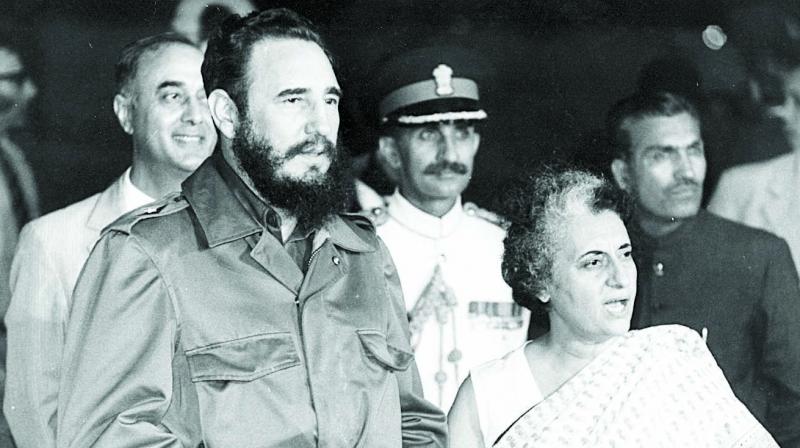
(…)
Now we can say the same thing a lieutenant said who took me prisoner in a forest near Santiago de Cuba in the early hours of dawn several days after the attack against the Moncada army garrison. We had made a mistake, there is always a mistake. We were tired of sleeping on the ground, over roots and stones, so we fell asleep in a makeshift hut covered with palm fronds. Then, we woke up with rifles pointed against our chests. It was a lieutenant, a black man, with a group of unmistakably bloodthirsty soldiers who did not know who we were. We had not been identified. At first, they did not identify us. They asked us our names. I gave a false name. Prudence, huh? (LAUGHTER) Shrewdness? (APPLAUSE) Perhaps it was intuition or maybe instinct. I can assure you that I was not afraid because there are moments in life when it is so, when you consider yourself as good as dead, and then it is rather your honor, your pride, your dignity that reacts.
If I had given them my name, that would have been it: tah, tah, tah! They would have done away with that small group immediately. A few minutes later they found some weapons nearby. These had been left behind by some comrades who were not in physical conditions to continue the struggle. Some of them were wounded and we had all agreed they should return to the city to turn themselves in to the judicial authorities. Only three of us were stayed, only three armed comrades! And we were captured the way I have just explained.
But that lieutenant, what an incredible thing! I have never told this story in detail publicly. This lieutenant was trying to calm down the soldiers but he could hardly stop them anymore. When they found the other comrades’ weapons while searching the surroundings, they were infuriated. They had us tied up with their loaded rifles pointing at us. But the lieutenant moved around calming them down and repeating in a low voice: “You cannot kill ideas, you cannot kill ideas.” What made this man say that?
He was a middle-aged man. He had taken some university courses and he had that idea in his head, and he felt the urge to express it in a low voice, as if talking to himself: “You cannot kill ideas.” Well, when I look at this man and I see his attitude, in a critical moment when he was hardly able to keep those angry soldiers from firing, I get up and tell him: “Lieutenant,” him alone, of course, “I am so and so, first in command of the action. Seeing your chivalrous attitude, I cannot deceive you, I want you to know who you have taken prisoner.” And the man says, “Do not tell anyone! Do not tell anyone!” (APPLAUSE) I applaud that man because he saved my life three times in a few hours.
A few minutes later they were taking us with them and the soldiers were still very irritated. They heard some shots not far from there, got ready for combat and said to us, “Drop down to the ground.” I remained standing and I said, “I will not drop to the ground!” I thought it was some kind of trick to eliminate us, and I said, “No.” I also told the lieutenant who kept insisting that we protected ourselves, “I am not dropping to the ground, if they want to shoot let them shoot.” Then he says, listen to what he says, “You boys are very brave.” What an incredible reaction!
I do not mean that he saved my life at that moment, but he had that gesture. After we reached a road, he put us in a truck and there was a major there who was very bloodthirsty. He had murdered many of our comrades and wanted the prisoners handed over to him. The lieutenant refused, said we were his prisoners and he would not hand them over. He had me sitting in the front seat of the truck. The major wanted him to take us to the Moncada but he did not hand us over to the major –there he saved our lives for the second time– nor did he take us to the Moncada. He took us to the precinct, in the middle of the city, saving my life for the third time. You see, and he was an officer of that army we were fighting against. When the Revolution triumphed, we promoted him to captain and he became aide to the first President of the country after the triumph.
As that lieutenant said, ideas cannot be killed. (APPLAUSE) Our ideas did not die, no one could kill them. And the ideas we sowed and developed during those thirty odd years until 1991 more or less, when the special period began, were what gave us the strength to resist. Without those years we had to educate, sow ideas, build awareness, instill feelings of solidarity and a generous internationalist spirit, our people would not have had the strength to resist.
I am speaking of things that are somewhat related to matters of political strategy. Very complicated things because they can be interpreted in different ways, and I know very well what I want to express. I have said that not even a Revolution like ours, which triumphed with the support of over 90% of the population, a unanimous, enthusiastic backing, great national unity, a tremendous political force, would have been able to resist. We would not have been able to preserve the Revolution under the current circumstances of the globalized world.
I do not advise anyone to stop fighting, one way or another. There are many ways, and among them the action of the masses, whose role and growing strength are always decisive.
Right now, we ourselves are involved in a great combat of ideas, disseminating our ideas all over, that is our job. It would not occur to us today to tell anyone: “Make a revolution like ours.” Because under the circumstances that we think we know quite well, we would not be able to suggest: “Do what we did.” Maybe if we were in those times we would say: “Do what we did.” But in those times the world was different and the experience was different. Now we are more knowledgeable, more aware of the problems and, of course, respect and concern for others should come first and foremost.
At the time of the revolutionary movements in Central America, when the situation had become very difficult because the unipolar world already existed and not even the Nicaraguan revolution could stay in power, and peace negotiations were begun, we were visited quite often because of the long friendship relations existing with Cuba, and we were asked our views. We would tell them: “Do not ask our views about that. If we were in your place, we would know what to do, or we might be able to think what we should do. But you cannot give opinions to others when they are the ones who will have to apply opinions or criteria on matters as vital as fighting until death or negotiating. That decision only the revolutionaries of each country themselves can take. We will support whatever decision you make.”
It was a unique experience, which I am telling in public for the first time too. Everyone has his own options but no one has the right to convey to others his own philosophy on facing life or death. That is why I say that giving opinions is a very delicate matter.
This does not hold true for criteria, viewpoints and opinions about global issues that affect the planet, recommendable tactics and strategies of struggle. As citizens of the world and part of the human race, we have the right to clearly express our thoughts to those who want to hear, be they revolutionaries or not.
We learned a long time ago how our relations with the progressive and revolutionary forces must be. Here, before you, I limit myself to conveying ideas, reflections, concepts in keeping with our common condition of Latin American patriots because, I repeat, I see a new hour in Venezuela, an immovable and inseparable pillar of the history of our America. One has the right to trust one’s own experience or viewpoint. Not because one is infallible or because one has not made mistakes but because one has had the opportunity to take a 40 yearlong course in the academy of the Revolution.
(…)
In an incident related to a plan to steal a passenger boat in the port of Havana to create a migratory disorder there was some turmoil and some began to throw stones against some store windows. What did we do then? We have never used soldiers or policemen against civilians. We have never had a fire engine throwing powerful jets of water against people, as one can see in those images from Europe itself almost every day, nor people wearing masks as if ready for a trip to outer space. (LAUGHTER AND APPLAUSE) No, it is consensus that maintains and gives the Revolution its force.
That day I remember I was just getting to my office, it was about midday and I heard the news. I called my escorts, who were carrying weapons, and told them: “We are heading for the disturbances. You are forbidden to use your weapons!” I really preferred to have someone shoot at me than using weapons in this type of situation, that is why I gave them categorical instructions and they dutifully went there with me.
How long did the disturbances last? Minutes, seconds perhaps. Most of the people were perched in their balconies. They were somewhat shocked, surprised. Some underclass were throwing stones. And, suddenly, I think even those who were throwing stones started to applaud then the whole crowd moved and it was really impressive to see how the people react when it becomes aware of something that might harm the Revolution!
Well, I intended to get to the Havana City Museum where the city historian was. “How might Leal be?” He was said to be besieged in the Museum. But some blocks away, near the sea wall a whole crowd was walking with us and there were no signs of violence. I had said: “Not one unit should be moved, not one weapon, not one soldier.” If you trust the people and if you have the trust of that people, you do not have to use weapons ever. We have never used them in our country. (APPLAUSE)
So what you need is unity, political culture and the conscious and militant support of the people. We built that through a long work. You, Venezuelans, will not be able to create it in a few days, nor in a few months.
(…)

Do I believe myself to be a sort of prophet of fortune-teller? No. Do I know much about economics? No. Hardly anything. To make this statement it is enough to know how to add up, subtract, multiply and divide — something children learn in grammar school.
How will such transition take place? We do not know. Will it be through violent revolutions or devastating wars? That seems unlikely, irrational and suicidal. Will it be through deep and catastrophic crises? Unfortunately, this is most likely, almost inevitable and it will happen through many different ways and forms of struggle.
What kind of globalization will it be? It cannot but be supportive, socialist, communist or whatever you want to call it.
Does nature, and the human species with it, have much time left to survive in the absence of such change? Very little time. Who will be the builders of that new world? The men and women who inhabit our planet.
Which will be their basic weapons? Ideas will be, and consciousness. Who will sow them, cultivate them and make them invincible? You will. Is it a utopia, just one more dream among so many others? No, because it is objectively inevitable and there is no alternative to it. It has been dreamed of before, only perhaps too early. As the most visionary of the sons and daughters of this island, José Martí, said: “Today’s dreams will be tomorrow’s realities.”
This speech is available in full at fidelcastro.cu.


 Avant-Garde: A Journal of Peace, Democracy, and Science
Leave a comment