
We welcome our readers to Organization for Positive Peace’s blog! The purpose of our blog is to share news and posts about our times, and contributing to the struggle for ideas that can build a positive peace. We will publish monthly updates on current affairs, book reviews, guest posts from organizations and individuals who support the cause of positive peace, and tributes to important peace activists and leaders.
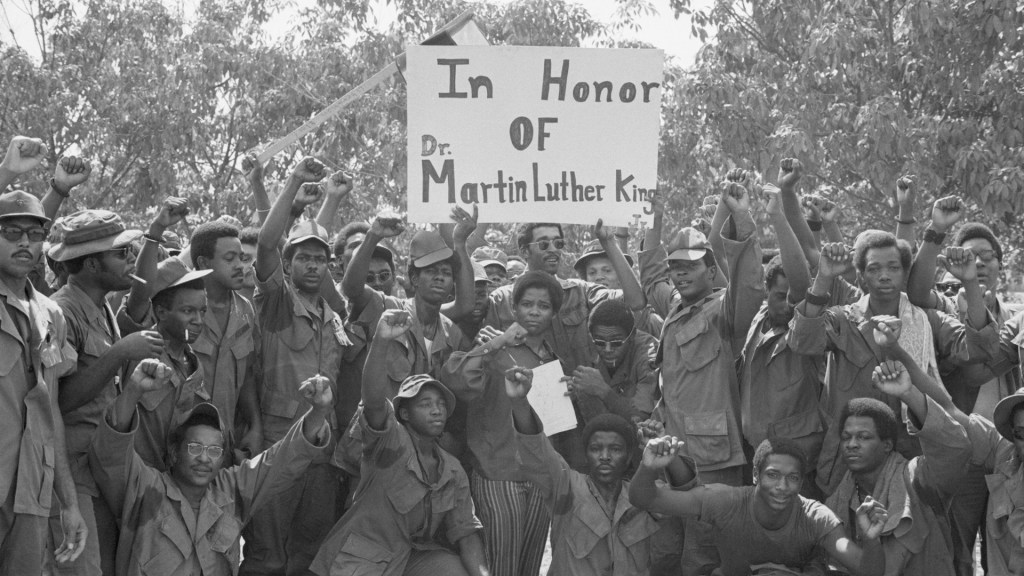
It is only right for us to celebrate and honor Martin Luther King Jr in our first post. We want to mark the date of his assassination, April 4, which is also the date of his speech “Beyond Vietnam–A Time to Break Silence”. King’s landmark speech deserves to be studied and heard around the country. In his speech, King theorized that war is an enemy of the poor. Not only was the Vietnam War an enemy of the poor at home by wasting resources that could be used for the uplift of the poor, he said furthermore
“Perhaps a more tragic recognition of reality took place when it became clear to me that the war was doing far more than devastating the hopes of the poor at home. It was sending their sons and their brothers and their husbands to fight and to die in extraordinarily high proportions relative to the rest of the population. We were taking the black young men who had been crippled by our society and sending them eight thousand miles away to guarantee liberties in Southeast Asia which they had not found in southwest Georgia and East Harlem. And so we have been repeatedly faced with the cruel irony of watching Negro and white boys on TV screens as they kill and die together for a nation that has been unable to seat them together in the same schools. And so we watch them in brutal solidarity burning the huts of a poor village, but we realize that they would hardly live on the same block in Chicago. I could not be silent in the face of such cruel manipulation of the poor.”
Today, the United States continues its nearly two decades-long wars on Afghanistan and Iraq, maintains 800 military bases around the world, while segregation is immediately visible in any major city and black men face inhuman violence at home by the police. The military along with the dollar and the American university are the clear signs of active imperialism. King explained the role of the American government by saying
“I knew that I could never again raise my voice against the violence of the oppressed in the ghettos without having first spoken clearly to the greatest purveyor of violence in the world today — my own government.”
Finally, King called for a radical revolution of values to overthrow the triple evils of American society: racism, war and poverty.
As we honor King, we also honor along with him the leader of the Russian revolution, V.I. Lenin, who famously raised the slogan of bread, peace and land. This April 22nd is the 150th anniversary of Lenin. It may seem strange to some to pay respects to Martin Luther King and Lenin together. This is only because of the irrational anti-communism that continues to plague the United States. Around the world, both men were and continue to be respected as great world leaders who dedicated the length, breadth, and depth of their lives to humanity.
The Russian Revolution was perhaps the greatest revolution of modern times. It not only withdrew Russia from its imperial ambitions, but it overthrew a Tsarist monarchy and created a workers’ state. When the anti-colonial movements rose in the 20th century, the Soviet Union aligned itself with the oppressed, darker peoples of the world fighting for their freedom. The great W.E.B. Du Bois described Lenin:
“Lenin the leader, and one of the greatest men of this century was, as I have said, a social scientist; that is a man who believed that the actions of human beings were subject to natural law and that this law could be discovered stated and its action measured…He therefore studied not only written world of history and economics, but the actual deeds of living men.”
In paying homage to these great leaders of the past, we wish to study their work and derive from it all that is important for our current and continuing struggle for positive peace. Whereas they represented movements that were seen as seeming opposites at one time, we believe it is our task to discern from these past movements a synthesis that is needed for our time.


 Avant-Garde: A Journal of Peace, Democracy, and Science
Leave a comment